
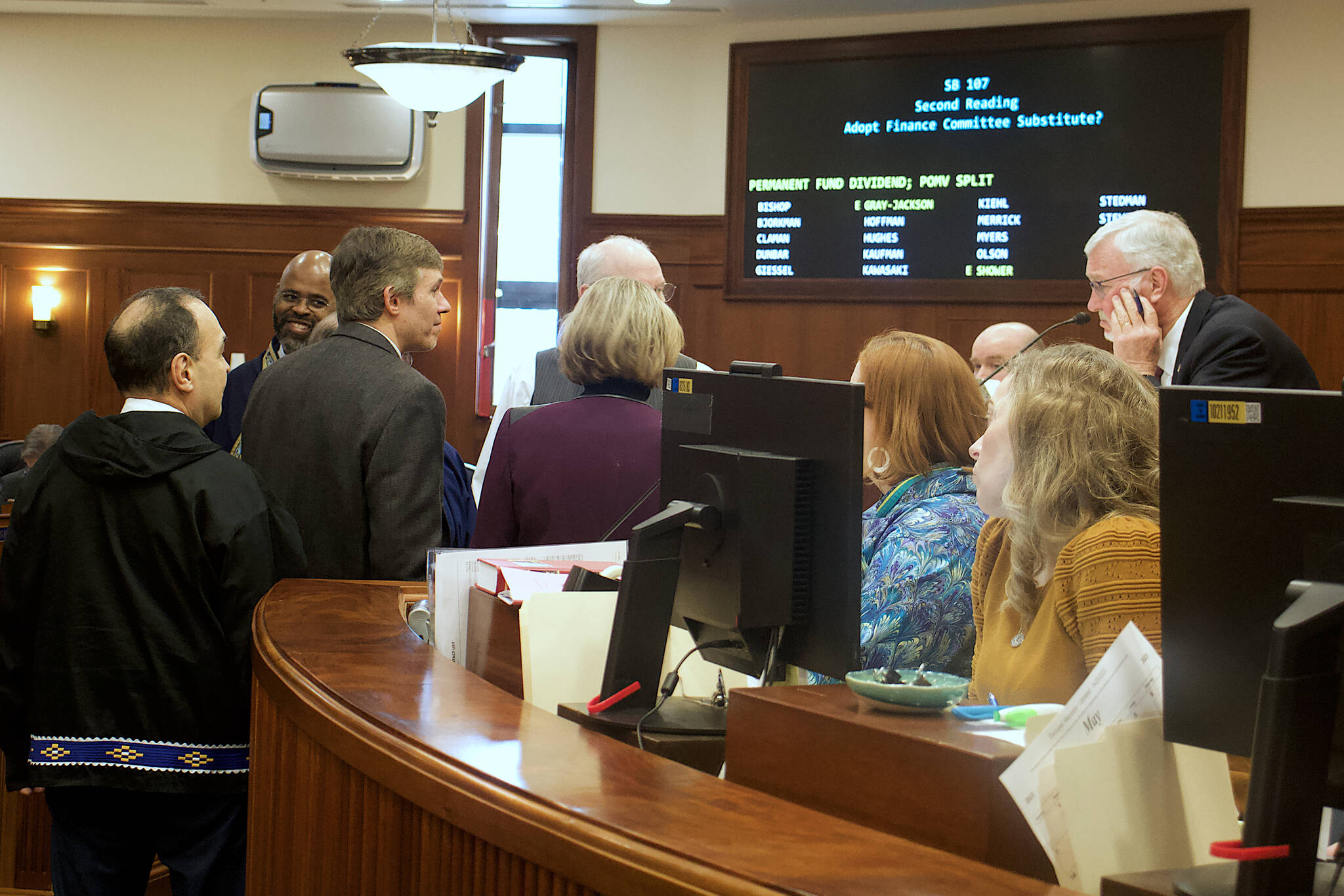
Nearly the entire state Senate appears ready to grab the proverbial “third rail” of Alaska politics by voting for a drastic change in how the Permanent Fund dividend is calculated, as a so-called “75-25” bill that would divert most available fund earnings to state spending reached the floor on Friday and is scheduled for a vote Monday.
Senate Bill 107 would result in a PFD of about $1,300 this year, compared to about $3,500 under the “statutory” formula used from the first dividend in 1982 until 2015. A primary argument of senators favoring the bill is the statutory dividend results in a budget deficit of more than $900 million before “extras” such as an increase in education funding are considered, while the reduced dividend results in a small surplus even after the funding boost and other items are added.
The other primary argument is the redefined PFD formula is essential to a long-term fiscal plan that doesn’t drain the state’s reserves and result in a crisis requiring drastic measures if, for instance, there is a sharp drop in oil prices that account for a large percentage of the state’s revenue.
While a statutory dividend remains in Gov. Mike Dunleavy’s proposed budget for next year that he introduced last December, the discussion by state lawmakers has refocused almost entirely on competing House and Senate proposals that feature, respectively, a “50-50” or “75-25” split of Permanent Fund earnings between state programs and PFDs. While the Senate’s $1,300 PFD under a 75-25 plan would result in a small budget surplus, the House’s 50-50 split that offers a PFD of about $2,700 would result in about a $600 billion deficit under a similar spending plan.
[House budget includes a so-called ‘50-50’ PFD]
The version of SB 107 scheduled to be considered Monday does contain a provision allowing for a 50-50 PFD — if the state has a rosy outlook with its revenue and reserve funds, said Donny Olson, a Golovin Democrat who co-chairs the Senate Finance Committee.
“To reach that the state needs to pass new revenue measures totalling $1.3 billion and the state must also have $3.5 billion in the Constitutional Budget Reserve fund,” he said during Friday’s floor session.
The reserve fund, which lawmakers say currently has about $2.4 billion, is a politically tricky since a three-fourths vote of the House and Senate are needed to tap into it, meaning concessions to minority caucus members are generally necessary. Also, many Senate leaders supporting SB 107 say legislative financial experts are arguing a $3.5 million minimum balance is advisable in case of a large financial crisis.
Objecting to the current version of the bill was Sen. Robert Myers, a North Pole Republican, who said lawmakers have used the CBR during nine of the past 10 years to cover shortfalls, and some opponents of the bill argue the requirements for a 50-50 dividend are impossible to meet.
“What it means is that any time that we have a drop in regular revenue those of us like myself who prioritize the PFD will be less likely to vote to use the CBR and potentially use another revenue source,” he said. He cited as an example the Alaska Housing Finance Corp., a self-supporting public entity that provides loans for affordable housing programs and similar purposes, which has a balance of about $1.6 billion that in theory is available to the Legislature.
Several revenue measures, including a 2% statewide sales tax and increasing taxes on oil companies, have been introduced this session. Each of those could potentially generate several hundred million dollars. Dunleavy has also introduced bills to enter the carbon capture market that administration officials suggest could generate similar amounts within a few years.
“I think the targets are reasonable,” said Sen. Bert Stedman, a Sitka Republican who also co-chairs the finance committee, who has stated repeatedly in recent weeks the 50-50 PFD plan is unacceptable with the state’s current financial situation due to the deficit that would result.
But convincing some residents of the need for such changes may prove to be an impossible sell.
“I support a FULL Permanent Fund Dividend and the pay back of our capped PFD payouts,” stated Francesca Allegrezza, in written testimony opposing the bill. She argued changing the statutory formula needs to be voted on by the public and lawmakers acting otherwise are committing theft.
• Contact reporter Mark Sabbatini at mark.sabbatini@juneauempire.com.
