29 testify in support of equal rights ordinance
Published 5:48 pm Wednesday, June 22, 2016
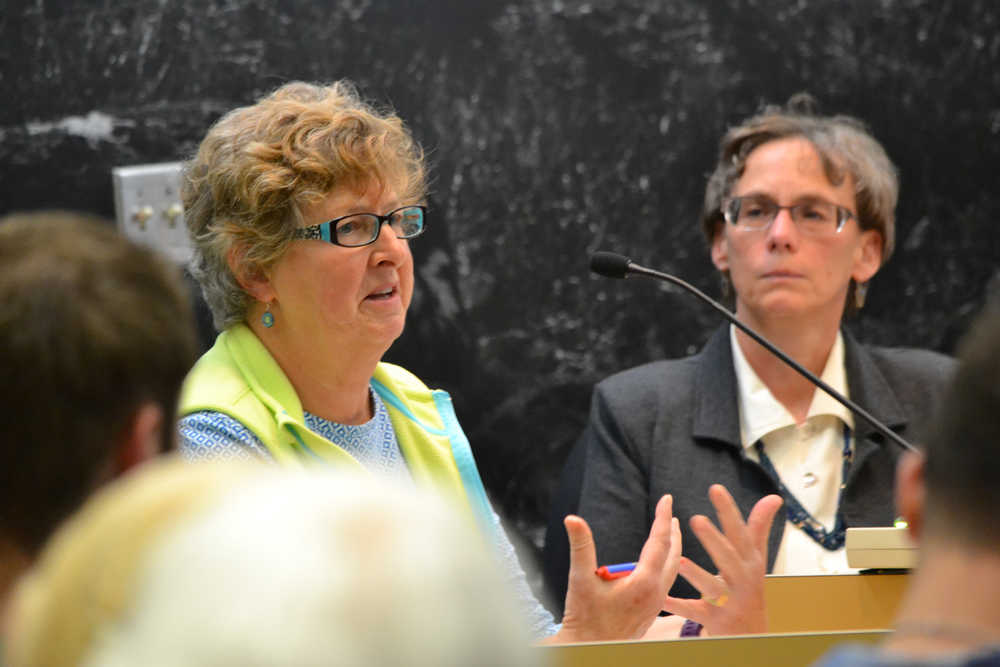
Twice during the 1980s Juneau resident Kristen Bomengen was evicted. The first time, her landlord told her it was because he “didn’t like her friends.” The second time, a different landlord offered a similarly simple explanation.
“I don’t like your lifestyle,” her landlord said.
Bomengen, like several others who testified in support of an equal rights ordinance at Tuesday’s special Assembly work session, is gay.
“My first reaction was ‘You can’t do that,’” Bomengen said, recounting her second eviction in front of a crowd that filled the Assembly Chambers beyond its capacity. “But she could and she did, and she still could today.”
Recognizing this more than a year ago, Assembly member Jesse Kiehl began drafting a city ordinance that would ban discrimination based on race, color, age, religion, sex, familial status, disability, sexual orientation, gender identity or national origin.
“There are folks who came to me and told me their stories, and I think that the broad language in the ordinance dealing with housing and dealing with employment would address their situations,” Kiehl told the Empire in a phone interview shortly before the Assembly work session.
He introduced his ordinance last week, and it has since gained a lot of support from the community and other Assembly members alike. At Tuesday night’s meeting, held specifically to take public comment on the equal rights ordinance, 29 people testified in favor of the ordinance. A large contingent of those in support belonged to Juneau’s LGBTQ+ population. But several straight people backed the ordinance as well.
Juneau resident and Alaska House of Representatives hopeful Justin Parish told the Assembly that he isn’t “a central stakeholder” like some of the other testifiers, but straight people also need to support this ordinance as well.
“How can we remain silent? How can we fail to act?” he asked rhetorically. “I don’t think we can. And I don’t think we will.”
[Democrat to challenge Munoz this fall]
One man, however, did speak against the ordinance.
“What it ultimately does, and you may not believe it, is it pits people against people,” Tom Williams, the lone dissenter, told the Assembly. The crux of his disagreement with the equal rights ordinance is that it would require landlords like himself to accept low-income housing vouchers, which he currently doesn’t.
This will likely be a point of discussion when the ordinance comes before the Assembly again next month. Kiehl said that this portion of the ordinance would prevent discrimination against the poor. But Assembly member Debbie White, who said this was her only problem with the ordinance, sees it as government overreach.
“I think forcing somebody into a very cumbersome government program is very contradictory to everything I believe in, but once again that is my only problem with this ordinance,” she said.
For the majority of those who testified though, this ordinance, which many called “long overdue,” is about putting an end to discrimination in housing, employment and public accommodations and activities.
Though state and federal laws offer some protection, they fail to protect people from discrimination based on sexual orientation and gender identity, according to City Attorney Amy Mead, who helped Kiehl draft the equal rights ordinance. And as Bomengen and several others, including former city manager Kim Kiefer, pointed out, that omission has serious consequences even here in Juneau.
Juneau resident Mark Hutter, who testified Tuesday, knows about them better than most. About a month ago he was fired from a seafood company where he worked as a fish processor. He wouldn’t provide the name of his former company.
“I was fired not for the quality of my work, which I am proud of, but because I am gay,” he told the Assembly.
Hutter said that during the month that he worked at the seafood company, his partner would occasionally join him on his lunch breaks. This caught the attention of his supervisor, who fired him a day later.
Had it already been enacted, the equal rights ordinance would have given Hutter the ability to sue his employer in state court. If he were to win such a suit, he could be rewarded back pay, front pay or the restoration of his job among other things.
Because there is no such ordinance on the books currently though, Hutter has no legal recourse. Had he the protection offered by the equal rights ordinance at the time of his firing, Hutter said he would probably have sued. And there may yet be time.
Under the equal rights ordinance, a person who has been discriminated against in a manner prohibited by city code would have 300 days to file suit against his or her discriminator.
But until this ordinance, or one similar to it, passes, “There’s not a damn thing I can do,” Hutter said. And if Tuesday’s meeting is any indicator, he’s not alone.