
The short December days don’t allow for long explorations, but even short ones can be productive for a curious naturalist.
I took a little stroll on the wetlands on the north side of the Mendenhall River. At least four short-eared owls were coursing low over the grassy meadows, with their distinctive slow wingbeats. They were looking for voles, their favorite prey. Vole tunnels were evident under the thin and patchy snow, but I did not witness a capture, despite some serious watching. Short-eared owls often forage during the daylight hours, probably using visual clues to supplement acoustic ones. Like other owls, they have the ability to pinpoint a prey animal by using only their ears, but in daylight their eyes are useful, too.
Plodding on snowshoes around some mid-elevation meadows, we noted lots of deer tracks, some not-recent porcupine trails, and several sets of hare and squirrel tracks. But the big excitement, in two widely separated sets of mid-elevation meadows on two different days, was finding clear, recent footprints of wolves; they wove in and out among the trees at the edges of the meadows. That was a high point of the rambles on those days!
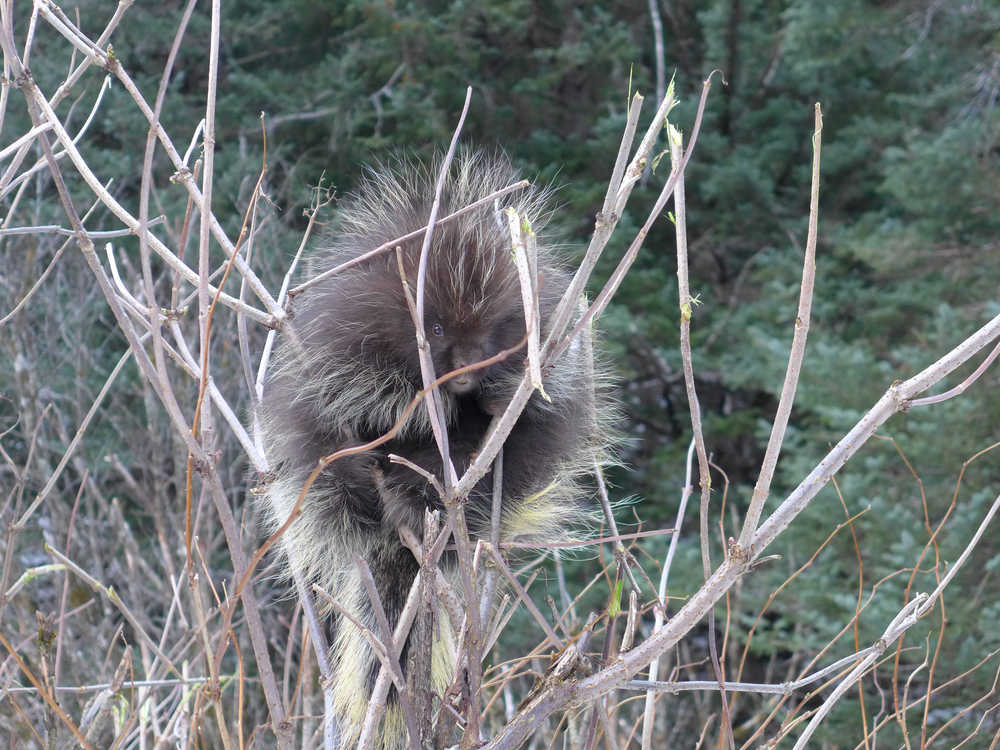
A Parks and Rec hike up Perseverance Trail found a small flock of pine grosbeaks, eating buds. A small porcupine sat up in and elderberry bush that showed the signs of its munching. Porcupines often eat elderberry buds in winter, apparently not deterred by the distinctive, rather musty odor.
A friend and I walked out toward Crow Point and the Boy Scout beach, but we soon forsook the trail for explorations right along the river. There was not a lot of bird activity — a little squad of Barrow’s goldeneyes and a few gulls, but on a little grassy rise above the sandy river-shore we did find something interesting. In the snow that covered some of the grass, we saw otter tracks leading up to the top of the rise. There we found three or four spots where the grass was torn up and heaped off to the side. What were the otters doing? Just playing? Scent marking (the grassy heaps smelled faintly sweet)?
Where the trail reaches the beach, recent heavy erosion had chopped off a good part of the dense stand of little spruces and carved a steep cliff in the sandy edge of the grassy bank. The most severe erosion was very localized. Just around the corner, where the beach extends southward, erosion was much less. We wondered if there had been a big northerly wind that coincided with a good high tide. Possibly the bank around the corner was somewhat protected from wind and wave by the broad, sandy flats that extend away from shore and are exposed at low tide.
We walked south on the beach, watching gulls at the water’s edge picking up and carrying black lumps that were probably little clumps of mussels. The gulls did not do much else with those lumps, at least while we were watching. Gulls tracks were everywhere. In the dry sand at the top of the beach were many tracks of another kind of bird — something small, smaller than a robin. But not a shorebird, because this bird had a well-developed hind toe, which shorebirds lack. The unusual thing about these small birds was the gait — lots of running, with intermittent hopping. Most of our small birds, such as sparrows, seldom run; they usually hop. So what bird could this be? I think the two most likely candidates are pipits and horned larks, but December is rather late for them to stay here.
Another stroll, just after a few days of freezing temperatures, yielded some of the most beautiful ice formations we’d ever seen. Dead twigs and fallen logs had absorbed water from fall rains; as the low temperatures froze the water, it expanded. The expanding ice was extruded from the wood in thin sheets of fine, almost silk-like strands. The most elegant sheets were up to five inches long, curving gracefully like a tousled head of wavy hair. Alas, no camera!
• Mary F. Willson is a retired professor of ecology.
