
If you think about it, plants are really quite remarkable organisms. They don’t have hearts or brains, and they can’t run or hop around, but lots of them do some interesting and surprising things (many of which have been discussed in previous essays).
They can communicate with each other via airborne signals of herbivore attack and send signals calling in herbivore enemies. They trade nutrients and defensive compounds through root grafts and mycorrhizal connections. They can make their own food, using sunlight. Even though they are sessile, they can move various body parts, opening and closing flowers, folding and unfolding leaves.
More recently, researchers have discovered that plants can both hear and produce sounds; they may use this capacity to signal pollinators (in addition to the more usual color and aroma signals).
Plants can hear: experiments with evening primroses showed that the sound waves of nearby bee wings soon (within about three minutes) induced an increase of nectar production. The reaction was very specific to the frequency of bee wingbeats. The increase of nectar did not happen when some of the flower petals were removed, showing that the flowers are sound-receivers. As usual, this leads to more questions: How does the shape of the flower affect sound reception — perhaps the bowl-shape of many flowers focuses the sound? And exactly how do bees respond to the increase of nectar — does the maker of the wingbeats come back to take advantage of the increase or is it the next bees to come that profit?
Then researchers discovered that plants can also “scream.” That is, they make clicking noises when they are stressed. We can’t hear those clicks, except with special equipment, because those noises are ultrasonic (very high frequency). Experiments with several plant species showed that, under the stress of dehydration, the plants started clicking. Still to be determined is what other stresses might induce the clicks, as well as just how the clicks are produced.
Who might be listening to the clicks? Possibly other plants, which might ramp up their own defenses. Or perhaps helpful insects that are attracted to signals of herbivore attacks (if the clicks are produced when attacks happen). That’s still to be determined, but it’s clear that plants have a bigger sensory world than we previously imagined.
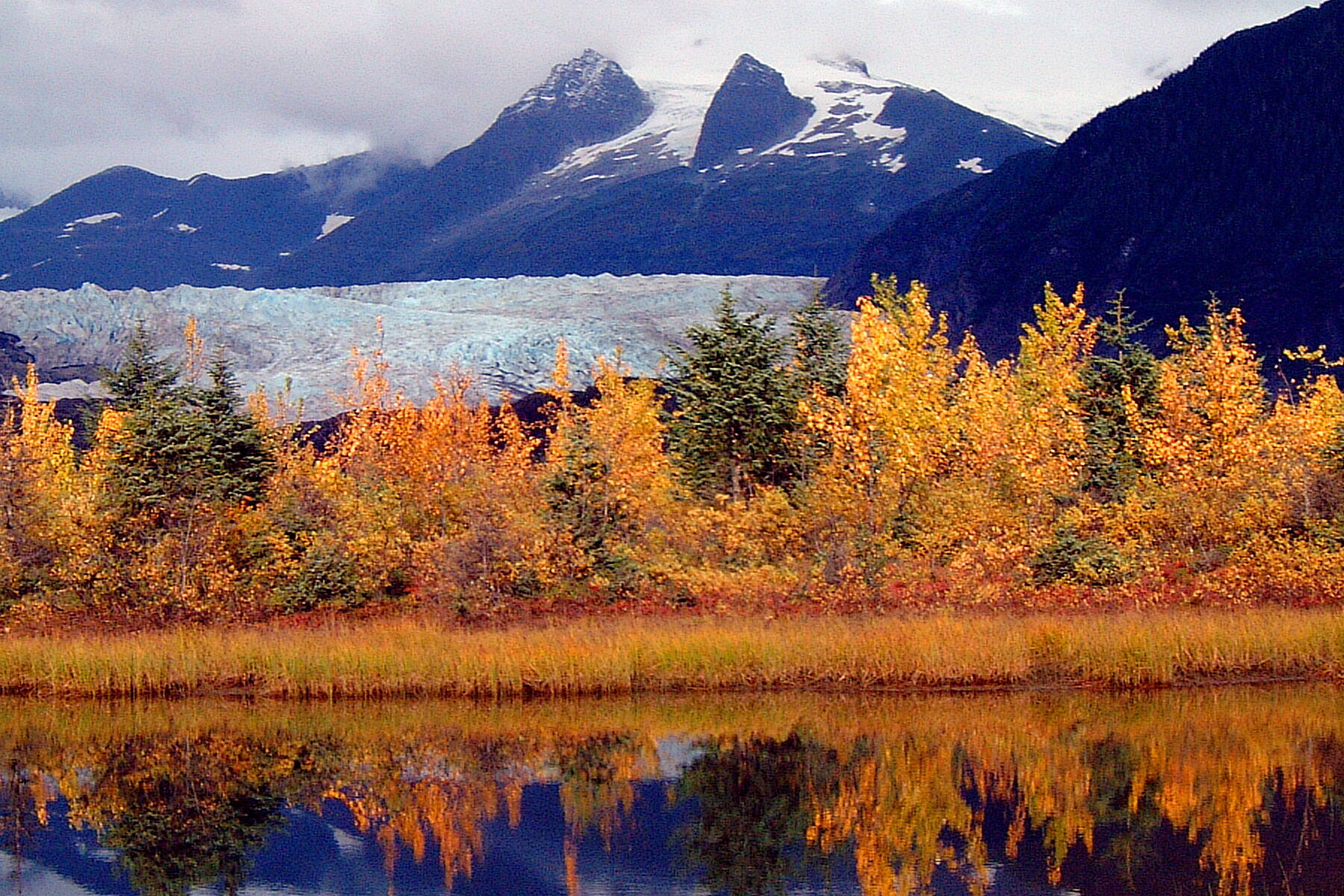
On another topic: The eastern deciduous forests are famous for spectacular displays of fall foliage and we sometimes wish for more of that around here, to relieve to dark greens of the conifer forest. We don’t have great swathes of bright color gracing the hillsides, but when we pay attention, we see fall foliage colors in many forms. Around town, there are the brilliant crowns of the (introduced) katsura trees, glowing with yellows and oranges. Maples, both native and introduced, add the visual spice of colors from yellow to crimson.
Out on the landscape, fall hikers often comment on the yellow leaves of devil’s club, saying how they brighten up the forest. Cottonwood trees add fine local color, ranging from yellow to bronzes. Highbush cranberry shrubs offer yellows, pinks, and reddish hues. At the edges of the forest, red-osier dogwood shrubs sometimes have flaming-red leaves, one just one side of the bush or mixed in with healthy green leaves. Much of the foliage color, however, comes from smaller plants, such as bunchberry, deer cabbage, fireweed. We’ve noticed that, while some plants produce only yellow leaves (e.g. devil’s club, skunk cabbage), some almost always make yellow leaves but very occasionally make red ones, while others produce a wide range of non- green colors. And sometimes that range of color is seen in a single leaf.
This topic has appeared in my earlier essays, so here is just a brief synopsis. Those all colors happen when the green pigment chlorophyll breaks down, exposing other pigments, such as the yellow carotenoids. On warm fall days, however, the breakdown process is slow and photosynthesis continues. The sugars from that process are added to other compounds to make anthocyanins, which commonly make the reddish hues, particularly when the leaf is exposed to good light. So leaves or parts of leaves with good exposure to light are most likely to become reddish. Why some plants never (or almost never) make red but only yellow is unexplained (as far as I can tell). It is not clear if those fall colors have any adaptive value to the plants or if they just happen as a result of some necessary physiology. As usual, many questions remain!
Footnote: The little plant called eyebright was a focus of a recent essay. That prompted a local photographer to send me this video (https://youtu.be/dpnGtvuNyrA) showing a selection of insect visitors to the eyebright flowers. There’s a variety of flies, some clearly investigating the flower, and a moth, with its proboscis inserted deep into the flowers, probably searching for nectar. The lines and spots visible on the petals are likely to function as nectar guides (clues to the location of nectar) for visiting insects. This new information tends to support the idea that cross-pollination is possible.
Thanks to photographer Bob Armstrong for the video.
• Mary F. Willson is a retired professor of ecology. “On The Trails” appears every Wednesday in the Juneau Empire.
