
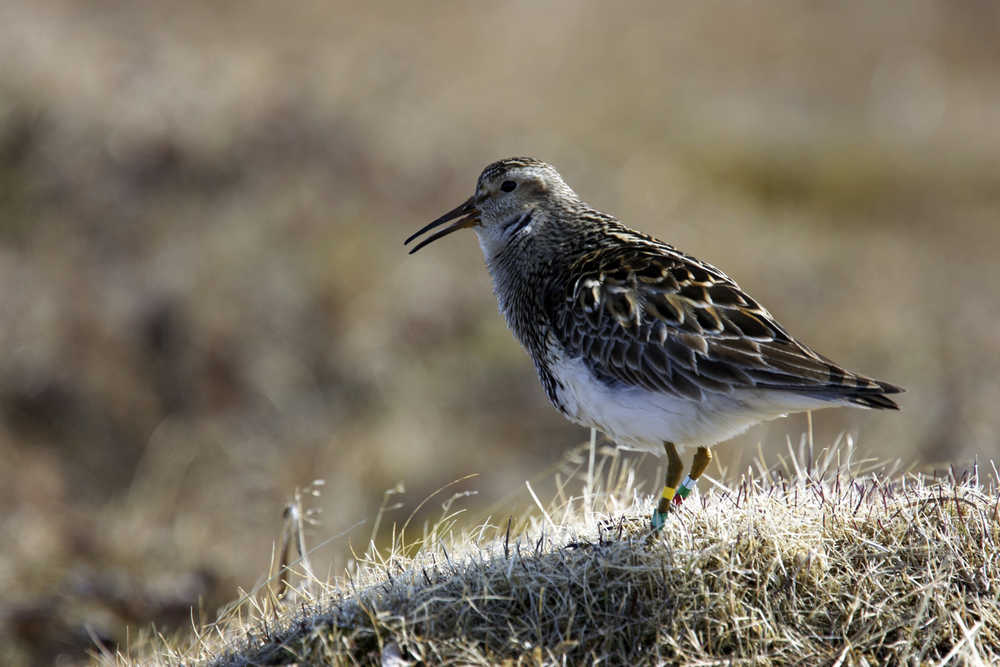
In this image provided by Bart Kempenaers via the Max Planck Institute for Ornithology, an ale pectoral sandpiper on the tundra near Barrow, Alaska, calling to attract a female. (Bart Kempenaers/Max Planck Institute for Ornithology via AP)

In this image provided by Bart Kempenaers via the Max Planck Institute for Ornithology, an ale pectoral sandpiper on the tundra near Barrow, Alaska, calling to attract a female. (Bart Kempenaers/Max Planck Institute for Ornithology via AP)

Long-distance birdie call

WASHINGTON — You fly more than 100 miles for love. You get rejected. You fly another 100 miles. Another rejection. And another.

That’s the high-flying but futile sex life of the male pectoral sandpiper looking for love in northernmost Alaska, according to a new study.

Some males are more persistent than others. Researchers tracked one desperate small shorebird that logged more than 8,100 miles in two dozen different hook-up attempts over a frenetic four weeks.

“They’re definitely trying hard to flirt and court,” said biologist Bart Kempenaers of the Max Planck Institute for Ornithology in Germany . “They are not particularly successful most of them. Failed Don Juans mostly.”

Sandpipers migrate from South America to breeding grounds in the Arctic tundra in the summer. The males tend to be sex crazy during this time because females are only fertile for a few weeks. They flit all over the place, trying hard to seal the deal with loud throaty hoots as many times as possible. The problem for them is that the females only mate once or twice a season.

“Copulations are incredibly rare,” Kempenaers said. “The males need to try and try and keep at it.”

Researchers tracked the activity of 100 male birds during a breeding season. It is “the most extreme example” of promiscuity in animals seen yet, said Kempenaers, who led the study published Monday in the journal Nature .

The males mostly forgo sleep as they embark on non-stop flights in search of a mate, getting by on snatches of shut-eye lasting several seconds at a time, Kempenaers said.

The average bird flies about 110 miles between mating attempts. In a breeding season, the males log on average about 1,900 miles, a bit farther than flying from Los Angeles to Chicago.

Sandpipers can fly 40 hours non-stop around 37 mph, but these long trips often end up in rejections. Those that successfully mate don’t have a role in raising the offspring, Kempenaers said.

George Divoky, a biologist at the scientific group Friends of Cooper Island that monitors the changing Alaskan Arctic, said in general Arctic shorebirds are shrinking in population.

He called the study on this species of bird impressive, adding that it “will make me think differently about every pectoral sandpiper I see during the summer.”

More in Neighbors

Fred LaPlante serves the Juneau community as the pastor of the Juneau Church of the Nazarene. He is passionate about encouraging others to see life more clearly through faith in God’s Word.
Living and Growing: Love listens first

‘Loving people well requires more than speaking clearly; it requires listening carefully.’

Weekly events guide: Juneau community calendar for Feb. 9 – 15
Juneau Community Calendar

Weekly events guide: Feb. 9 – 15

Jeff Lund/contributed
The author would rather fish for steelhead, but he’ll watch the Super Bowl.
I Went to the Woods: Super Bowl spectacle

At some point on Sunday, dopey characters, hopelessly addicted to Doritos, will… Continue reading

Peggy McKee Barnhill (Courtesy photo)
Gimme a Smile: How much snow can one backyard hold?

Snow, snow, everywhere, and no place to put it!

The Spruce Root team gathers for a retreat in Sitka. Spruce Root, is an Indigenous institution that provides all Southeast Alaskans with access to business development resources. (Photo by Lione Clare)
Woven Peoples and Places: Wealth lives in our communities

Sustainable Southeast Partnership reflects on a values-aligned approach to financial wellness.

calendar
Weekly events guide: Juneau community calendar for Feb. 2 – Feb. 8

Visit Juneau Arts and Humanities Council at JAHC.org for more details on this week’s happenings.

Actors in These Birds, a play inspired by death, flowers and Farkle, hold ‘flowers’ during a performance at the UAS Egan Library on Saturday, Jan. 31. (photo courtesy Claire Richardson)
Living and Growing: Why stories of living and dying in Juneau matter

What if we gave our town a safe space to talk about living and dying with family and friends?

calendar
Weekly events guide: Juneau community calendar for Jan. 26 – Feb. 1

Visit Juneau Arts and Humanities Council at JAHC.org for more details on this week’s happenings.

Courtesy photo
Adam Bauer of the Local Spiritual Assembly of Bahá’ís of Juneau.
Living and Growing: Surfing into the future

Many religious traditions draw strength from the past.

calendar (web only)
Weekly events guide: Juneau community calendar for Jan. 19-25

Visit Juneau Arts and Humanities Council at JAHC.org for more details on this week’s happenings.

(web only)
Weekly events guide: Juneau community calendar for Jan. 12-18

Visit Juneau Arts and Humanities Council at JAHC.org for more details on this week’s happenings.

Four members of the Riley Creek wolf pack, including the matriarch, “Riley,” dig a moose carcass frozen from creek ice in May 2016. National Park Service trail camera photo
Alaska Science Forum: The Riley Creek pack’s sole survivor

Born in May, 2009, Riley first saw sunlight after crawling from a hole dug in the roots of an old spruce above the Teklanika River.