
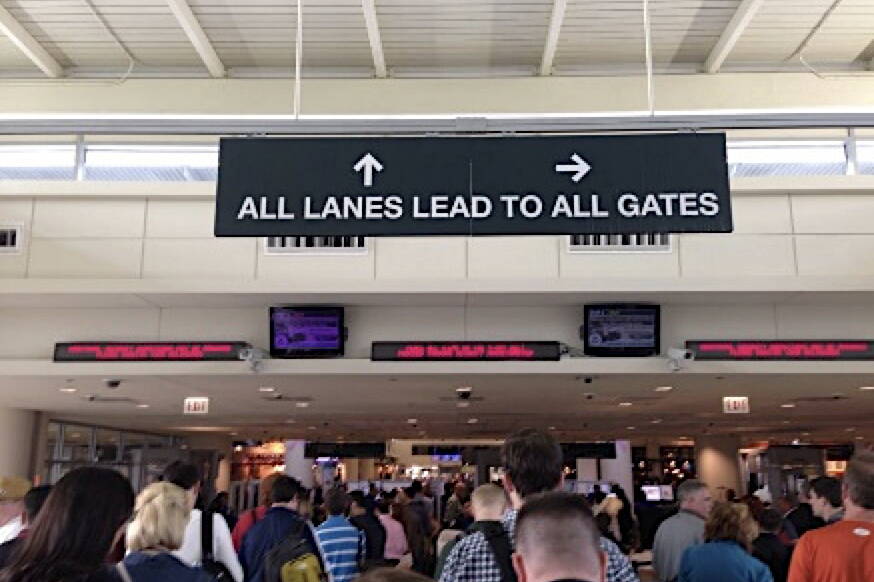
Some time ago I was standing in a long security line at Chicago’s Midway airport. Above the crowd a large sign read “All Lanes Lead to All Gates.” Standing amidst a sea of people, I found a rather mundane sign had a uniquely profound theological message — a Universalist message of sorts: there are many paths in life, but one common end. Ultimately, whichever line you choose in this life is going to eventually going to the end. A beloved family member used to often quip: “No one gets out of here alive.”
Unitarian Universalists are people of all ages, of many backgrounds, and a people of many beliefs. We seek to grow our spirits and work to create a more just world. Our tradition is rooted in two liberal denominations of the 1800s — the Unitarians and the Universalists — who merged in 1961.
In the 19th century the Universalists proclaimed a radical idea: a loving God could never damn anyone to hell. Of course there were myriad theological debates about the natures of belief, practice and atonement that might be involved: but the central idea — universal salvation — was revolutionary; all lanes lead to all gates. This was heretical and unabashedly bold; it was an idea that was ahead of its time.
It was a small leap from that bold 19th-century salvific proclamation to a deep respect for the wisdom traditions of the world’s religions. It is for this reason that over time our worship life evolved to draw upon poetry and prose; scripture from Hebrew, Christian, and other world traditions; and Indigenous and folk wisdom. We are equally guided by reason and science, and by our own direct experience of mystery and wonder. No one (not even us) has a sole claim on truth.
As Unitarian Universalists we are the inheritors of a bold people who proclaimed hope, not hell. With our Universalist inheritance comes a responsibility: it is our work to be love’s people in today’s world. That means we believe that Indigenous Lives Matter, Black Lives Matter, women’s reproductive rights matter, LGBTQIA2S+ rights matter, and that people of all abilities and bodies are worthy of not just the rights and resources to survive, but to flourish. We see it as our work to bend the moral arc of the universe towards justice, if only a little.
As our religious forebears did in the theological language of their day, we say in these plain words of our own time: all are worthy, all are welcome. In this life, ultimately, all lanes lead to all gates: it matters less what lane we are in, and more how move along the lane of our own lives and how we care for others along the way.
Ultimately our time is short. No one gets out of here alive. It’s been said that religion is our human response to being alive and knowing we have to die. We are living in the space in between. We gather in church, in part, to remind ourselves of our own mortality. When we are willing to grapple with that inevitability, sometimes we get lucky enough to have a renewed sense of purpose and urgency.
With questions of ultimacy before us, we are given chances at every turn to be love’s people in the world. When we do that, we may well reach that gate at the end of our lane with deep satisfaction and a legacy of love. No one gets out of here alive — but the good news is that all lanes lead to all gates. May we proceed with love; work for justice; and give them not hell, but hope.
• Teri Schwartz is the reverend for Juneau Unitarian Universalist Fellowship. “Living & Growing” is a weekly column written by different authors and submitted by local clergy and spiritual leaders. It appears every Saturday on the Juneau Empire’s Faith page.
