
When you’re through changing, you’re through.
— Martha Stewart
This morning my partner and I are having coffee in our sunroom and watching our dogs Hugo and Molly cavorting in the yard, leaping and bounding as they chase each other. The way they leap about — it doesn’t seem to serve any apparent purpose; it doesn’t add to the speed of the chase or improve their attempts to dominate each other or help hapless Hugo get the ball away from his fearsome competitor.
Their leaping doesn’t seem to serve any purpose at all other than a simple, reflexive joie de vivre — the sheer fun of it, a playful leaping for joy at having the freedom and ability to leap.
I don’t think we give playfulness its full due. Psychologists talk about the purpose of play as a way we learn about our world and develop cognitive abilities, physical strength, and social skills, etc., etc., and sure that’s probably all part of it, but we treat play as if it has to have some pragmatic end, as if it’s not valid without having a goal, without having some identifiable, purposeful function in a serious world.
But these, I think, are ancillary functions, if not just the inferences of a pragmatist culture, serious stuff for psychology professors to talk about in the lecture hall. These things are all secondary to what I think of as the true life of play.
True play, like a dog’s leaping, is spontaneous and without any forethought or end other than itself. Strictly speaking, it’s meaningless — given our usual sense of “meaning” as some reductive abstraction of experience.
As my readers may know by now, the first refuge of my ignorance is always etymology, the origin of a word. Here too etymology and my ignorance can serve us well. The word spontaneous comes to us from the Latin word sponte or spons, which means “of one’s own accord.”
Of one’s own accord: not just willful, but without any external stimulus, an action provoked only by itself, by the freedom and ability to act. Spontaneity is a sheer willfulness that is the free will willing itself into action.
I know how tautological that last sentence must sound, but I think that’s right. Saint Augustine thinks the free will is an illusion and describes it as a body trying to lift itself. You may have the strength to lift your own weight, he writes, but you have nowhere to stand.
That’s what 20th-century continental philosophy is getting at. We have a free will and a responsibility: we are free to respond to the moment as the moment demands. But there’s nowhere to stand. There are no stable values apart from our actions. Life is crazy and absurd and meaningless. That doesn’t let us off the hook. In fact, it puts us more on the hook than ever.
Simone de Beauvoir has a phrase I’ve quoted a few times in these pages, the “élan of spontaneity.” She’s talking about an enthusiasm that comes out of the sheer freedom of being human. She sees that élan as exclusively human. But I see it in the playfulness of dogs too.
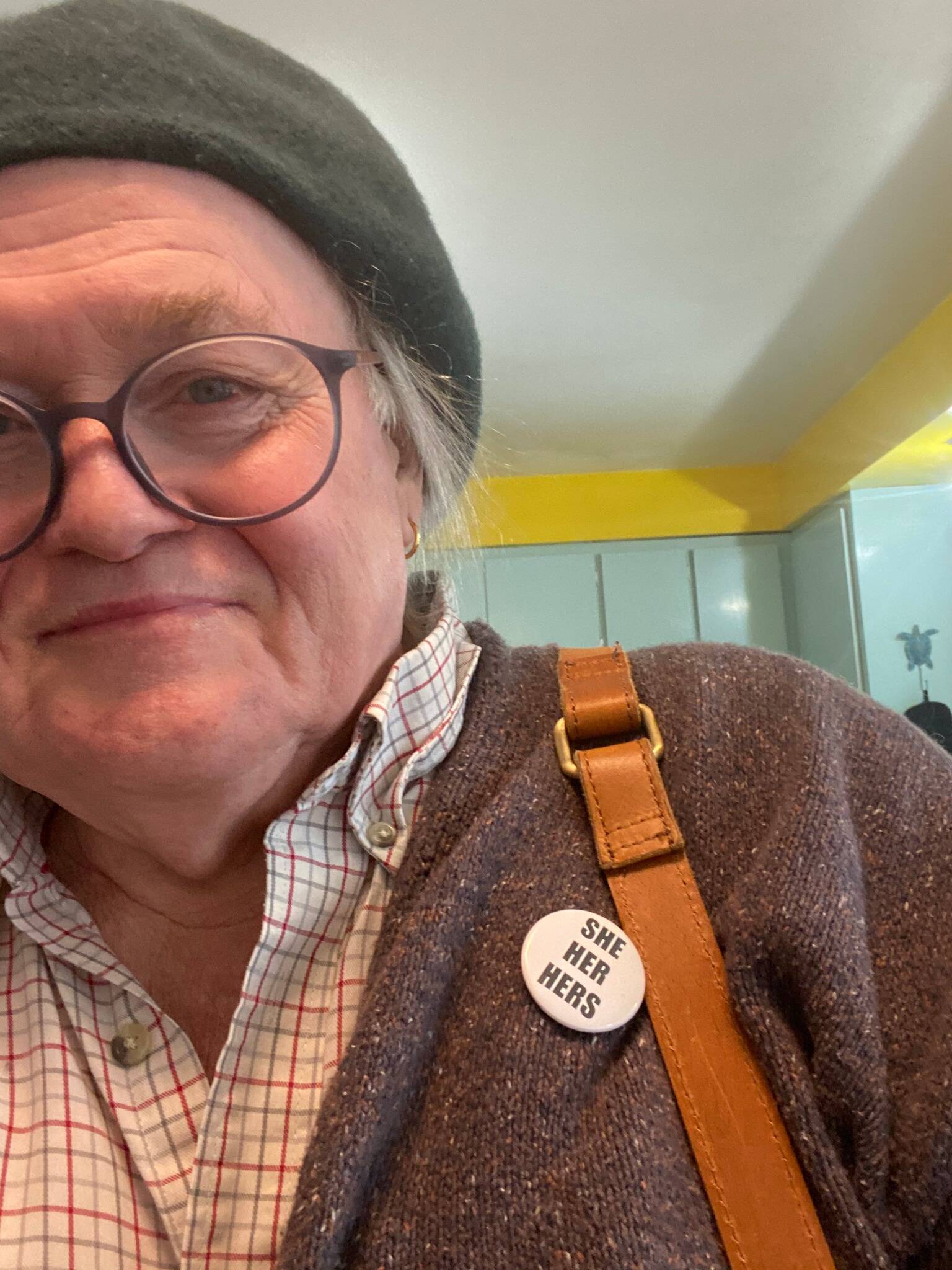
What’s human in it is the ability to change, to change the direction of our lives, to change majors and careers and partners and values, to change the way we think of ourselves and how we deal with others; to change gender and the way we think about gender, and the way those around us think about it, too.
Those changes are our taking personal responsibility for our lives, changing to respond to the demands of an ever-changing world. “Respond”—there’s that Latin word “sponte” again: to answer of our own accord.
When I look at attacks on transgender and non-binary folks and the political attempts to criminalize the transgender experience, I see something emblematic in the Florida governor’s squabble with an empire built on a cartoon and an amusement park. It’s the radical right’s war on play, a war on freedom, spontaneity, fun.
We have seen these kinds of puritanical excrescences before. In the seventeenth-century, British puritans shut down the London playhouses and theaters, which they had long condemned as sources of sexual immorality and corruption — but which theaters, of course, gave us Shakespeare.
Those readers who know me and my friend Johnny Negotiable know that we think of Bob Dylan as the Shakespeare of our time. It’s not too big a stretch to wonder if DeSantis’s next move is to ban rock & roll, our greatest expression of that élan of spontaneity. Ban the music of David Bowie, Joan Jett, Little Richard, Chrissie Hynde, Boy George, Mick Jagger, Patti Smith, Prince and all of pop music’s other androgynes. .
Speaking of Dylan, maybe the best example of what I’m talking about is his earliest masterpiece, “Mr. Tambourine Man.” Dylan sings about freedom, but it’s not a freedom of abandon, but a freedom of responsibility. The song comes as the dazzling conclusion of a group of songs where Dylan announces a change in direction, beginning with a last look back in “My Back Pages” and a defiant escape from the restraints of traditional folk music in “Maggie’s Farm.”
In “Mr. Tambourine Man” Dylan seizes the freedom to be responsible only to the music itself. He doesn’t want to be free to go anywhere, like some tumbling tumbleweed, but to follow the Tambourine Man, to follow the music wherever it leads. Here in 2023, we see the glory of that change in direction.
What Dylan suggests about artistic freedom is true for us all. Our responsibility for being human, for exploring all our individual and social potential, demands a freedom to respond as our freedom and abilities will allow — to be fully ourselves in a world where others are free to be their own selves.
Our title today comes, of course, from Bowie. The stutter of the song’s refrain expresses the scary uncertainty of change. It’s always a gamble, a risk, a chance. We should be stuttering.
But it’s a helluva lot of fun, and the freedom is invigorating.
• Jane Hale lives in Juneau with her partner and their two dogs. “Coming Out” appears biweekly on the Empire’s neighbors page.
