Buzz, chirp, squeak: How and why insects make sound
Published 10:21 am Tuesday, August 14, 2018


Back in the Midwest, in the summers I listened to cicadas calling and crickets chirping — sounds that don’t happen here in Southeast Alaska.
We hear mosquitoes and bees buzzing, of course, but that’s about all we hear from local insects. It gives us a very small sample of the sounds that insects can make, both within the audible range for humans and in ultra-high frequencies beyond our range.
Sometimes, insect sounds are made in response to disturbance, as a form of defense, startling or warning the attacker. Or they reinforce a visual similarity to potentially dangerous insects — thus involving both visual and acoustic mimicry. In other cases, the sounds communicate among members of the same species — males courting females, for instance.
Insects can make sounds in five principal ways. Perhaps the best known is by “stridulation” — rubbing one body part again another. This is how grasshoppers, crickets, some beetles and certain spiders make noise. Different body parts are involved for different species: for example, in some species, special places on the front two wings are scraped together, or the hind legs are rubbed against the front wings, or two mouthparts are rubbed together. The “songs” are mostly made by males, and may serve to bring the sexes together for mating or they may warn off competing males (clearly, they can only work in these ways if the recipients of the acoustic signals can hear; and various kinds of insects have ears on their legs, or antennae or their bodies).
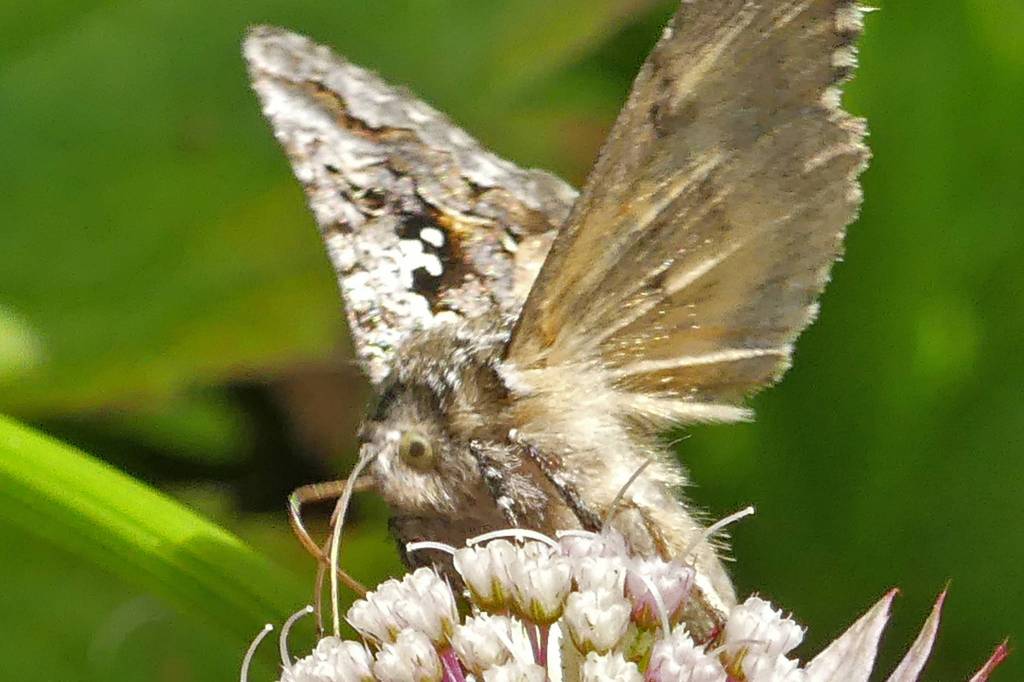
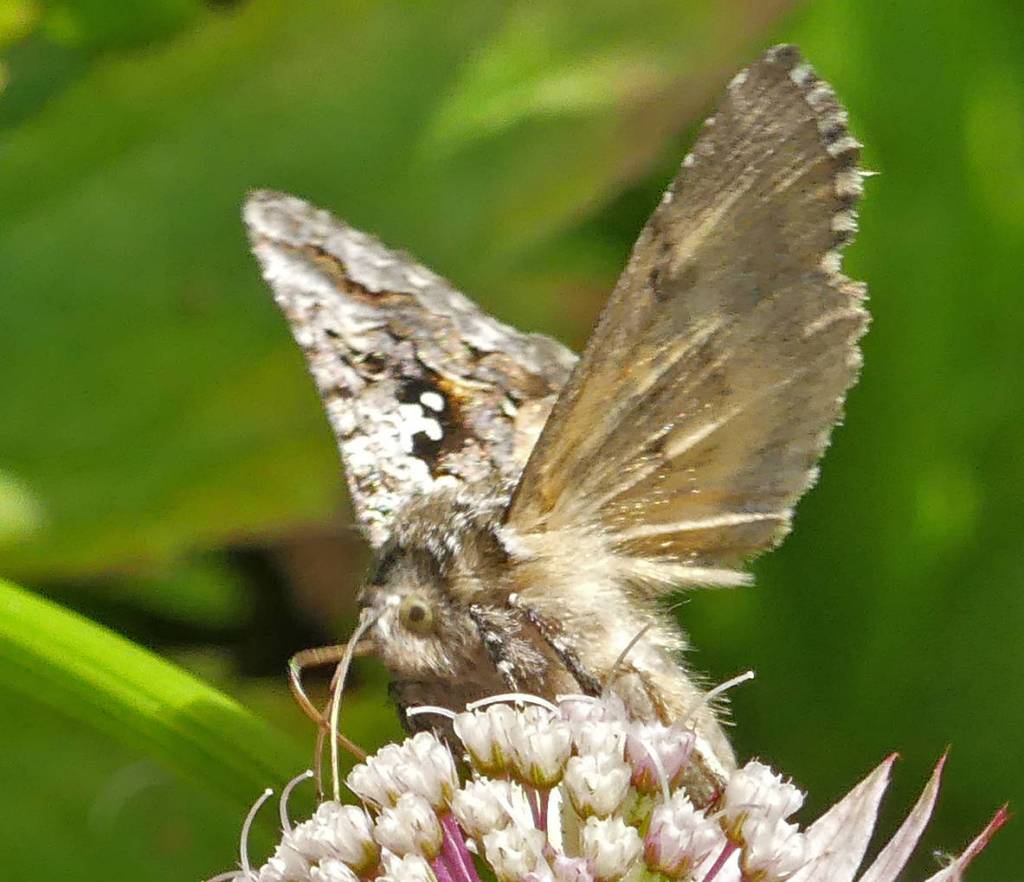
Some moths can stridulate too. Decades ago, scientists learned that certain moths are able to escape predatory bats by making sudden evasive movements when they hear the sonar of an approaching bat. Later research disclosed that these species of tiger moth and hawk moth were able not only to dodge the bats but actually jam the bat’s sonar with extremely rapid ultrasonic clicks. The moths create a sort of blanket of sound around themselves, so the bats cannot sense them clearly in the cloud of noise. The moths are reported to stridulate by rubbing their genital parts together.
Less dramatic acoustic signaling can be done by tapping some body part against the substrate. For instance, certain grasshoppers tap their feet, cockroaches tap the tip of the abdomen, and certain beetles bang their heads. Flies and bees buzz, using the flight muscles and wings. The buzzing of bumblebees and some solitary bees is important in the pollination of numerous plants: the buzzing releases pollen, which falls onto the bees, which then carry the pollen to another flower (this buzz is said to be quite different from an angry buzz). Male cicadas have special organs in paired cavities in the front part of the abdomen. In each cavity is a hard, ribbed structure that is vibrated by strong muscles, making rapid clicks; two membranes moderate the volume and type of “song.” Each species of cicada has a distinctive mate-attracting song.
The fifth main means of sound production by insects is by forcibly ejecting air or fluid from the body. Bombardier beetles eject from the anus a hot fluid that vaporizes when it meets air; the high temperature is generated when two different chemical substances are combined at the time of ejection. A popping sound accompanies the fluid ejection. This unusual system is a defense mechanism.
Sound production by forcible expulsion of air is said to be rare in insects. Although naturalists have previously known that hawkmoth caterpillars could make sounds — loud squeaks or whistles — only relatively recently have researchers investigated how these sounds are made, by studying the walnut sphinx moth caterpillars. The caterpillars have eight pairs of openings (called spiracles) on their sides; these openings are part of the respiratory system. By systematically blocking each pair of spiracles in turn, experiments showed that the enlarged openings of the eighth pair were responsible for the whistling sounds. The caterpillar forces the air out by contracting the front part of the body.
Further experiments showed that the whistles had a secondary defensive function called into play when an avian predator spotted the caterpillar despite its camouflage and pecked at it. Foraging birds such as yellow warblers were startled by the whistles and typically moved away. Further research found that these caterpillar whistles mimic the alarm calls of certain birds, such as chickadees, and the whistles kept these birds away from food sources.
There are undoubtedly numerous other nifty acoustic signals used by insects in various interesting ways. They are out there, waiting to be discovered.
• Mary F. Willson is a retired professor of ecology. “On The Trails” is a weekly column and appears every Friday. Her essays can be found online at onthetrailsjuneau.wordpress.com.