
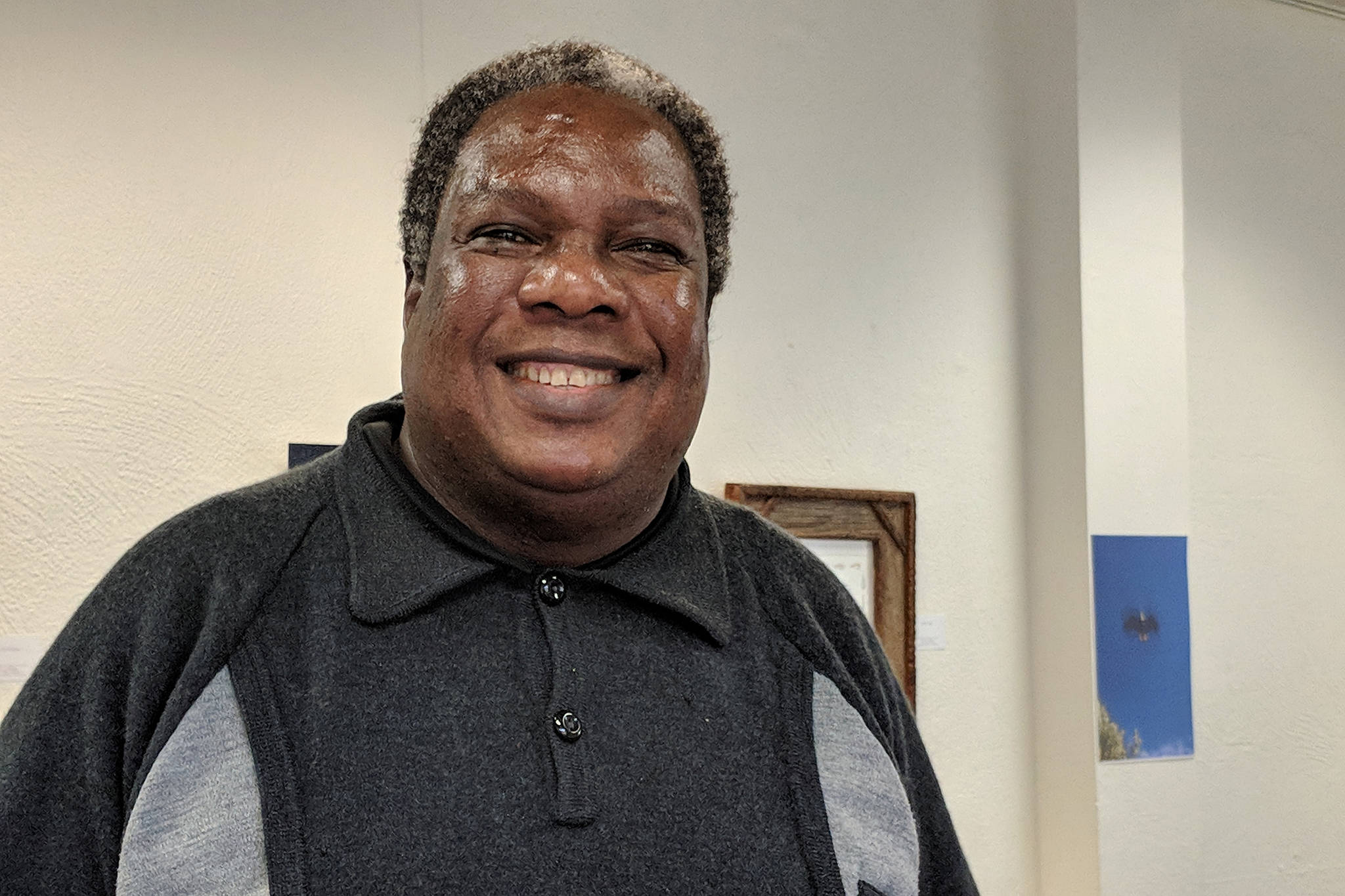
Vusi Mahlasela has a mug full of coffee, and he was ready to talk.
“All right, let’s go,” Mahlasela said smiling in the green room at the Juneau Arts & Culture Center while gripping a cup.
Mahlasela, a South African singer and guitarist known as The Voice in South Africa, was initially expected to arrive Friday afternoon in Juneau from Skagway for the first concert in the Performing Arts and Culture Series, but weather pushed his arrival into the night.
[South African singer, guitarist starts concert series Season 45]
So after a Saturday afternoon soundcheck , he wanted a cup of something warm and caffeinated before conversation could really begun.
With coffee in hand, Mahlasela was ready to talk to the Capital City Weekly about his early music memories, politically galvanizing run-ins with the police and playing Nelson Mandela’s inauguration.
Something I’m particularly curious about is your influences on your guitar playing?
I’m a self-taught guitarist. I have my own way of tuning to play. I don’t play to standard. The E string I tune it to D sometimes. It’s also of course influenced by the style of music we play back home.
What made you want to pick up a guitar in the first place?
Because I saw a man playing a guitar at home when I was young because at home there used to be quite a lot of people coming there because my grandmother owned a shebeen, which is a speak easy. There used to be a lot of people coming there, musicians and those who sang a cappella-type music. I built my first guitar using a container that held cooking oil, and for strings I used fishing nets.
What is it about that first guitarist that you saw that made you think that’s what you want to do?
I just loved it, the sound of the guitar, and the singing, and I said, “I just want to see me playing that someday.” So I built my first guitar.
At what point does it get to a point where you realize it’s something you could do professionally?
It got to a point, where I’m playing with my young friends. They also built their own instruments, like drums. We were very creative. We were very young building our own instruments and playing them, and also people loved it when we were playing. Also, my neighbor, who gave me my first guitar, he loved the music, but when we were making noise while he was sleeping, he gave us our name. The name of my band was The Pleasure Invaders.
There was quite a lot of music being played at home from the vinyls. Music from home, but also music from America that was also played there because America did not respect the cultural boycott, so we ended up listening to quite a lot of Motown, which was nice.
What age were you, when you’re in this band with self-made influence?
We were 7 or 8, so still quite young. But there was a lot of music around.
How did the politics of the era influence what you could play, where you played, how you played and what you played?
That all came up in 1976 when there was an uprising in Soweto where the students boycotted the language of Afrikaans and medium for oppression but also fighting segregation as well. That’s when I started asking questions. From then, that’s where my political inclination started. I joined a poetry group that was called Ancestors of Africa. Later on, it became a problem, where we were harassed a lot by police, confiscating our instruments, our poems, our writings.
Once you start encountering that resistance from the police, what makes you stay dead-set on doing what you’re doing?
That gave me more inclination. When we were arrested because we were minors they were still hiding that they were arresting us. They would not put our names on the registration because we were young ones, which frustrated our parents because they’d look for us in hospitals, yet we were there. But inside the cell we met some people who were very political. It was like a school for politics inside the cells.
So then you stayed on that political slant, and eventually wound up playing Nelson Mandela’s inauguration?
It was not only just political what was happening. It was for the love of music. There would be some places we would play where it was more like parties and weddings. In some way, it directed me toward my love of poetry and music. I found my voice. I discovered I could express my poems better when I sang it. I did play at Mandela’s inauguration. That’s something one will cherish, and something great that I’ll always know.
How did you feel when they invited you?
It was through the Congress of South African Writers, so some of the people who made the program organized artists and poets, and so I was invited. Already, at that time, I had my first album. It was really great to witness such a really great, historic event, and we shared the platform with other great musicians on that day.
Do you remember the songs you performed?
I played a song called “When You Come Back.”
Why did you choose that song?
That’s what the people loved. It was more relevant to play the songs that were giving people hope then.
Have you ever been to Alaska before this?
Yes, this is my fourth time. Three times in Anchorage, but the smaller towns this is the first time. Towns like Haines, Cordova, Juneau — this is the first time. It’s great. We meet people, and they invite us into their homes, invite us for a meal and it’s great. That’s what we like more, when we meet people and we’re able to share experiences and explaining the concept of the whole humanity about Ubuntu that’s in the subject matter of the songs.
What is that message that you’re trying to spread?
It’s to make people happy musically, but it’s also just spreading the message of humanity, in principle, which is important. There are people who are very kind and living their humanity here, but to experience life on the other side, to embrace each other and other cultures, and how to belong, which is important.
• Contact arts and culture reporter Ben Hohenstatt at 523-2243 or bhohenstatt@juneauempire.com. Follow him on Twitter at @capweekly.
