
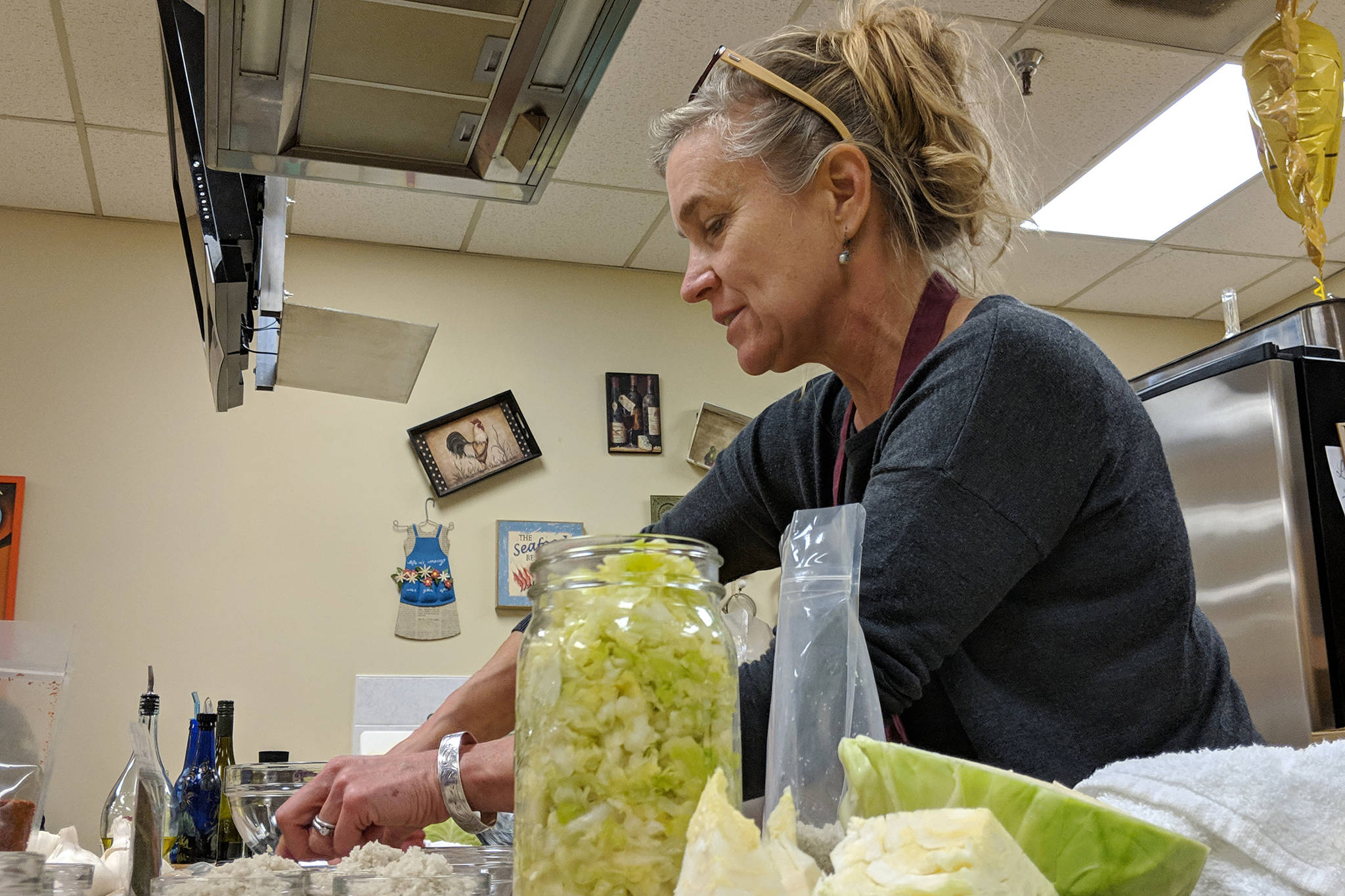
Cabbages, glass jars and pre-portioned piles of seasoning lined the counter at Chez Alaska Cooking School, but the most noticeable thing in the room was the smell.
Friday night, during Fermentation 101, a workshop led by Julie O’Brien, a University of Alaska Southeast alumna and owner of the Seattle-based Firefly Kitchens, the tangy, pronounced scent of fresh fermented foods hung in the air.
“I do have a crazy passion for these fermented food,” O’brien told the two dozen or so people in attendance.
She succinctly told the Capital City Weekly why while preparing for the UAS Alumni & Friends Association event.
“It’s life changing and heals people’s guts,” O’Brien said.
Attendees sipped wine or kombucha and sampled many of the fermented foods that are Firefly Kitchens’ specialty. They also heard O’Brien extole the virtues of fermented foods and got to try their hand at making some of their own. Proceeds from the event went toward the UAS Alumni Association Scholarship.
Fermentation 101 attendees were drawn to the event for a variety of reasons.
Michael Griffin was gathering information for his spouse.
“I’m on a mission for my wife,” Griffin said. “We’ve been trying to eat correctly as far as food that’s good food value. I never thought I’d eat as much cabbage as I eat.”
But he said fermenting food at home is a blindspot for the couple.
Sisters Sarah and Krisi Selvig were at the event mostly because they grew up with O’Brien in Juneau.
However, the Selvigs said they were also interested in learning about fermented foods — this was especially true for Krisi Selvig, who said she was a recent convert to food allowed to sit in brine.
“I’d always been not interested in this kind of food,” Krisi Selvig said. “For me, it’s definitely stretching my food boundaries.”
The Selvigs said they were hopeful they’d be able to replicate the tangy, crunchy sensation of O’Brien’s fermented goods in their own kitchens.
Before O’Brien began showing the crowd how to begin making kraut at home, she asked everyone in attendance to share what brought them to the workshop and what they were hoping to get out of Fermentation 101.
Some said they were fans of fermented foods but hadn’t tried to make any at home, others said they were specifically fans of Firefly Kitchens products and more than a few tiptoed around the idea that they were hoping fermented food would improve their digestive health.
O’Brien opted to put it plainly.
“Poop is real, and we all should be doing it every damn day,” O’Brien said. “This food really aids in digestion.”
Classic kraut
After introductions, O’Brien provided some instruction and insight for how to make the probiotic food at home.
One recipe, which was included on a printout at the event, was for a two-ingredient take on sauerkraut as follows.
Ingredients: One head of cabbage (3 quarts shredded) and 1 1/2 teaspoons of Celtic sea salt.
Equipment: A one quart mason jar, large metal bowl, large knife or food processor with a slicing blade attachment and an optional cabbage pounder. O’Biren said she prefers to use a sterilized rock.
Instructions: Peel off older, discolored cabbage leaves and cut cabbage into quarters. Remove and save the core.
Thinly slice into long strips, about 1/8 inch wide.
Working in small batches, place 1/3 of the cabbage into the large metal bowl and add 1/3 of the salt. Lightly mash the cabbage with the pounder until water starts to seep in from the cabbage, forming a brine at the bottom of the bowl.
Add another 1/3 of the cabbage and salt and repeat these steps until all of the cabbage is blended. This takes about 10 minutes of pounding and massaging. The end result is a thick mixture of cabbage and brine. It is important to taste this mixture — it needs to taste as if you have oversalted your food.
Put the cabbage into the quart jar and press down until the brine rises above the compressed cabbage by about 1 inch.
The cabbage core can be used or extra outer leaves can be used to keep the compressed cabbage below the brine.
Screw the lid on “finger tight.” Carbon dioxide is created in the process and needs a way to escape. A slightly tightened lid will allow gas to escape but not particles to get in.
Leave the jar at room temperature for at least five days. After five days, the ferment can be in a slightly cooler place and should be used within two to six weeks — it is read to eat after about two weeks.
The kraut can now be stored in the fridge.
O’Brien recommended keeping the jar out of sunlight and placing it in a bowl, especially during the early days of fermentation.
• Contact arts and culture reporter Ben Hohenstatt at (907)523-2243 or bhohenstatt@juneauempire.com.

Julie Hamilton, assistant professor of accounting for University of Alaska Southeast, and Julie O’Brien, owner of Firefly Kitchens, ready equipment and ingredients for a fermented foods demonstration. Fermentation 101 was a UAS Alumni and Friends Association event that gave those in attendance hands-on practice with fermented foods Friday, Nov. 9 at Chez Alaska Cooking School. (Ben Hohenstatt | Capital City Weekly)
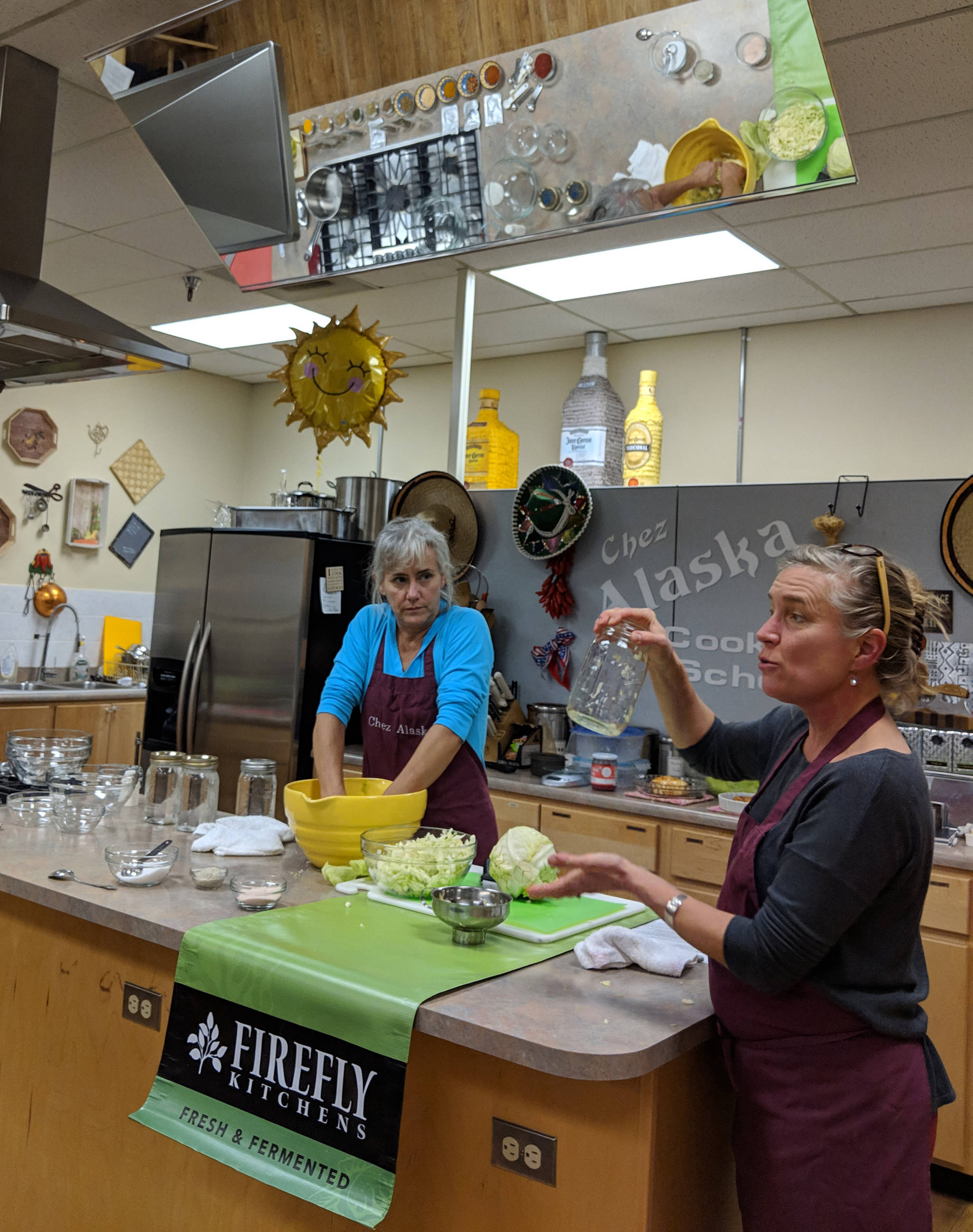
Julie O’Brien, a University of Alaska Southeast alumna and owner of Firefly Kitchens, holds a jar up while Julie Hamilton, a assistant professor of accounting for UAS, works on cut cabbage during Fermentation 101. The workshop focused on the benefits of fermented foods and how folks could make their own. The large mirror above the counter at Chez Alaska Cooking School allowed the audience to see how the food prep was done. (Ben Hohenstatt | Capital City Weekly)
