
To give directions around town, people often use landmarks for reference.
“How do we get to Fred Meyer?” Neil Nickerson asked a packed crowd at the Marie Drake Planetarium Tuesday night.
“Down the road and turn right,” a kid responded.
[Planetarium fundraises for new projector, seeks volunteers]
That was exactly the answer Nickerson was looking for. During Nickerson’s presentation about celestial navigation, he talked about how people get to where they need to go. In the time before Google Maps, people used landmarks to give directions. But out at sea, they had to use “skymarks.”
Most Juneauites know seeing the stars isn’t an everyday occurrence. Cloud cover inhibits stargazing most nights. But ancient sailors relied on these stars to lead the way to other places. The art of celestial navigation is ancient, but it still has some uses today, especially in emergency situations.
Nickerson is an Assistant Professor of Marine Transportation Career Education at the University of Alaska Southeast. He’s a retired U.S. Coast Guard officer, with a variety of experience USCG cutters. After that he worked as a mate aboard various towing vessels and for the Alaska Marine Highway System. He also was the owner of sightseeing charter boat company.
Last fall, he taught the first celestial navigation class at UAS. His talk on Tuesday was just a taste of what students learn in that class.
The class focuses mainly on the techniques of celestial navigation: how to calculate your positioning using pointer stars and trigonometry. The class was first offered in fall 2018, but only three students took it. Nickerson said they didn’t really advertise it at first because he wanted to test run the curriculum. But it will be offered again in fall 2019, and up to 16 people can register for it.
At his planetarium talk, Nickerson briefed the crowd on rudimentary ways to assume your position, such as using sticks to measure the sun’s shadow, similarly to how the Vikings navigated. Polynesians, he said, also used similar techniques. They even had designated apprentices to memorize patterns, wind and swell patterns. While they didn’t understand latitude, their deductive reckoning methods allowed them to successfully navigate among islands.
“Until we find out where we are, we only think we know where we are,” Nickerson said.
He also overviewed modern ways to calculate position.
“We’ve catalogued where all navigational stars are now,” he said. Sailors can reference books with exact times and positions of stars to find more accurate positions. He said the closest he’s gotten lately to finding his position with these methods was within 10 miles.
“I was pretty happy with that,” he said.
Nickerson’s talk on celestial navigation was a part of Marie Drake Planetarium’s monthly public presentation series. To find out about upcoming shows visit their website at www.mariedrakeplanetarium.org/shows-events.
Marie Drake Planetarium Board Member Clark Branch said anyone is welcome to host a show at the planetarium.
• Contact reporter Mollie Barnes at mbarnes@juneauempire.com or 523-2228.
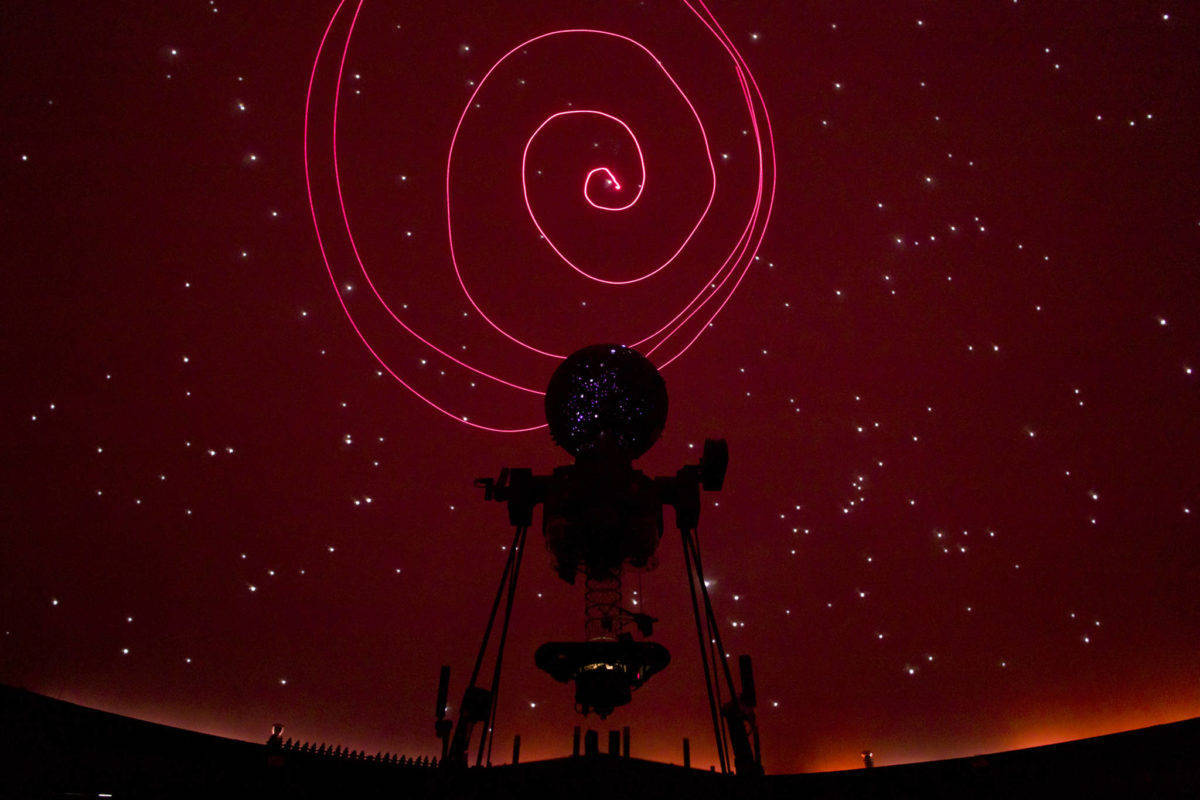
Marie Drake Planetarium volunteer Clark Branch uses a laser pointer to circle the North Star during a monthly talk on the night sky on Tuesday, Jan. 31, 2017. (Michael Penn | Juneau Empire File)
