
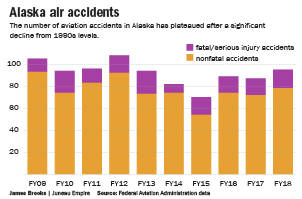
New statistics from the Federal Aviation Administration show a slight year-over-year increase in the number of aviation accidents in Alaska.
The figures were released Wednesday at a regular meeting of the Alaska aviation industry council in Anchorage. According to the FAA, there were 95 reported aviation accidents between Oct. 1, 2017 and Sept. 30, 2018, a period coinciding with the federal fiscal year. That’s up from 87 accidents during the same period from 2016 to 2017. The number of accidents involving fatalities or serious injuries rose from 15 to 17.
“I’m not seeing a real trend,” said Tom George, manager of the Alaska chapter of the Aircraft Owners and Pilots Association and one of the people familiar with the information from Wednesday’s meeting.
Since the 1990s, the number of aircraft accidents has fallen in Alaska, but within the past 10 years, that trend has leveled off and may have reversed itself. The number of accidents has risen each of the past three years.
“It’s more likely that FY15 was a very low year,” George said by phone from Fairbanks. “The trend is still generally a downward trend.”
He also cautioned that without knowing how many aircraft were flying (and for how long), there’s no way to tell if the increase is because there are more flights or because the existing flights are becoming less safe.
Ian Gregor, a spokesperson for the FAA’s Pacific Division said by email that “accident numbers are always fluid, and for many different reasons. We don’t have an answer as to why FY18 accidents were higher than the previous year, but it is not an abnormally large increase.”
Historically, most Alaska aviation accidents occur in the fall, when moose and deer hunters travel to remote locations amid worsening weather conditions. September is the most accident-prone month, according to recent averages.
That wasn’t the case this past year. In June 2018, 23 accidents were reported to the FAA, nearly three times the average.
“As far as accidents in June, the NTSB hasn’t yet released the probable cause for them so it’s not really possible to address the issue of why there was a surge that month. Again, accident numbers are fluid,” Gregor wrote.
The Empire examined available accident investigation information from the National Transportation Safety Board and found that the June incidents mostly consisted of private aircraft encountering problems in remote locations. Notably, an aircraft crashed in Sitka’s Katlian River, killing two people, and two aircraft collided with each other north of Anchorage, killing one. A flightseeing floatplane suffered an accident while landing in Sitka, and more than a dozen other aircraft suffered the aviation equivalent of fender-benders.
According to FAA data, 50 of the 95 accidents during the last fiscal year happened during landing, and half of those took place away from airports.
“You’re probably never going to get to zero accidents,” George said, but improved training and practice do help pilots prevent them.
George’s organization has also lobbied the federal government and state to improve Alaska’s aviation infrastructure, particularly with regard to weather forecasting.
Without proper observing equipment, he said, pilots don’t have good information and forecasters can’t tell them what to expect.
“If you do have bad weather, it’s not like you can turn around and land at an airport 20 miles away,” he said.
The recent FAA funding bill passed by Congress includes money for additional weather stations, and George expects that will help.
“There are some things on the horizon that could make this situation better than it is today,” he said.
• Contact reporter James Brooks at jbrooks@juneauempire.com or 523-2258.
