
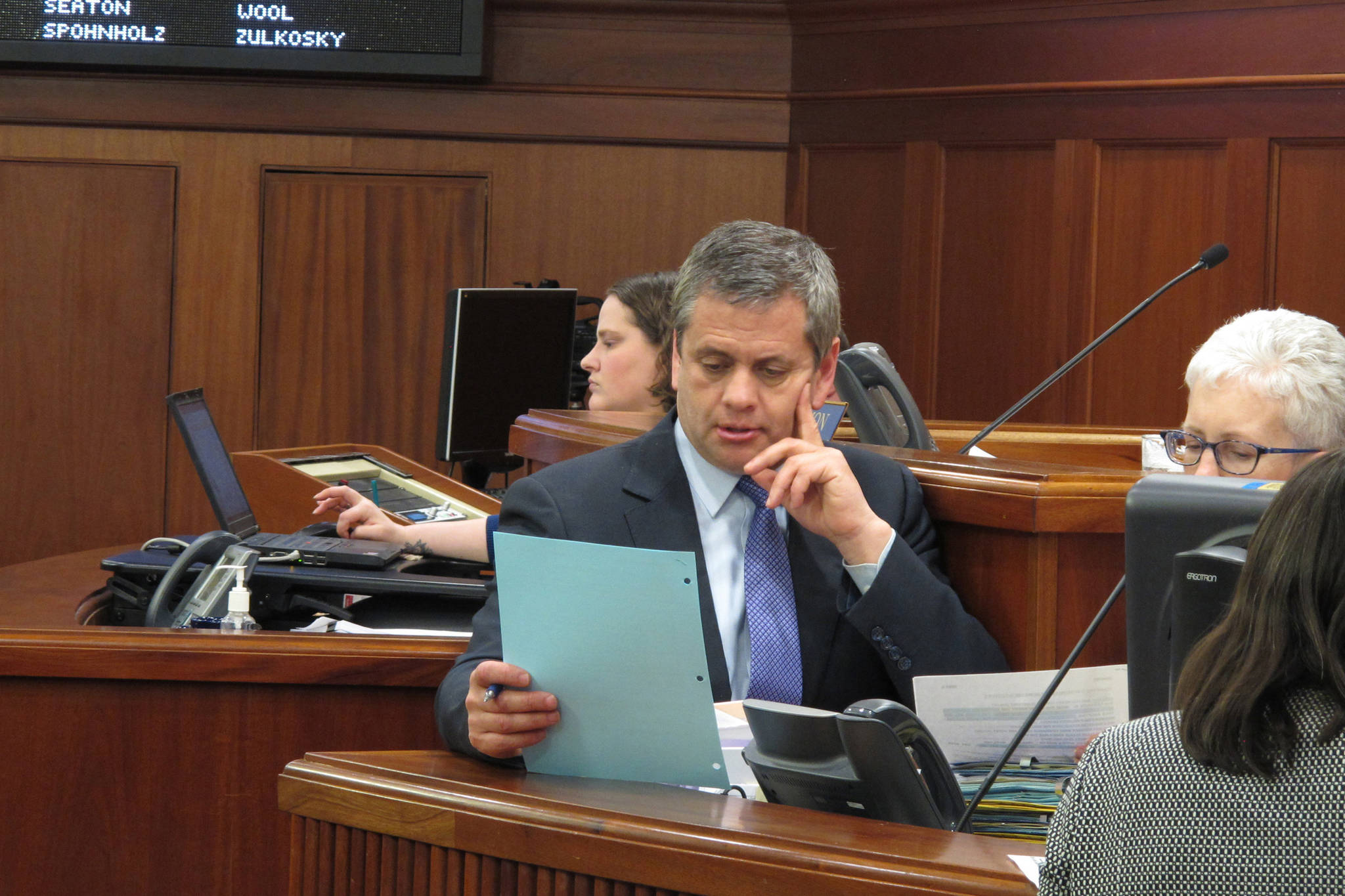
The big question heading into the new legislative session Tuesday is: Who will control the Alaska House?
Republicans will hold 23 of the chamber’s 40 seats, which would be enough for a small majority. But party doesn’t always dictate how lawmakers organize.
Bipartisan coalitions have formed when the parties are closely divided or evenly split. Organizations have formed, too, in bids to help protect constituent interests.
Rural Alaska Democrats, for instance, have organized with the GOP when it’s in charge to ensure their districts aren’t left out of budget and policy decisions.
[Pre-filed bills tackle Alaska’s sexual assault problem]
The way lawmakers organize determines their top leadership.
For the past two years, the House has been controlled by a largely Democratic coalition that formed with a goal of addressing the state’s deficit following drawn-out and gridlocked legislative sessions. The few Republicans who joined were branded turncoats by then-state GOP chair Tuckerman Babcock, now Gov. Mike Dunleavy’s chief of staff.
In November, two of the coalition’s members lost re-election bids to Republicans, and a third successfully ran for state Senate. His House seat went to a Republican.
Republicans, therefore, were eager to reclaim control, asserting the day after the elections that they had organized a bare-minimum majority, even though a race involving one of their members, Bart LeBon, was too close to call. While the race was being sorted out, ultimately in LeBon’s favor, Kenai Rep. Gary Knopp left the GOP caucus, saying the organization was too small and “doomed to fail.” Nancy Dahlstrom, who had just won a seat, left to become Dunleavy’s corrections commissioner.
[Here’s four of the most important pre-filed bills]
The two Republicans who caucused with Democrats and won re-election have indicated a desire to be part of a coalition. Knopp, who hasn’t joined with Democrats either, has expressed interest in the parties working together. Republican Sharon Jackson, whom Dunleavy appointed to replace Dahlstrom, must be confirmed by House Republicans and seated.
Some current or incoming Republican members have said they would prefer a GOP-led majority organization, or pledged to voters that they would only be part of an organization led by Republicans.
In 1981, a permanent speaker wasn’t elected until the 22nd day of session, and that organization was tenuous. That June, during session, the Democratic House speaker, Jim Duncan, was ousted from the role and replaced by Republican Joe Hayes.
No one wants a repeat of that, said Rep. Dave Talerico of Healy, a leader of the Republican caucus. The best outcome, in his mind, would be for his group to pick up a few more members.
He and other legislators hoped having everyone in Juneau, face to face, could help break the logjam.
The majority leader the past two years, Anchorage Democratic Rep. Chris Tuck, said having freshmen get to know members from the other party is important.
[Juneau’s freshman lawmakers gear up for session]
Tuck likes, at least as a starting point, a so-called committee of the whole. A version of that concept was floated in an Anchorage Daily News opinion piece by Republican Gail Phillips and Democrat Kay Brown, former lawmakers who proposed the Republican and Democratic-led groups share power, with co-speakers who would rotate in the duty and committee co-chairs. Under their proposal, the full House would vote on a leadership package.
“Right now, just staring at each other isn’t a very good process,” Tuck said.
Republican Rep. David Eastman, a conservative lawmaker at times at odds with his party, said organization should occur around agenda items and priorities, not around personality and positions of authority. He said two issues that lawmakers should begin organizing around are repeal of a sprawling criminal justice overhaul and following the traditional formula for calculating the annual checks residents receive from the state’s oil-wealth fund, both issues Dunleavy has championed.
Some legislators argue fixes have been made to the criminal justice overhaul, and all-out repeal is unnecessary. The dividend calculation has not been followed since 2016, as lawmakers grappled with the budget deficit.
Typically being in the majority means bigger offices, committee chairmanships and larger staffs.
If lawmakers have not organized in a way that forms a majority by Tuesday, Lt. Gov. Kevin Meyer would oversee nominations for and election of a speaker pro tempore, according to his office.
[Free speech under attack? ACLU alleges political retaliation in Dunleavy firings]
“The State is facing real challenges to move forward, and Alaskans need all branches of their government functioning to help find solutions,” Meyer’s chief of staff, Josh Applebee, said by email.
Dunleavy’s budget office has projected a $1.6 billion deficit for the coming fiscal year. Dunleavy said he would work to ensure his budget proposal is in line with revenues.
North Pole Republican Rep. Tammie Wilson said cutting $1 billion would be difficult without major restructuring and she doesn’t think it could happen in a year.
But she said the state can move in that direction by asking whether certain services are necessary and whether some can be covered through public-private partnerships.
There was pushback last year against the level of cuts already made in some areas. Alaska does not have a state sales or personal income tax. Tuck said he doesn’t know how $1.6 billion could be cut “without tanking the economy further.”
The state has long relied on oil revenues and last year, after years of deficits, began using Alaska Permanent Fund earnings to help cover part of the gap. Earnings also are used to pay the annual dividend residents receive from the oil-wealth fund.
• This is an Associated Press report by Becky Bohrer.
