
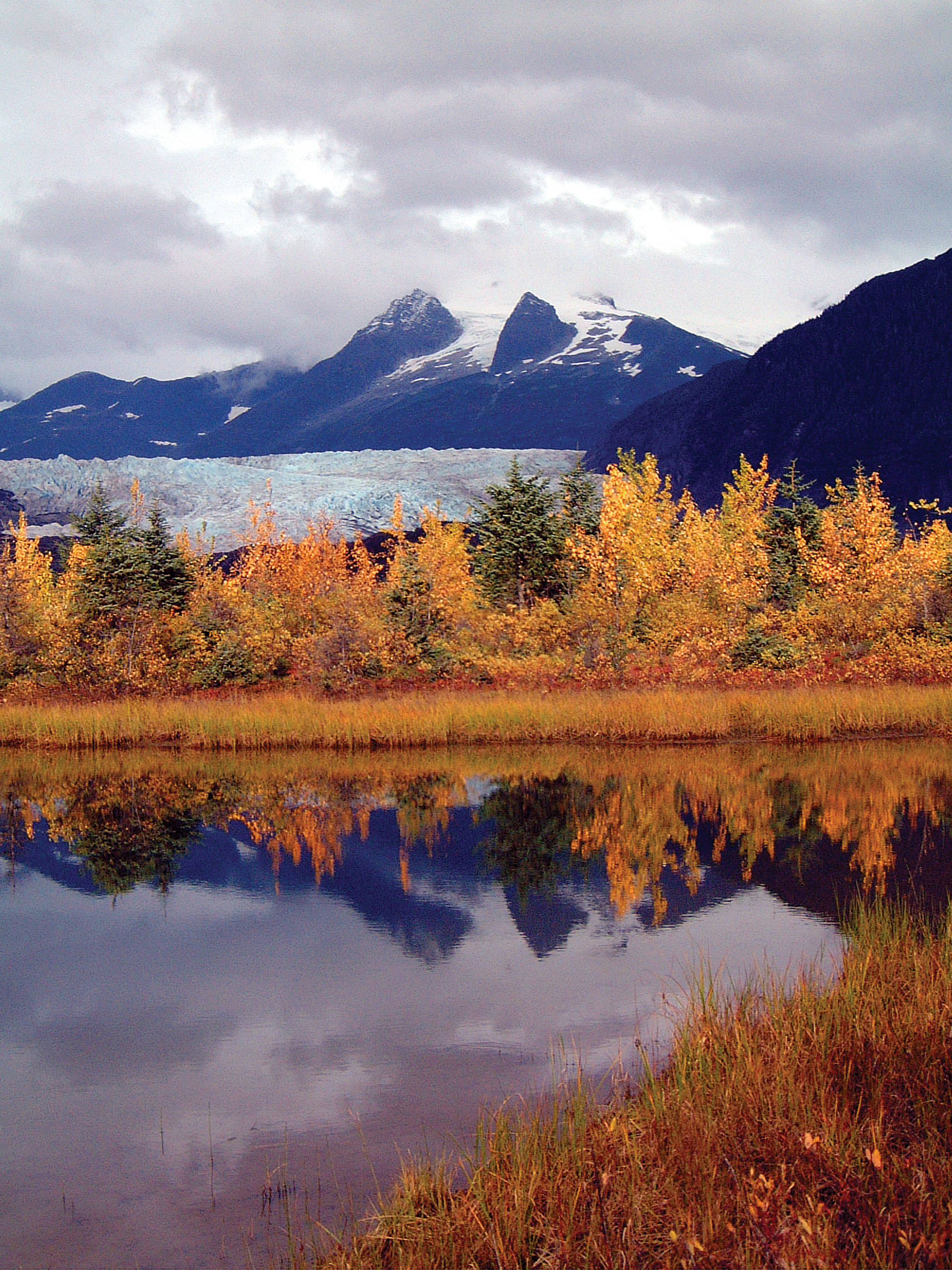
Juneau leaf-peepers don’t have to travel to the upper Midwest or New England for a view of lovely fall colors. This fall there is a pretty good show right here. Although the somber greens of the conifers dominate the landscape, a good color spectrum from yellow to orange to red and pink and even purple can easily be seen.
Returning to the Mendenhall Valley from a hike out the road on a drizzly day when the clouds sat low on top of Benjamin Island, I saw several places along the highway where the golden-yellow leaves of cottonwood seemed to light up the whole area. Patches of fireweed provided flaming scarlet mixed with other shades of red. Across the highway from the Methodist camp, the roadside shrubs and small trees made a splendid pastel expanse of glowing yellows and pinks. Dogwood shrubs sometimes offered a spectacular array of reds and the broad yellow and gold leaves of devil’s club brighten the understory. Highbush cranberry can do it all — yellow, orange, bright red, pink — sometimes even on a single leaf. Closer to the ground, dwarf dogwood and low-bush blueberries do the reds and purples.
The visual color show happens when the leaves of deciduous plants senesce (deteriorate with age) in the fall. The vascular connection between leaf and stem is gradually closed, shutting off the supply of water and nutrients to the leaf and slowing the passage of materials from the leaf to the rest of the plant. Photosynthesis slows and the green pigment (chlorophyll) that does the work of making carbon dioxide and water into carbohydrates breaks down. As it breaks down, leaves lose the green color and the yellow and orange pigments are exposed; they were there all along, capturing light energy and passing it on to chlorophyll for photosynthesis. Chlorophyll is broken down by complex processes that are still being elucidated, but apparently some of the break-down products are still photo-reactive and perhaps potentially damaging, unless quickly de-activated or protected in some way. Meanwhile, the plant retrieves any remaining carbohydrates and nitrogen-containing products of breakdown before the vascular connection closes completely and the leaf drops.
What about the red colors in fall foliage? In most plants, they come from anthocyanins, synthesized toward the end of the season during leaf senescence, using some of the carbohydrates made by the leaf. Anthocyanins account for the reds, pinks and purples — the hue depending on acidity within the leaf, which depends, in turn, at least partly on the accumulation of carbon dioxide in the leaf when photosynthesis is slowed. It is thought that warm sunny days and cool nights in fall favor the development of red foliage, so our unusually nice September weather might have contributed to the color show this year. I think we can see this effect sometimes in a single highbush cranberry shrub: the side of the bush exposed to light and dropping temperatures at the edge of the woods can be far more colorful than the other side of the same bush that is more protected under the tree canopy.
The functions of anthocyanins have been a subject of much discussion in the literature, but it appears that in autumn leaves they may have a protective function, defending the last days of photosynthesis and protecting from the possibly unstable, over-reactive products of chlorophyll breakdown from too much sun. There may be other physiological functions as well, still to be described.
Many questions remain. For instance: Why do some plants produce only yellow autumn leaves and not red ones? Do they have some other way of accomplishing whatever the anthocyanins do? An interesting comparison comes from quaking aspen, a relative of cottonwoods, in which some clones do make red or orange leaves. Also, willows usually make yellow leaves, but occasional some willow trees make lots of red leaves. Do they all have that capacity but just aren’t triggered to make red, or do only some willow trees have the capacity? And there are the alders, whose leaves invariably just turn brown. And a fundamental question: How does a plant decide when to shut down photosynthesis — there are easily observable differences among individuals of the same species, some retaining green leaves much longer than others. Stress from drought or insect attack might encourage a particular plant to shut down for the season, but what, specifically, are the mechanisms of this response?
Then there are the ferns, for which I have found little information about fall colors. But there is considerable observable variation. On one walk, there were wood ferns with whitish fronds, bracken with dark or light coppery fronds, and lady ferns all black, while in another area, lady ferns were tawny.
There’s no end to natural history questions; one answer just leads to another question! What fun! If we knew it all, there would be nothing left to provide surprises and discoveries.
• Mary F. Willson is a retired professor of ecology. “On The Trails” appears every Friday. Her essays can be found online at onthetrailsjuneau.wordpress.com.
