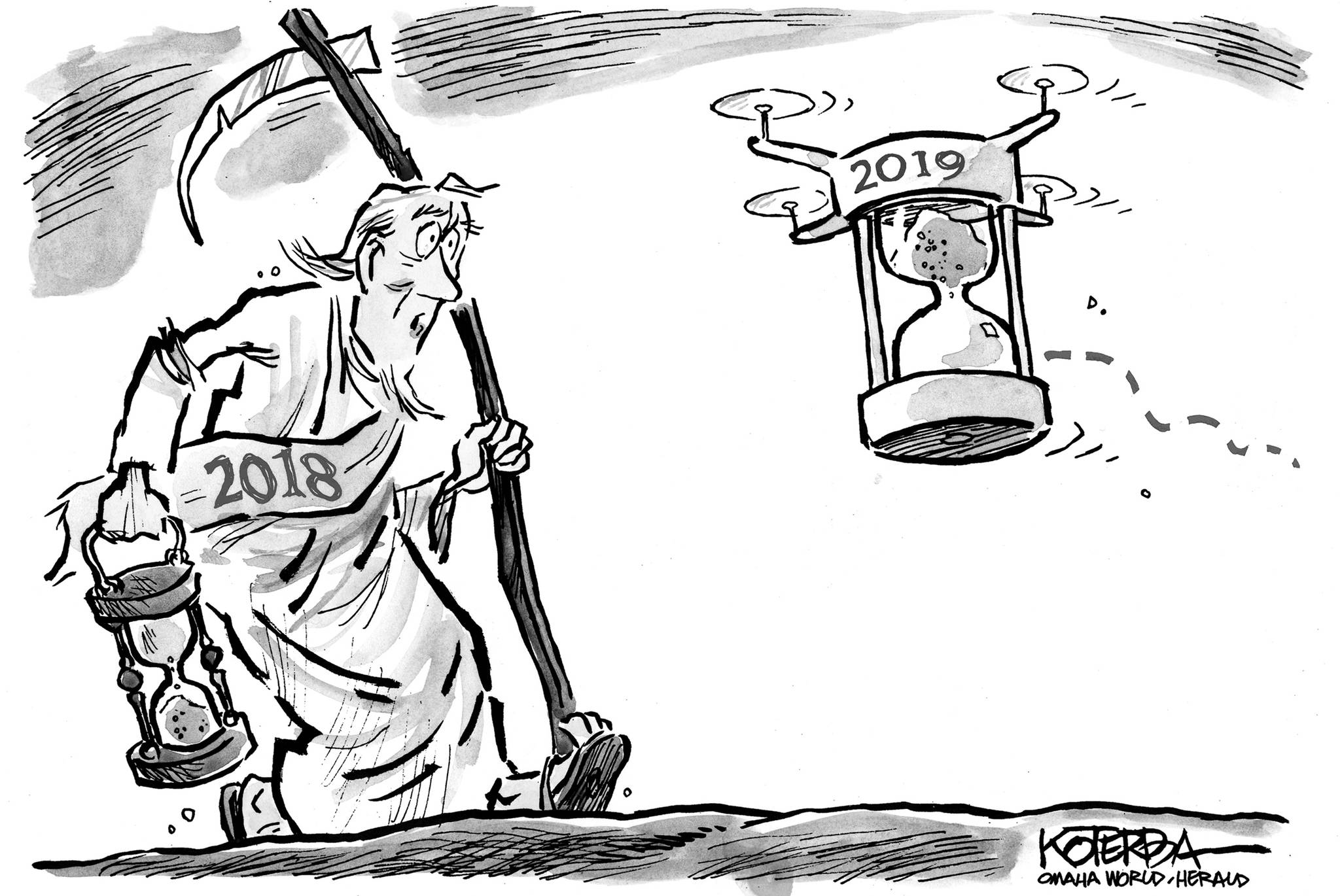
Last week in the Empire, an editorial cartoon offered a high-tech take on New Year’s Eve symbolism. Typically in New Year’s Eve cartoons, a wizened Father Time hands over his hourglass to Baby New Year in a scene of continuity and rebirth. In this version, however, Father Time looks up astounded as 2019 hurdles toward him in the form of an hourglass-shaped, quadcopter drone — no baby in sight. The artist catches Father Time mid-stride, sand still left in his hourglass, suggesting a different relationship to the future than New Year’s cartoons usually convey: that definitively modern one of risk and disruption.
On the one hand, the drone’s faceless nature and the premature obsolescence it forces on Father Time evoke the chaos that algorithms and automation runamok have wrecked over the past year in civil society. On the other hand, its squiggly flight across the cartoon frame seems almost lighthearted, a bit of fun poked at the next generation’s unaccountable new toys. For all its topical urgency and invitation to interpretation, however, one thing the cartoon doesn’t do is change the plot of our New Year’s stories. Whether Father Time peacefully passes on his hourglass and retires, or gets terminated by the hourglass-drone, the same ending remains: out with the old, in with the new, as if this were the nature of time itself.
[An autumnal mediation on salmon and sustainable decision making]
Thinking sustainability is fundamentally a practice of thinking time. And if the past year’s challenges to our society’s economic and ecological sustainability have taught us anything, it’s that our sense of time needs to be much more nuanced, yet also broader. We aren’t on a river flowing forward, as Heraclitus had it some 2,500 years ago, but riding something more like tides, coming and going, awash with rips and undertows. In terms of thinking a sustainable Alaska, that means situating decisions about our health and wealth within a much broader historical context than our public discourse commonly acknowledges.
What would it look like to widen the cartoon frame, beyond the instant of disruption, and beyond its conception of futurity as primarily a matter of technological advancement — for those who can afford it — rather than a more equitably livable, sustainable world? What else would the artist need to include? For one thing, we’d need to see who’s controlling the New Year’s drone. In terms of thinking a sustainable Alaska, that means looking ahead to see who, and in pursuit of what values, are flying their preferred versions of the future our way. Equally, it means looking around us, honoring, for example, Alaskan indigenous intellectual authority established and refined since always, alongside the diversity of others who call this place home. And it means zooming out further, to understand who will inherit the particular futures we bring into being.
[The problem with fossil fuels]
Perhaps nowhere is this wider perspective more needed than with regard to Alaska’s changing climate, whose collective impacts on our economy, environment and ways of life are one of the single greatest challenges we face. These impacts, already visible around us, are altering Alaskan cultures and ecosystems millennia in the making, and will do so for far longer than we are accustomed to looking, beyond the next election, or economic boom, or bust. It’s telling that religious institutions, long accustomed to looking before the beginning and beyond the future, are increasingly addressing climate change and its human impacts as a matter of justice — the sustainability of one’s own soul, not just other species.
Another institution that sheds light on where we’re going in part by understanding where we’ve been is the University of Alaska Southeast, tasked specifically with developing and disseminating the knowledge needed to meet Alaska’s challenges. As we move into 2019, let’s plan ahead for the sustainability of the institution that plans ahead for the sustainability of our state. Let’s resolve to support higher education in Alaska, else we find ourselves like the aforementioned Father Time, caught unprepared for a future that is always and already arriving.
• Dr. Will Elliott is a Term Assistant Professor at the University of Alaska Southeast and lives in Juneau. Dr. Elliott is a member of the University of Alaska Southeast Sustainability Committee. “Sustainable Alaska” is a monthly column, appearing on the first Friday of every month. It’s written by UAS Sustainability Committee members who wanted to promote sustainability. The views expressed here do not necessarily represent the views of the University of Alaska Southeast.