
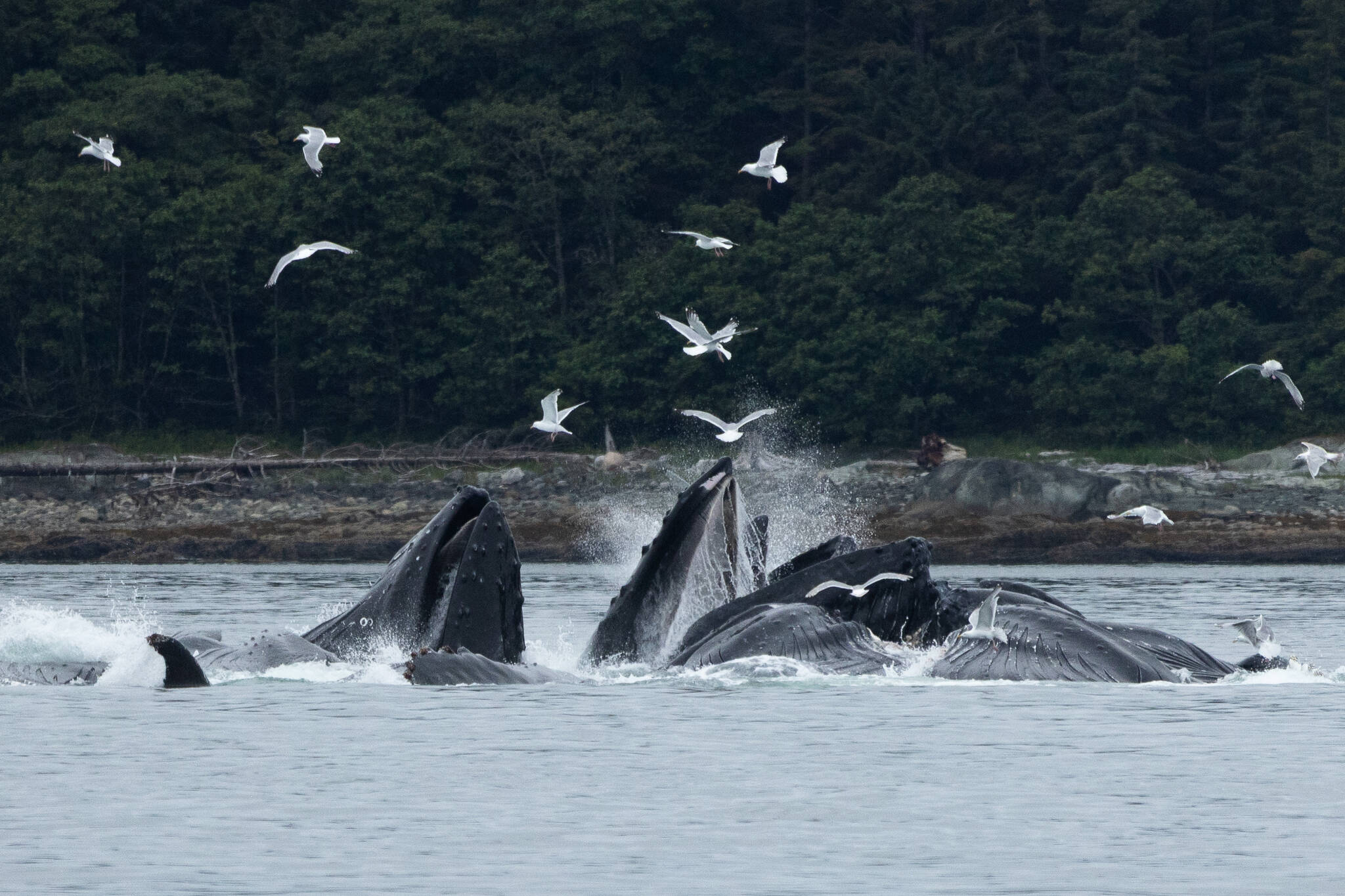
Everyone waits with bated breath, watching seagulls circle over the water. We break our collective focus to make excited eye contact when a faint vocalization comes through the hydrophone.
“Get your cameras ready,” our captain says with a smile, his eyes fixated on the water.
The gulls begin dive-bombing the water as the vocalization crescendos. I press my eye against my camera’s viewfinder and capture dozens of photos in the few seconds it takes the whales to lunge out of the water and gulp down hundreds of fish. The cruise ship passengers I’m guiding are exclaiming, clapping and taking countless photos and videos as 14 massive whales swim away. As our captain starts the boat’s engines and begins heading back to the harbor, I reiterate to my guests that what we just witnessed is among the rarest forms of humpback whale behavior.
Bubblenet feeding is a complex cooperative feeding behavior handed down from one generation of whales to the next. A group of up to 15 whales will circle under a school of fish, blowing air through their blowholes to create a net. Next, the leader trumpets, and the group starts swimming upward in a spiral, simultaneously keeping the fish trapped in the bubbles and pushing them closer to the surface. Finally, they rush to the surface, mouths agape, swallowing huge amounts of fish with minimal energy output.
The type of net used depends on the prey. Researchers say tool-using species are relatively rare, but animals with the capability of modifying their tools are even more unique. Bubblenet feeding points to a high level of intelligence and, because the group follows a leader and stays in a particular order every time, suggests a social hierarchy.
Humpback whale intelligence isn’t a new concept. They have spindle neurons, the part of the brain scientist Constantin Von Economo dubbed “what make us human” because of their role in processing social and emotional intelligence and empathy. Humpback whales have saved people from shark attacks and pinnipeds from orca predation. Most famously, their songs are long and highly complex, suggesting they have a language adhering to the rules of our own. They mourn their dead, come to the rescue of entangled whales and band together to fend off threats. Whalers used these characteristics against them when they were hunting, often capturing a calf and killing the mother whale who came to its aid.
The glimpse we get when they lunge to the water’s surface and the brief vocalization preceding it offer a mere window into a world of unknown. But what we do know — albeit in an abstract sense — is that these whales are experiencing a range of emotions similar to our own. Their lives may mirror ours in ways we can’t possibility understand.
• Chloe Anderson is a naturalist photography guide and freelance photojournalist based in Juneau. Her work has appeared in The Associated Press, The Denver Post, Alpinist magazine and more. For more, visit www.chloeandersonphotography.com.
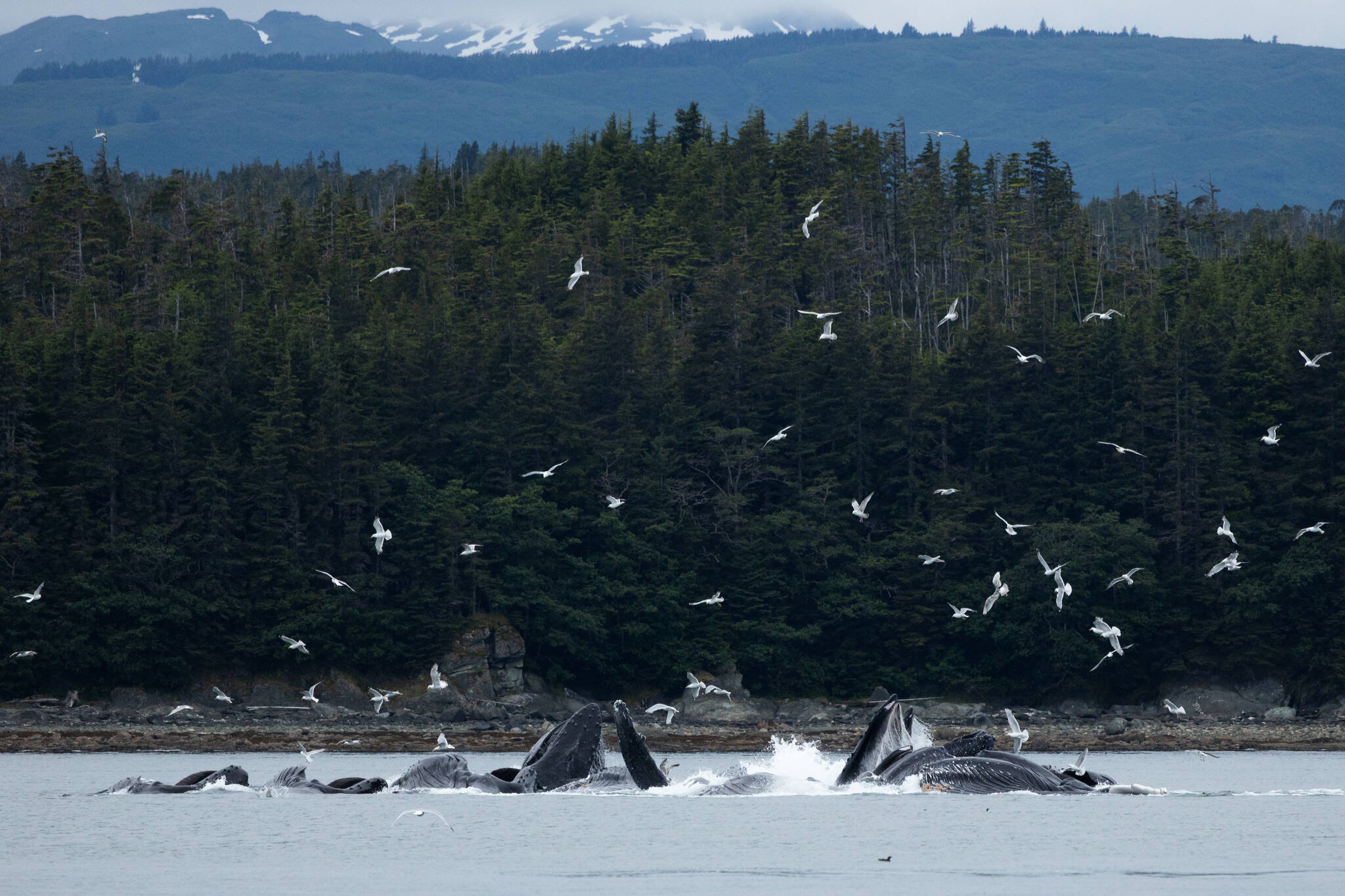
Humpback whales bubblenet feed in Saginaw Channel on July 18, 2025, in Juneau, Alaska. (Photo by Chloe Anderson/Juneau Empire)
