
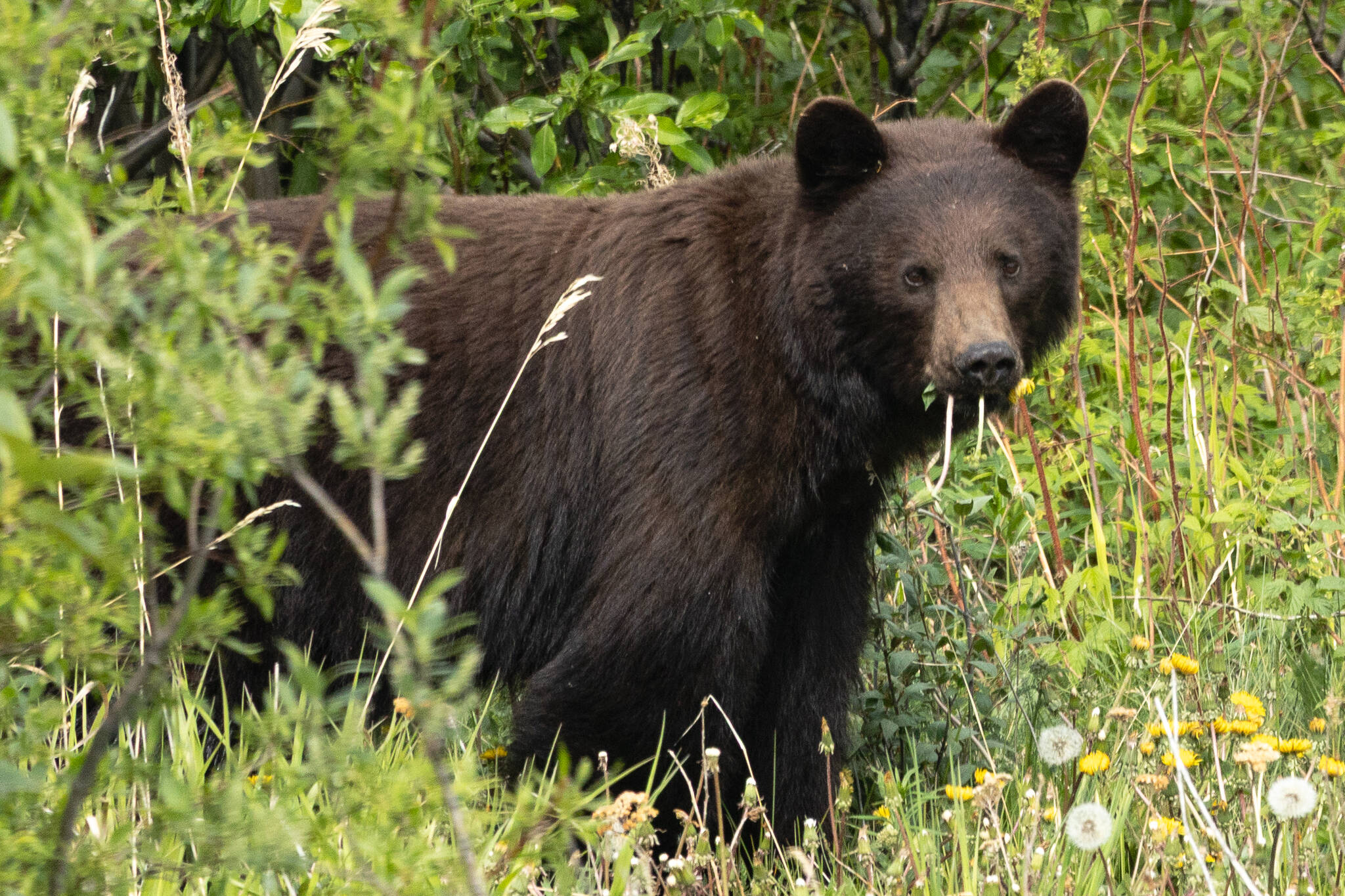
One of the most insufferable traits I’ve inherited as a result of my time as a guide is an inability to keep my attention on the road during my 10-mile commute from the valley to downtown. During low tides, I glance over at the muddy flats near Salmon Creek, often catching glimpses of seagulls preying on the dully colored bodies of spawned-out fish. My eyes regularly wander from the blacktop to scan the trees above Twin Lakes for eagles, searching for their characteristic white heads and massive wingspans. As I near Thane, my field of vision widens to include the steep hillside where deer occasionally roam.
While all of these creatures bring a smile to my face, only one makes me sit up straight, swerve until my Subaru’s lane assist feature starts beeping, and seriously consider pulling over to take a photo. Like the seagulls, this critter enjoys tidal flats, and, like eagles, they too frequent the meadow near the city’s dump — but their similarities stop there. My favorite sight, often visible from Egan drive, is the black bear.
Black bears are the most widely distributed species of bear in North America, found virtually everywhere throughout the continent with the exception of the Midwest. (As a gal born and raised in Kansas, I can’t say I blame them for excluding the Bible Belt from their habitat.) Although they’re not the smallest species of bear — sun bears, which are up to 5 feet tall and 150 pounds, claim that title — they’re the smallest we have in Alaska by far.
While researching this column, I asked a friend about his favorite black bear characteristics. “I like that when I see one, it’s just as scared to see me as I am to see it,” he answered. “Also, their ears are just so [expletive] cute.” His answer speaks volumes to how people view black bears.
In his 2015 paper “Human-bear conflict in Alaska: 1880-2015”, bear biologist Tom Smith analyzed 682 conflicts. 88% involved brown bears and polar bears made up a mere 1%, leaving black bears credited with 11% of all attacks. The last verifiable report of a black bear attack in Juneau occurred in 2020, when one entered a man’s home and injured him while trying to escape.
While black bears can, have, and will again hurt people at some point, the general consensus is they’re not typically a threat. Let me say that again: An animal weighing up to 550 pounds that can flip a 300-pound rock with a single paw and run upward of 30 miles per hour is not typically a threat to us. They roam our streets, eat berries in the bushes near the trails we hike on and walk through streams under viewing platforms peacefully.
Despite my many valid complaints about working with tourists, one thing I’ll credit them with is the constant reminder of how special all this is. For some, seeing a black bear sow and her three cubs chase a bald eagle through a field is a once in a lifetime experience. For others, it’s just something to look at on the way to work.
The fireweed is starting to turn to cotton, the days are getting shorter and the air has a crisper bite to it in the mornings and evenings. Soon, termination dust will settle on the tallest peaks, and the bears will find a place to den up for the winter. But for now, I’ll keep scanning the wetlands and meadows, hoping to catch a glimpse of our beloved fuzzy Juneau residents.
• Chloe Anderson is a naturalist photography guide and freelance photojournalist based in Juneau. Her work has appeared in The Associated Press, The Denver Post, Alpinist magazine and more. For more, visit www.chloeandersonphotography.com.
