
Wary teams make tweaks ahead of shorter shot clock

  • By GENARO C. ARMAS
  • Friday, November 13, 2015 1:06am
  • Sports
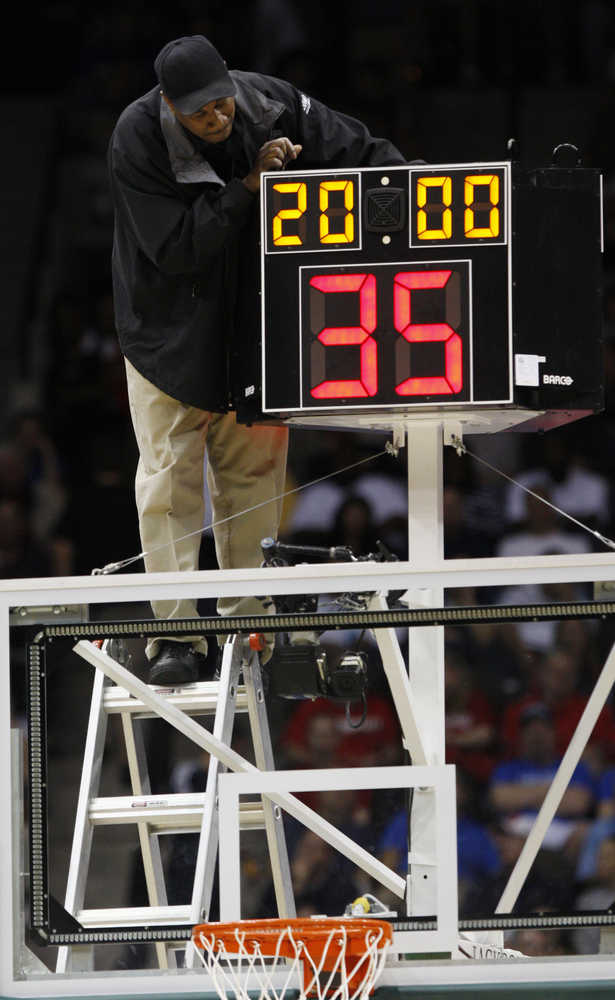
FILE - In this March 19, 2010, file photo, a technician adjusts a shot clock after it malfunctioned and delayed the start of the California against Louisville NCAA first-round college basketball game in Jacksonville, Fla. The NCAA has shaved 5 seconds off the shot clock, leaving teams 30 seconds to run their offense. Coaches don't expect dramatic changes, but practices have changed, communication and court awareness are more important than ever, and full-court pressure is getting a new look as a way to take advantage of the shorter time. (AP Photo/Steve Helber, File)

FILE - In this March 19, 2010, file photo, a technician adjusts a shot clock after it malfunctioned and delayed the start of the California against Louisville NCAA first-round college basketball game in Jacksonville, Fla. The NCAA has shaved 5 seconds off the shot clock, leaving teams 30 seconds to run their offense. Coaches don't expect dramatic changes, but practices have changed, communication and court awareness are more important than ever, and full-court pressure is getting a new look as a way to take advantage of the shorter time. (AP Photo/Steve Helber, File)

MADISON, Wis. — Not all that long ago, Wisconsin grinded out games and won regularly by scoring in the 40s and 50s. Last year, Wisconsin could keep up with anybody with Frank Kaminsky and Sam Dekker leading the way.

The efficient Badgers are adept at adapting to the times and a new wrinkle has arrived this season: The shot clock has been shaved by five seconds, leaving teams — patient and otherwise — 30 seconds to run their offense.

Wisconsin’s Bo Ryan and other coaches aren’t necessarily buying that this will lead to dramatic changes in college basketball. But practices have changed subtly at many schools, communication and court awareness are more important than ever, and full-court pressure is getting a new look as a way to turn up the heat on offenses getting used to having less time on their hands.

“I’ve noticed it a little bit, having the clock five seconds less, especially with our scout squad putting pressure on us full court,” Wisconsin point guard Bronson Koenig said. “We just have to get things a little quicker.”

Teams with experienced guards like Koenig, and Wichita State’s Fred VanVleet and Ron Baker, may have easier adjustments. That veteran backcourt helped Wichita State finish fourth-best nationally in limiting turnovers last year.

“We’ll have to teach (new players) what it’s like to have to get a shot off at a certain point, whether that’s in a one-on-one situation, a ball screen, or whatever,” Shockers coach Gregg Marshall said. “When it comes to guys like (VanVleet and Baker), I’m not worried about it.”

At Arizona, Sean Miller is among many coaches making players more aware of “soft” full-court pressure situations, where an opponent might press or show press in an effort to slow an offense.

“When you do that, and you don’t understand the difference of five seconds, you start getting into a situation where it might have been 15 seconds left in the past but now it’s 10,” Miller said. “Or all of a sudden it’s five and it’s dire straits.”

Regardless, Miller continues to emphasize attacking with the ball and getting quickly in the offense.

“Obviously, on defense, we want to get them to the end of the clock. Maybe that will be to our advantage defensively,” Miller said.

Other teams were going back to work in practice, like Michigan after what coach John Beilein saw last week in an exhibition game against Le Moyne.

“There’s three seconds sometimes that it takes us to get into something, that we had the luxury to do before,” Beilein said. “We don’t have it. We’ve got to pop that ball and move and drive it.”

The shot clock was last changed before the 1993-94 season, when it went from 45 seconds to 35 seconds. It’s being changed again amid concerns over low scoring; Since 2012, teams have averaged around 68 points per game every year except 2014 — all near historic lows.

Like Michigan, North Carolina State used a 25-second clock in the preseason to prepare his team. Gottfried’s squad was also one of best in the country last year in limiting turnovers. The nonconference schedule in November and December will be a trial period, Gottfried said, but “people adjust a little bit, and I think everybody will be fine.”

At Syracuse, where coach Jim Boeheim’s 2-3 zone has frustrated teams for decades, there’s not much consternation.

“Most team shoot between 12 and 16 seconds, so I don’t think it’s going to have any effect at all,” Boeheim said. “I think if you went to 24, there would be a noticeable effect, but not 30.”

Over the summer, the Badgers played with an NBA-standard, 24-second clock for some pickup games. For practice possessions at half court, Wisconsin will start the clock at about 23 seconds now instead of 27. Working with a less experienced roster this season, Ryan started working on press defense and press-break situations on offense a little earlier than usual this preseason.

“You know, it’s still going to be you’ve got to put the ball in the basket and you’ve got to try to stop the other guys from putting the ball in the basket, whether it’s a 5-second shot clock or 30,” Ryan said.

More in Sports

Senior Juneau-Douglas High School: Yadaa.at Kalé hockey players were recognized at the Treadwell Arena on Friday, Jan. 23, 2026 before the Crimson Bears faced the Homer High School Mariners. Head coach Matt Boline and assistant coaches Mike Bovitz, Luke Adams, Jason Kohlase and Dave Kovach honored 11 seniors. (Chloe Anderson / Juneau Empire)
JDHS celebrates hockey team’s senior night with sweeping victory over Homer

The Crimson Bears saw an 8-2 victory over the Mariners Friday night.

Photo by Ned Rozell
Golds and greens of aspens and birches adorn a hillside above the Angel Creek drainage east of Fairbanks.
Alaska Science Forum: The season of senescence is upon us

Trees and other plants are simply shedding what no longer suits them

Things you won’t find camping in Southeast Alaska. (Jeff Lund/Juneau Empire)
I Went to the Woods: Sodium and serenity

The terrain of interior Alaska is captivating in a way that Southeast isn’t

An albacore tuna is hooked on a bait pole on Oct. 9, 2012, in waters off Oregon. Tuna are normally found along the U.S. West Coast but occasionally stray into Alaska waters if temperatures are high enough. Sport anglers catch them with gear similar to that used to hook salmon. (Photo provided by the National Oceanic and Atmospheric Administration/West Coast Fisheries Management and Marine Life Protection)
Brief tuna bounty in Southeast Alaska spurs excitement about new fishing opportunity

Waters off Sitka were warm enough to lure fish from the south, and local anglers took advantage of conditions to harvest species that make rare appearances in Alaska

Isaac Updike breaks the tape at the Portland Track Festival. (Photo by Amanda Gehrich/pdxtrack)
Updike concludes historic season in steeplechase heats at World Championships

Representing Team USA, the 33-year-old from Ketchikan raced commendably in his second world championships

A whale breaches near Point Retreat on July 19. (Chloe Anderson/Juneau Empire)
Weekly Wonder: The whys of whale breaching

Why whales do the things they do remain largely a mystery to us land-bound mammals

Renee Boozer, Carlos Boozer Jr. and Carlos Boozer Sr. attend the enshrinement ceremony at the Naismith Basketball Hall of Fame in Sprinfield, Massachusetts, on Saturday, Sept. 6, 2025. As a member of the 2008 U.S. men's Olympic team, Boozer Jr. is a member of the 2025 class. (Photo provided by Carlos Boozer Sr.)
Boozer Jr. inducted into Naismith Hall of Fame with ‘Redeem Team’

Boozer Jr. is a 1999 graduate of Juneau-Douglas: Yadaa.at Kale

Photo by Martin Truffer
The 18,008-foot Mount St. Elias rises above Malaspina Glacier and Sitkagi Lagoon (water body center left) in 2021.
Alaska Science Forum: The long fade of Alaska’s largest glacier

SITKAGI BLUFFS — While paddling a glacial lake complete with icebergs and… Continue reading

Photo by Jeff Lund/Juneau Empire
The point of fishing is to catch fish, but there are other things to see and do while out on a trip.
I Went to the Woods: Fish of the summer

I was amped to be out on the polished ocean and was game for the necessary work of jigging

A female brown bear and her cub are pictured near Pack Creek on Admiralty Island on July 19, 2024. (Chloe Anderson for the Juneau Empire)
Bears: Beloved fuzzy Juneau residents — Part 2

Humor me for a moment and picture yourself next to a brown bear

Isaac Updike of Ketchikan finished 16th at the World Championships track and field meet in Budapest, Hungary, on Tuesday. (Alaska Sports Report)
Ketchikan steeplechaser makes Team USA for worlds

Worlds are from Sept. 13 to 21, with steeplechase prelims starting on the first day

Old growth habitat is as impressive as it is spectacular. (Photo by Jeff Lund/Juneau Empire)
I Went to the Woods: The right investments

Engaged participation in restoration and meaningful investment in recreation can make the future of Southeast special