
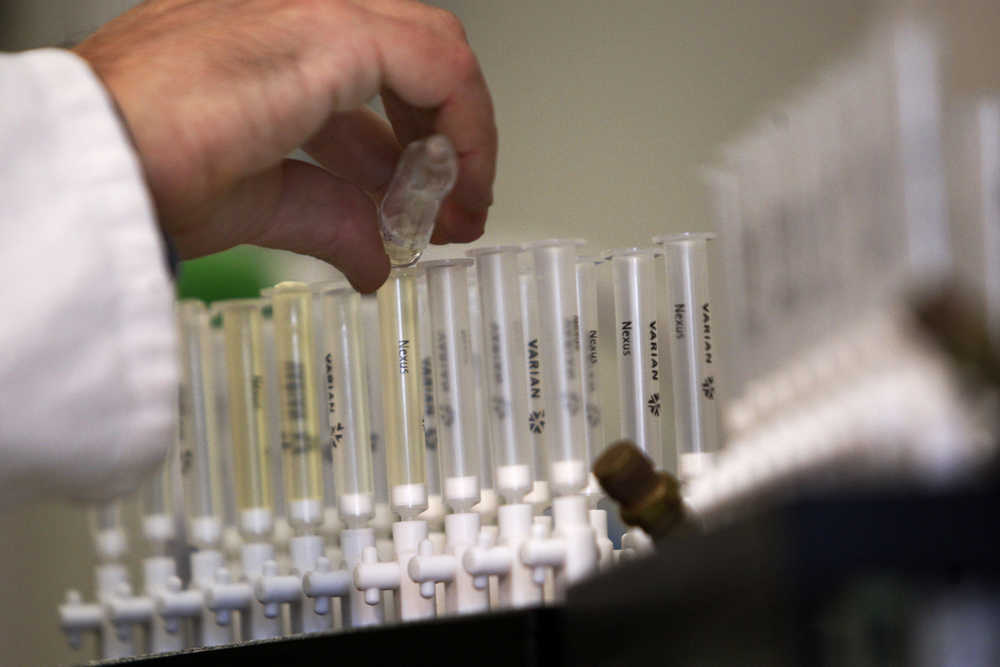
ELDORET, Kenya — From the moment the needle leaves the arm of an elite athlete in Kenya, the clock is ticking. The 3 milliliters, less than a teaspoon, of freshly collected rich, red blood offer potentially valuable intelligence about the extent of the doping crisis eating at the East African nation’s hard-earned reputation as a powerhouse of distance running. But the sample must be delivered to a laboratory quickly, within 36 hours, for testing.
And that is a major problem, because Kenya has no capable lab of its own. The nearest one is thousands of kilometers (miles) away.
Sometimes, rules are bent to get the job done.
The blood tube, sealed and signed for, is packed with others into a cool box to keep them refrigerated on their odyssey. The courier clambers into his battered but sturdy car. To make the flight out of Nairobi’s Jomo Kenyatta International Airport later that day, he must speed down 210 miles of heart-in-the-mouth highway — from Eldoret in the Kenyan highlands, across the Great Rift Valley, and up the other side to the capital.
He will cruise past the crushed wreck of the Mercedes that former marathon world record holder Paul Tergat plowed into an oncoming truck in 2010, miraculously escaping severe injury, and the forest memorial near the Equator to more than 100 people who burned to death when a gasoline tanker overturned in 2009, spewing fuel that exploded when someone lit a cigarette. If alert and lucky, he’ll avoid the suicidal farm animals and marauding baboons that stray without warning onto the weather- and truck-beaten road, not rip tires in one of the jagged potholes, and not bust shock absorbers on the large, aggressive speedbumps.
Restoring trust in Kenya’s running industry rests on getting samples collected from elite runners who will be expected to light up the Rio de Janeiro Olympics in August to technicians at overseas labs. With 38 runners banned for positive doping tests since the last Olympics in London in 2012, Kenyan authorities are facing intense international pressure to get their house in order. But the terrain and other constraints in Kenya are so challenging that those involved in anti-doping efforts there for the International Association of Athletics Federations, the global governing body of track and field, say they sometimes have to tip-off athletes in advance that they’re coming.
Anti-doping tests are meant to be sprung on athletes by surprise, to increase the chances of catching cheats unaware. But exceptions are regularly being made on the high-altitude plateaus of western Kenya where legions of runners live and train. Critics say this special treatment gives cheats a potential window of opportunity to beat the system.
Training there in February, Canadian marathoner Reid Coolsaet says he got an 8 p.m. call one night telling him to report at 6 a.m. the next morning for IAAF testing.
After an hour’s drive to Eldoret, Coolsaet was met by a who’s who of Kenyan stars also called there to give blood, including the Olympic and world champion over 800 meters, David Rudisha, marathon world-record holder Dennis Kimetto and about six others. Coolsaet, a veteran of the 2012 Games and multiple world championships, said it was the first time he’d ever had advance notice of a test.
“It was weird,” Coolsaet said. “In Canada, I wouldn’t know the night before, I would just get a knock on the door.”
Blood doping experts say cheats tipped-off in advance could use the overnight hours to confound the “Athlete Biological Passport,” the tool the IAAF and other sports use to look for tell-tale signs of doping in athletes’ blood.
“A doped athlete will mask suspicious values by diluting their blood, either by drinking copious fluid or infusing saline,” Australian scientist Michael Ashenden said. “It could be argued that it is worse than conducting no test at all, because a doped athlete may cease to be target-tested if they provide manipulated samples that wrongly indicate they are clean.”
Kyle Barber, the IAAF out-of-competition testing coordinator, said the potential for manipulation “is minimal.” But one of the experts the IAAF uses to analyze ABP results, who spoke on condition of anonymity because he wasn’t authorized to discuss the program publicly, said the overnight window could be sufficient for cheats to make their blood values look normal enough to no longer trigger red flags.
Under World Anti-Doping Agency rules, giving athletes advance notice is allowed in “exceptional and justifiable circumstances.” WADA spokesman Ben Nichols said that although the agency has no “specific evidence” of the practice in Kenya, “it would be most concerning.”
“No advance notice testing underpins every successful anti-doping program,” Nichols said. “If athletes are being told ahead of time when they will be tested, this would be outside the requirements.”
Advance notice is only given in Kenya for some ABP testing, Barber said. Athletes get no advance notice for all other anti-doping tests, including the collection of urine samples, that don’t have to reach labs so quickly.
ABP samples that aren’t delivered to labs within 36 hours of leaving the athlete’s arm are logged as invalid, Barber said. From Nairobi, five labs are within range — in Germany, Switzerland, Qatar, Sweden and London. To be guaranteed the blood can get through customs and there on time the next day, the courier must leave Eldoret by mid-morning for afternoon flights. That leaves sample collectors just a few early-morning hours to fill their tubes.
For runners living together in training camps, the process can be relatively straightforward: Sample collectors can show up unannounced, wake athletes up and draw blood in time to hook up with the courier. But for athletes who live or train alone in hard-to-find, far-flung locations, collectors may opt to tell them to report the following morning at a central spot and then bulk-test them as a group, filing the courier’s cool box and thus getting better value for money. The transport alone generally costs about 2,000 euros ($2,200) a trip. The IAAF started collecting ABP samples in Kenya in 2013; “the majority have been advance notice,” with athletes told beforehand, Barber said.
Advance notice would generally be given when testing larger groups of perhaps 12-15 athletes, but not for smaller missions on three to five athletes, Barber said.
“It’s not the way that we would like to do things, given a choice,” he said. However, “we are of the opinion, at present, given the limitations involved, that doing some testing is better than doing nothing.”
Ashenden and Barber agree that a better solution would be to analyze ABP samples in Kenya, giving collectors time enough to no longer tell athletes in advance. Barber said the IAAF is working with WADA and the Kenyan government to make that happen, but getting necessary approvals to set up ABP analysis in-country is a long process.
“We would hope to have that done before the end of this year and that changes the landscape entirely,” he said.
Ashenden said: “In my view the lack of a testing facility in Kenya is a red herring used to disguise inaction.”
“To suggest that it is too much trouble, or too expensive, to set up a satellite facility in a successful athletic nation like Kenya indicates to me that anti-doping authorities need to revisit their priorities,” he said. “Where there is a will there is a way, but when there is no will there are just a thousand excuses.”
Even now, the scale of IAAF testing in Kenya is unprecedented and “ever expanding,” Barber said. Some of the biggest names on the growing list of banned runners were caught using samples collected in Kenya, including Boston and Chicago marathon champion Rita Jeptoo and two-time world cross country champion Emily Chebet Muge.
“Compared to where we were two years ago, the situation has moved on incredibly,” Barber said.
