

Taking advantage of a rare gap in cruise ship arrivals, a friend and I strolled out to Nugget Falls, accompanied by the songs of warbling vireos. Barn swallows swooped through the air near the visitor center. We were entertained by a family of ruby-crowned kinglets flitting quickly through the shrubby vegetation, the juveniles still getting their parental attention. Wintergreen flowers were blooming, both the yellow-flowered, one-sided species and the more common pink one. We noted marked variation of the pink flowers, ranging from very pale to some with dark pink spots.
Along the way, we found some nice examples of last year’s willow roses. A midge lays its eggs in the tip of a shoot, the midge larva stunts the shoot growth while it eats the tissues, and eventually kills the shoot. But the willow branch isn’t done! Subsidiary branches below the dead shoot sprout exuberant new growth the next year.
Just a few days ago, we went up the Crow Hill trail, not quite to the Ditch trail. The muskegs were well decorated with white and green bog orchids and a few pink subalpine daisies, as well as the little herb that I will always call by its old name of Tofieldia, although its proper name is now Triantha.
Spittlebugs were busy on many plants, including the seed-bearing stems of shooting stars. Spittlebug nymphs have mouthparts adapted for piercing and sucking, and they feed from the plant’s xylem, which conducts water from the soil into the plant. Xylem fluid is watery and nutrient-poor, so the nymph has to process a lot of fluid. Symbiotic bacteria provide amino acids that are not otherwise available. The excess water is excreted, mixed with some fluids from the nymph’s body, as air is blown from the abdomen to make bubbles. The wad of “spit” helps protect the nymph from predators and parasites and insulates it from adverse weather conditions. The nymph breathes by poking its abdomen out of the spit. Eventually it matures into a flying, hopping adult. The activity of the nymph reportedly does not do much damage to the plant.
Shore pines grow throughout the muskegs along the trail. They grow slowly in the wettest, nutrient-poor parts of the muskegs and better near the drier edges. They are said to grow quite rapidly when young, but growth may slow; counting growth rings in the trunk becomes eye-straining, because they are so close together. The oldest known trees are over 400 years old, and even very small individuals may have lived for over 200 years. They are subject to attack by the western gall rust fungus, which makes big lumps on the branches. Those lumps can be invaded by other fungi, especially in wet conditions. One dead tree bore many such lumps on its branches, indicating that it has survived long enough to get multiple infections. We noticed that many of the pines bore lots of dead, brown needles; in some cases all the old needles were dead. The dead needles might be caused by a fungal blight that thrives in warm, wet conditions (at least the wetness we have certainly endured this year!). One little tree growing in a ditch was covered with brown needles but nevertheless was sending out vigorous new growth at the ends of its branches. Another instance of survival in the face of possible calamity!
Meanwhile, from my front window, I’ve been enjoying the appearance of this year’s juvenile birds. Two broods of mallards visited my pond regularly, growing and getting feathers, until they were as big as the mothers; flight feathers were getting close to adult size. And I now have one big fuzzy duckling with very stubby wings that is probably the remnant of a replacement brood. Juncos of various ages make use of peanut butter and suet and seed offerings, some of them quite new fledglings and others already getting adult coloration. Yellow-rumped warblers, adult and juvenile, come for peanut butter. Chickadees come too, grabbing a bite or a sunflower seed. Activity at the hummingbird feeder has increased, as juveniles contend with adults for access. There are four nectar ports on that feeder, but the hummers will only go there one at a time. And I am very happy that the local pair of nuthatches has produced a couple of robust juveniles that love suet and peanut butter.
Thanks to Robin Mulvey for helpful consultation.
• Mary F. Willson is a retired professor of ecology. “On The Trails” appears every Wednesday in the Juneau Empire.
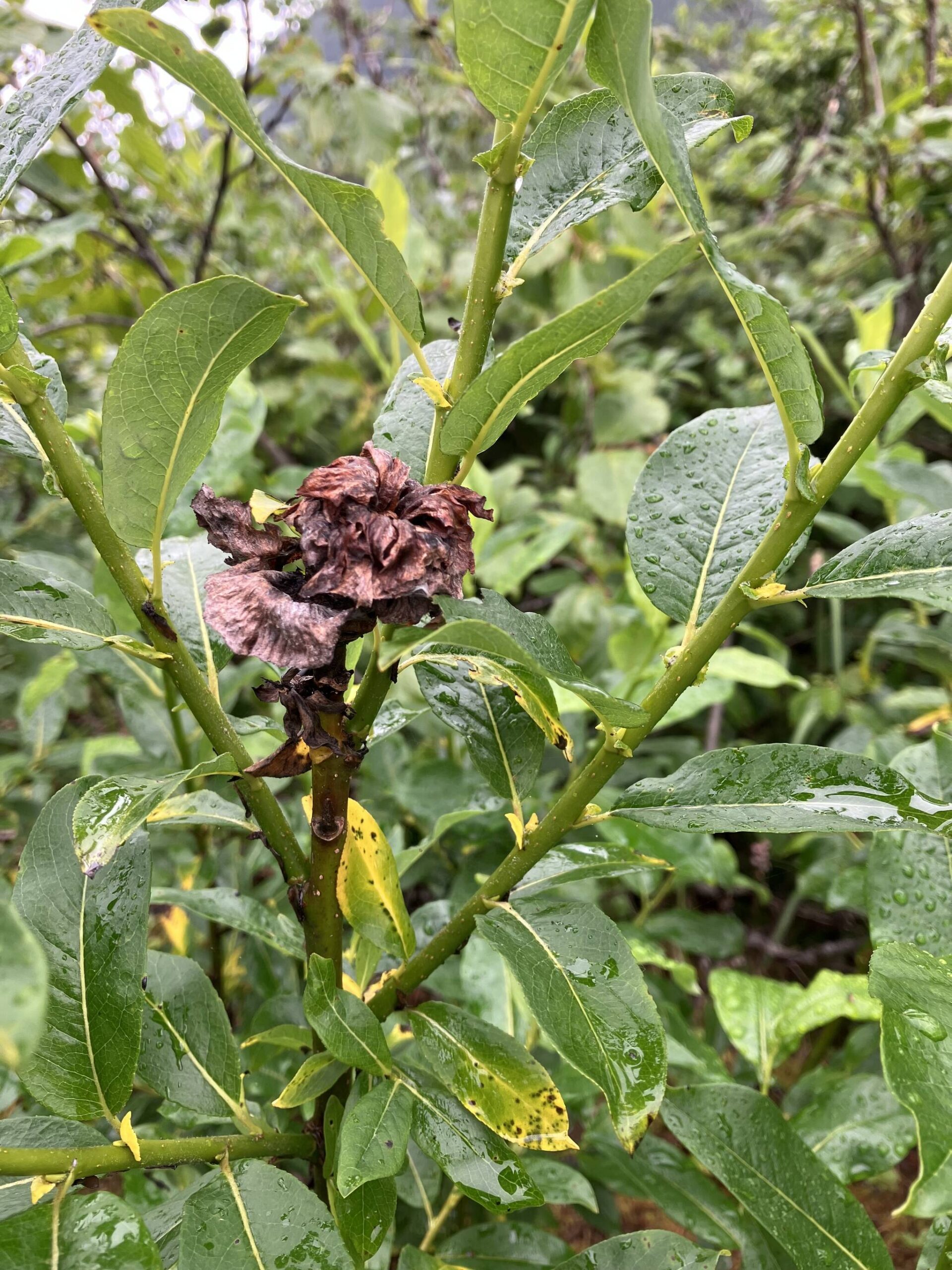
The shoot killed by last year’s willow rose is surrounded by exuberant new shoots.
