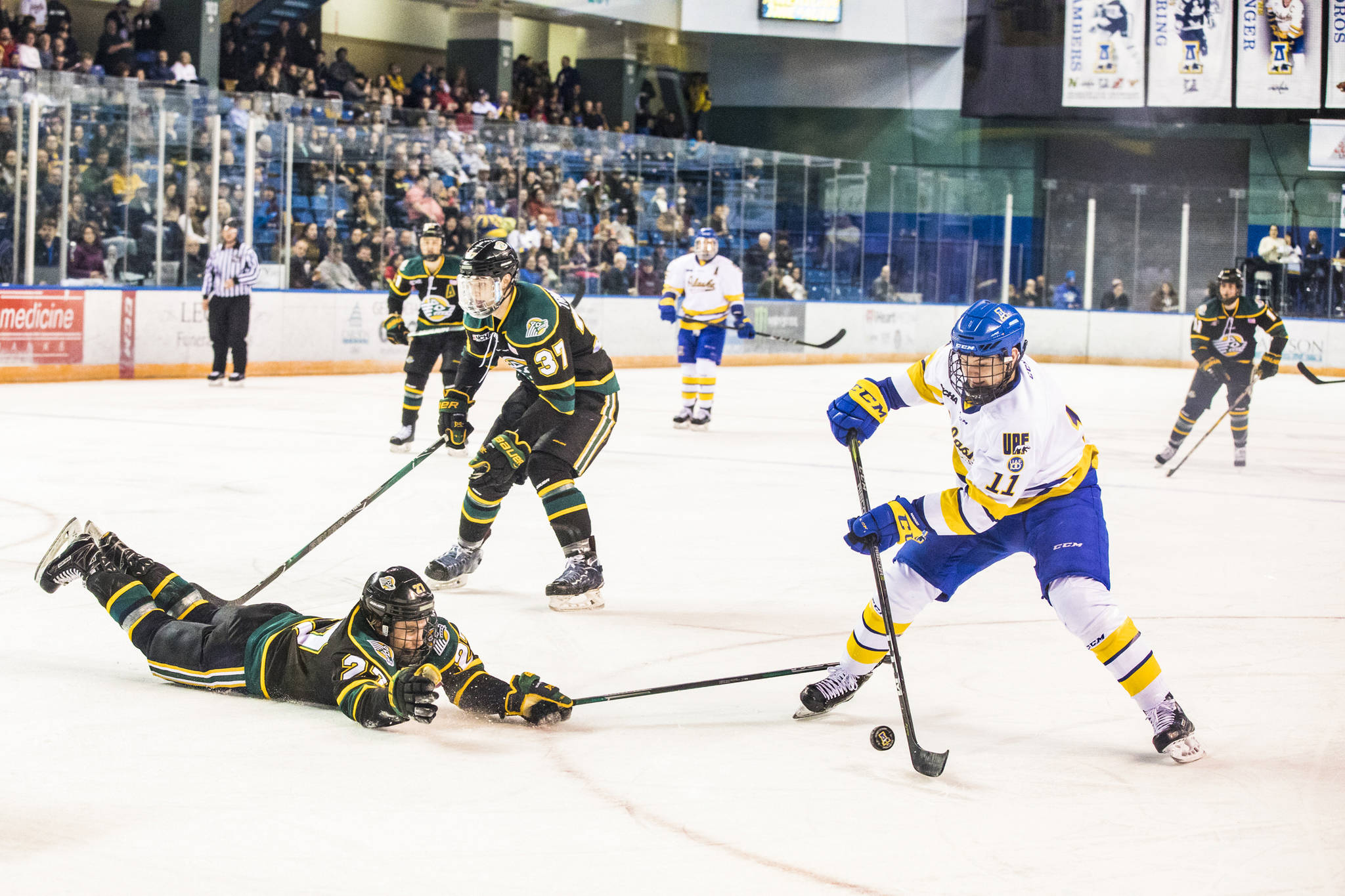
University of Alaska Fairbanks hockey team forward Steven Jandric skates with the puck against the UAA Seawolves. (Courtesy photo | JR Ancheta via UAF Photography)

University of Alaska Fairbanks hockey team forward Steven Jandric skates with the puck against the UAA Seawolves. (Courtesy photo | JR Ancheta via UAF Photography)

Alaska Science Forum: The physics of slapshots and mid-ice collisions

A look at one of the north’s favorite sports.

  • By Ned Rozell For the Juneau Empire
  • Thursday, February 6, 2020 12:05pm
  • Sportshockey

When two National Hockey League hockey players collide, their pads and body tissues can absorb enough energy to power a 100-watt light bulb for a minute and a half. During the 60 minutes of a hockey game, players can burn 6,000 calories and lose up to 15 pounds.

These are the calculations of Alain Hache, a physicist at the University of Moncton in New Brunswick, Canada. An amateur goalie, Hache has combined two of his passions in his book “The Physics of Hockey.”

Hache begins his look at one of the north’s favorite sports by examining the physical properties of ice, one of Alaska’s most abundant natural resources. Friction at contact points between surfaces is what slows most sports down, but the low friction coefficient of ice makes hockey players faster on their feet than the athletes of any other team sport.

Many NHL players can skate faster than 25 miles per hour, and Hall of Famer Bobby Hull was once clocked at 29.3 miles per hour. Scientists once tracked Hull during a game and calculated that he had skated more than eight miles during his 29 minutes on the ice.

While everyone agrees that ice is slippery, scientists have long debated the reasons why. Hache wrote about a study in the year 2000 by researchers at the University of California at Berkeley that revealed one of ice’s slicker secrets. The California scientists used an atomic microscope to find a thin, wet layer of quasi-fluid water on the surface of an ice crystal. That layer provides a lubricant, even when ice is very cold. Without it, the friction of ice would be comparable to concrete, Hache wrote.

This microscopic wet layer and other physical properties of ice make a sharpened skate on ice one of the fastest non-motorized ways of propelling the human body. Though downhill skis move fast, the friction between a waxed downhill ski and snow is 10 times greater than that between a steel skate blade and ice.

Using the magical surface of ice to combat friction, hockey players are able to generate incredible amounts of energy. Hache calculated that 180-pound NHL veteran Paul Kariya had more kinetic energy while skating at full speed than does a charging National Football League lineman of 300 pounds. He also calculated that a hockey player’s pads and flesh will compress as much as four inches during a collision with another player.

A goaltender on a series of teams since his youth, Hache devotes a chapter of his book to facts about that position. A goalie’s huge leg pads and other equipment cover 60% of a shooter’s target, the 4-by-6 foot goal made of red pipe and netting. Those leg pads, which cover 20% of the net space all by themselves, are made of leather and light synthetic padding because a hard plastic shell would allow the puck to bounce too far.

Hockey players have blasted slapshots faster than 100 miles per hour using a three-stage process, Hache wrote. First, a player rotates his or her torso and stick in an accelerated motion toward the puck. Next, the stick blade touches the ice and the puck as the stick bends for a fraction of a second, storing energy like a loaded spring. The puck accelerates off and the stick returns to its original shape as the player completes the swing. The puck rockets toward the goal as the player converts angular momentum (stick and torso swing) to linear momentum (the puck traveling a straight course for the goal).

Players mastering this technique include Shea Weber of the Montreal Canadiens, whose slapshot was clocked at 106.5 miles per hour at the 2020 NHL All Star Game.

• Since the late 1970s, the University of Alaska Fairbanks’ Geophysical Institute has provided this column free in cooperation with the UAF research community. Ned Rozell is a science writer for the Geophysical Institute. A version of this column ran in 2004.

More in Sports

The Juneau-Douglas High School: Yadaa.at Kalé Crimson Bears won fourth place during the Division II Hockey State championships in Palmer last weekend. Photo courtesy of Rapi Sotoa
Juneau takes home fourth place during high school state hockey tournament

The Crimson Bears also received the Sportsmanship Award last weekend.

Senior Juneau-Douglas High School: Yadaa.at Kalé hockey players were recognized at the Treadwell Arena on Friday, Jan. 23, 2026 before the Crimson Bears faced the Homer High School Mariners. Head coach Matt Boline and assistant coaches Mike Bovitz, Luke Adams, Jason Kohlase and Dave Kovach honored 11 seniors. (Chloe Anderson / Juneau Empire)
JDHS celebrates hockey team’s senior night with sweeping victory over Homer

The Crimson Bears saw an 8-2 victory over the Mariners Friday night.

Photo by Ned Rozell
Golds and greens of aspens and birches adorn a hillside above the Angel Creek drainage east of Fairbanks.
Alaska Science Forum: The season of senescence is upon us

Trees and other plants are simply shedding what no longer suits them

Things you won’t find camping in Southeast Alaska. (Jeff Lund/Juneau Empire)
I Went to the Woods: Sodium and serenity

The terrain of interior Alaska is captivating in a way that Southeast isn’t

An albacore tuna is hooked on a bait pole on Oct. 9, 2012, in waters off Oregon. Tuna are normally found along the U.S. West Coast but occasionally stray into Alaska waters if temperatures are high enough. Sport anglers catch them with gear similar to that used to hook salmon. (Photo provided by the National Oceanic and Atmospheric Administration/West Coast Fisheries Management and Marine Life Protection)
Brief tuna bounty in Southeast Alaska spurs excitement about new fishing opportunity

Waters off Sitka were warm enough to lure fish from the south, and local anglers took advantage of conditions to harvest species that make rare appearances in Alaska

Isaac Updike breaks the tape at the Portland Track Festival. (Photo by Amanda Gehrich/pdxtrack)
Updike concludes historic season in steeplechase heats at World Championships

Representing Team USA, the 33-year-old from Ketchikan raced commendably in his second world championships

A whale breaches near Point Retreat on July 19. (Chloe Anderson/Juneau Empire)
Weekly Wonder: The whys of whale breaching

Why whales do the things they do remain largely a mystery to us land-bound mammals

Renee Boozer, Carlos Boozer Jr. and Carlos Boozer Sr. attend the enshrinement ceremony at the Naismith Basketball Hall of Fame in Sprinfield, Massachusetts, on Saturday, Sept. 6, 2025. As a member of the 2008 U.S. men's Olympic team, Boozer Jr. is a member of the 2025 class. (Photo provided by Carlos Boozer Sr.)
Boozer Jr. inducted into Naismith Hall of Fame with ‘Redeem Team’

Boozer Jr. is a 1999 graduate of Juneau-Douglas: Yadaa.at Kale

Photo by Martin Truffer
The 18,008-foot Mount St. Elias rises above Malaspina Glacier and Sitkagi Lagoon (water body center left) in 2021.
Alaska Science Forum: The long fade of Alaska’s largest glacier

SITKAGI BLUFFS — While paddling a glacial lake complete with icebergs and… Continue reading

Photo by Jeff Lund/Juneau Empire
The point of fishing is to catch fish, but there are other things to see and do while out on a trip.
I Went to the Woods: Fish of the summer

I was amped to be out on the polished ocean and was game for the necessary work of jigging

A female brown bear and her cub are pictured near Pack Creek on Admiralty Island on July 19, 2024. (Chloe Anderson for the Juneau Empire)
Bears: Beloved fuzzy Juneau residents — Part 2

Humor me for a moment and picture yourself next to a brown bear

Isaac Updike of Ketchikan finished 16th at the World Championships track and field meet in Budapest, Hungary, on Tuesday. (Alaska Sports Report)
Ketchikan steeplechaser makes Team USA for worlds

Worlds are from Sept. 13 to 21, with steeplechase prelims starting on the first day