
An adult peregrine falcon in flight over Alaska. (Photo by Ted Swem)

An adult peregrine falcon in flight over Alaska. (Photo by Ted Swem)

Alaska Science Forum: Population of Yukon River peregrines nosedives

Numbers of adult peregrine falcons on the upper Yukon River in Alaska have decreased by more than a third in the last three years, according to a scientist who has counted them there for half a century.

Skip Ambrose is a biologist who has observed Yukon River peregrine falcons since 1973, missing only three years along the way.

He and his wife Chris Florian returned from 2023’s trip having seen only 77 adult peregrine falcons in the 166-mile stretch from the Yukon border to Circle. That is a 34 percent decrease in the average number of adult birds they counted there from 2012-2019.

“Normally, we have 58-to-60 nesting pairs and one or two single adults along the upper Yukon,” Ambrose said. “In 2023, we had 33 pairs and 11 single adults.”
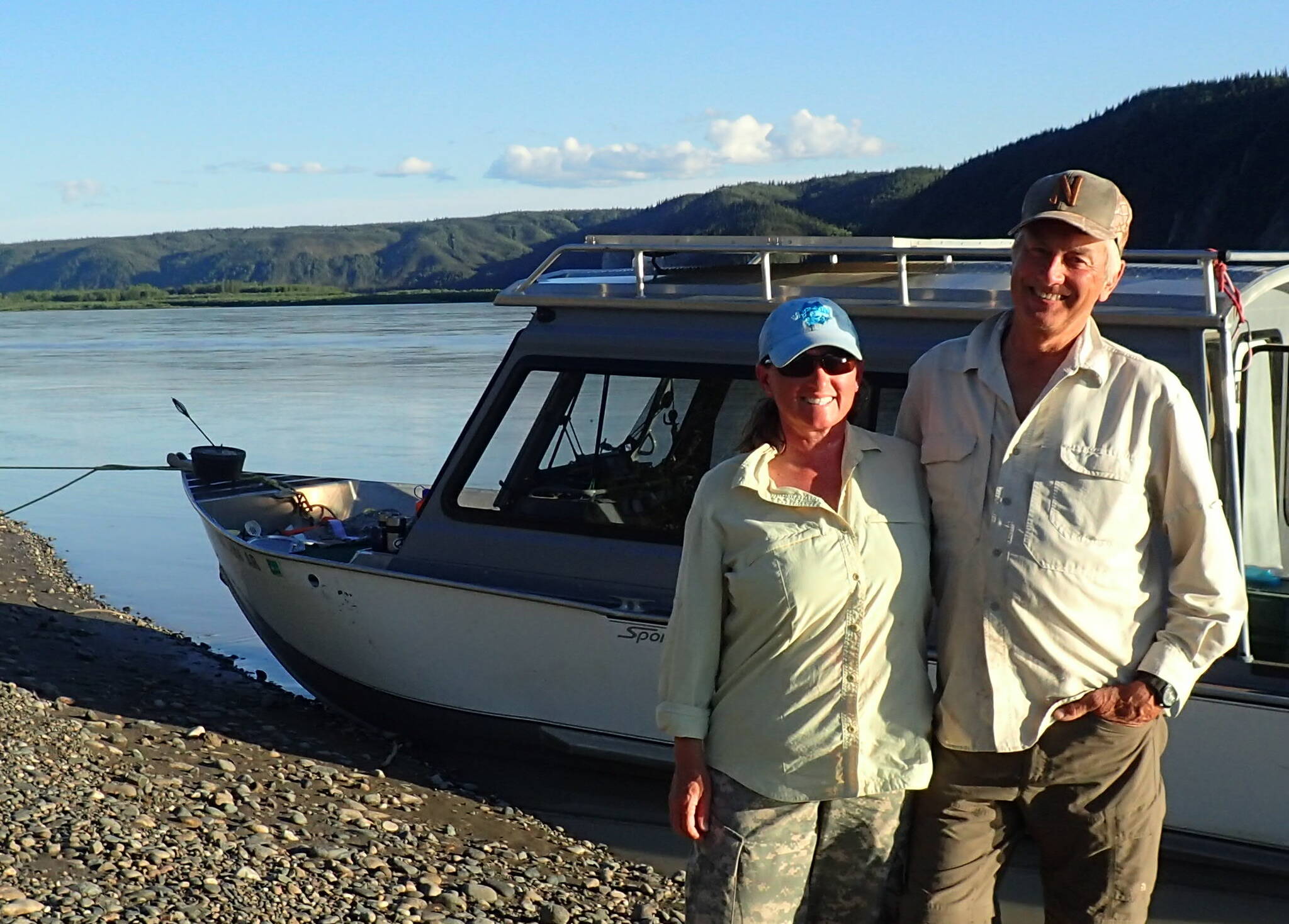
Chris Florian, left, and Skip Ambrose pose on the bank of the Yukon River during a trip to monitor peregrine falcon nests in July 2018. (Photo by Ned Rozell)

Chris Florian, left, and Skip Ambrose pose on the bank of the Yukon River during a trip to monitor peregrine falcon nests in July 2018. (Photo by Ned Rozell)

The population decrease comes after decades of peregrine falcons’ recovery from the effects of DDT, a compound introduced in 1947 to kill mosquitoes and other insects.

In 1973, the Environmental Protection Agency banned the use of DDT, which, when ingested by falcons, caused them to lay eggs with thinner shells that often broke.

In the decades since the DDT ban in the U.S. and other countries, peregrine falcons came back.

Ambrose thinks the population of peregrines stabilized by 2012, when the birds occupied 60 territories in the upper Yukon study area and most every good cliff nesting site was taken. The comeback took 40 years, and Ambrose had a front-row seat for the show. But he has seen things change during the last few years.

“This recent decline is very different from the DDT-induced decline, with adults disappearing rapidly … resulting in an immediate reduction in the number of breeding adults and the resulting reduced number of nestlings being raised,” Ambrose said. “With the disappearance of breeding adults, the population will decline at a much faster rate than during the DDT era.”
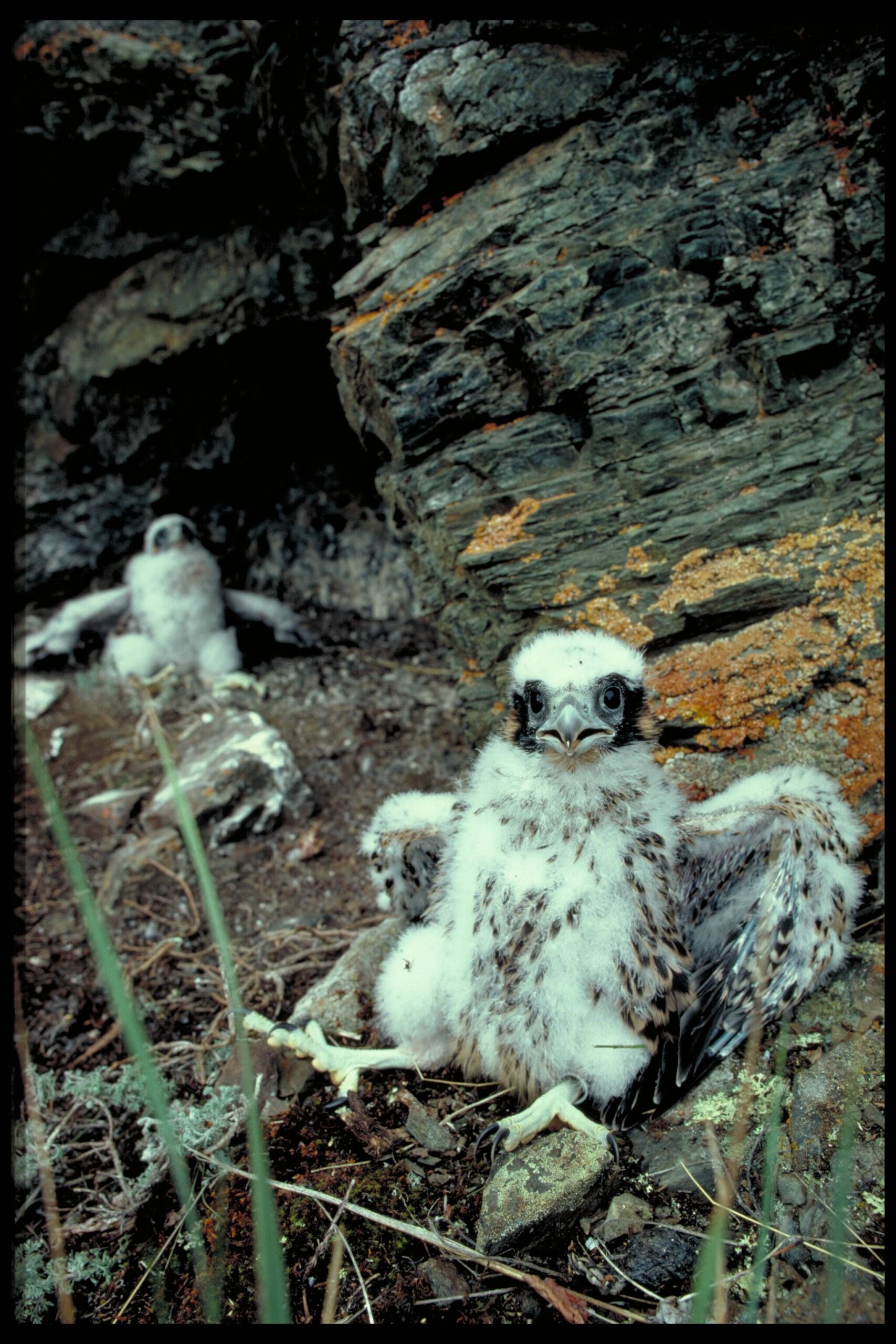
Peregrine falcon nestlings on ledges above the upper Yukon River. (Photo by Skip Ambrose)

Peregrine falcon nestlings on ledges above the upper Yukon River. (Photo by Skip Ambrose)

Ambrose and Florian think the avian bird flu is probably killing adult peregrine falcons, maybe before they get to Alaska. Peregrines, which live an average of six-to-seven years, migrate from the breeding grounds of the far north to the southern United States, Central and South America.

While they have found no dead birds to test for avian flu, Ambrose and Florian think the disease’s prevalence all over the continent makes sense as a reason for the birds’ decline.

Because peregrines capture and eat birds — from warblers to large ducks — they are quite susceptible to contracting bird flu, Ambrose said. The current strain of bird flu often kills birds within 48 hours of them contracting it (much like how the 1918 flu pandemic affected people).

With his single data point of lost peregrine falcons on the upper Yukon River, Ambrose is hoping to find out more from researchers who are monitoring them elsewhere, such as Padre Island in Texas where peregrines often hunt on their migrations to and from South America.

“We’re trying to get the word out, to see if people are noticing the same thing in other places,” Ambrose said. “Unfortunately, after the peregrine was (removed from the Endangered Species List) in the 1990s, most survey efforts in North America ended or were reduced substantially.”

What does the future hold for peregrine falcons, just a few years ago considered a great comeback success story?

“We have no idea,” Ambrose said. “In truth, nobody really knows.”

• Since the late 1970s, the University of Alaska Fairbanks’ Geophysical Institute has provided this column free in cooperation with the UAF research community. Ned Rozell is a science writer for the Geophysical Institute.
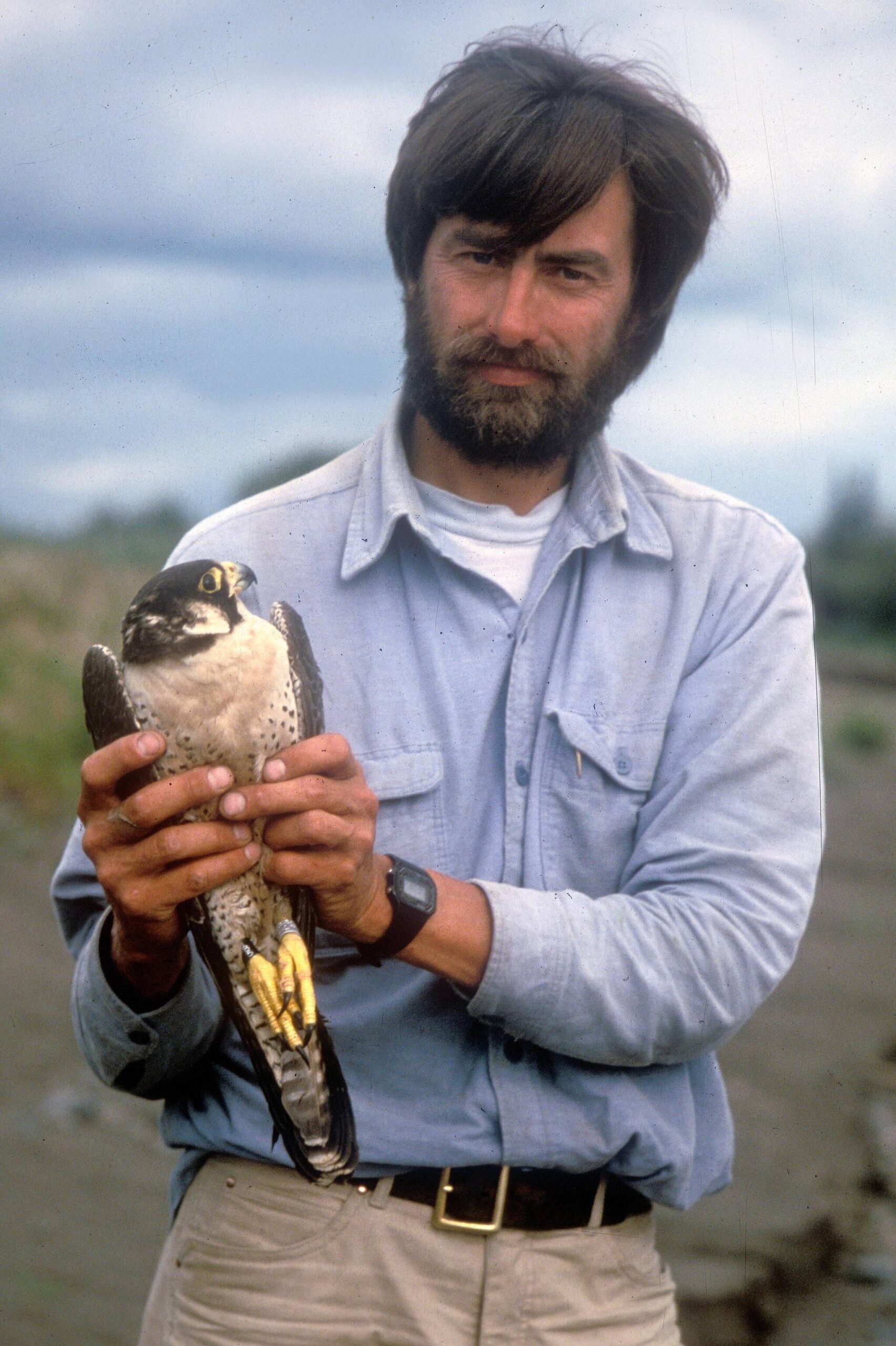
Skip Ambrose holds a peregrine falcon during a trip to monitor the birds along the upper Yukon River in 1985. (Photo by Robin Long)

Skip Ambrose holds a peregrine falcon during a trip to monitor the birds along the upper Yukon River in 1985. (Photo by Robin Long)

More in Sports

Senior Juneau-Douglas High School: Yadaa.at Kalé hockey players were recognized at the Treadwell Arena on Friday, Jan. 23, 2026 before the Crimson Bears faced the Homer High School Mariners. Head coach Matt Boline and assistant coaches Mike Bovitz, Luke Adams, Jason Kohlase and Dave Kovach honored 11 seniors. (Chloe Anderson / Juneau Empire)
JDHS celebrates hockey team’s senior night with sweeping victory over Homer

The Crimson Bears saw an 8-2 victory over the Mariners Friday night.

Photo by Ned Rozell
Golds and greens of aspens and birches adorn a hillside above the Angel Creek drainage east of Fairbanks.
Alaska Science Forum: The season of senescence is upon us

Trees and other plants are simply shedding what no longer suits them

Things you won’t find camping in Southeast Alaska. (Jeff Lund/Juneau Empire)
I Went to the Woods: Sodium and serenity

The terrain of interior Alaska is captivating in a way that Southeast isn’t

An albacore tuna is hooked on a bait pole on Oct. 9, 2012, in waters off Oregon. Tuna are normally found along the U.S. West Coast but occasionally stray into Alaska waters if temperatures are high enough. Sport anglers catch them with gear similar to that used to hook salmon. (Photo provided by the National Oceanic and Atmospheric Administration/West Coast Fisheries Management and Marine Life Protection)
Brief tuna bounty in Southeast Alaska spurs excitement about new fishing opportunity

Waters off Sitka were warm enough to lure fish from the south, and local anglers took advantage of conditions to harvest species that make rare appearances in Alaska

Isaac Updike breaks the tape at the Portland Track Festival. (Photo by Amanda Gehrich/pdxtrack)
Updike concludes historic season in steeplechase heats at World Championships

Representing Team USA, the 33-year-old from Ketchikan raced commendably in his second world championships

A whale breaches near Point Retreat on July 19. (Chloe Anderson/Juneau Empire)
Weekly Wonder: The whys of whale breaching

Why whales do the things they do remain largely a mystery to us land-bound mammals

Renee Boozer, Carlos Boozer Jr. and Carlos Boozer Sr. attend the enshrinement ceremony at the Naismith Basketball Hall of Fame in Sprinfield, Massachusetts, on Saturday, Sept. 6, 2025. As a member of the 2008 U.S. men's Olympic team, Boozer Jr. is a member of the 2025 class. (Photo provided by Carlos Boozer Sr.)
Boozer Jr. inducted into Naismith Hall of Fame with ‘Redeem Team’

Boozer Jr. is a 1999 graduate of Juneau-Douglas: Yadaa.at Kale

Photo by Martin Truffer
The 18,008-foot Mount St. Elias rises above Malaspina Glacier and Sitkagi Lagoon (water body center left) in 2021.
Alaska Science Forum: The long fade of Alaska’s largest glacier

SITKAGI BLUFFS — While paddling a glacial lake complete with icebergs and… Continue reading

Photo by Jeff Lund/Juneau Empire
The point of fishing is to catch fish, but there are other things to see and do while out on a trip.
I Went to the Woods: Fish of the summer

I was amped to be out on the polished ocean and was game for the necessary work of jigging

A female brown bear and her cub are pictured near Pack Creek on Admiralty Island on July 19, 2024. (Chloe Anderson for the Juneau Empire)
Bears: Beloved fuzzy Juneau residents — Part 2

Humor me for a moment and picture yourself next to a brown bear

Isaac Updike of Ketchikan finished 16th at the World Championships track and field meet in Budapest, Hungary, on Tuesday. (Alaska Sports Report)
Ketchikan steeplechaser makes Team USA for worlds

Worlds are from Sept. 13 to 21, with steeplechase prelims starting on the first day

Old growth habitat is as impressive as it is spectacular. (Photo by Jeff Lund/Juneau Empire)
I Went to the Woods: The right investments

Engaged participation in restoration and meaningful investment in recreation can make the future of Southeast special