
A few years ago, Randy Brown wondered if he might lose $50,000 he had just won as part of the Rachel Carson Award for Exemplary Scientific Accomplishment.
The problem: He earned the award in March 2020, when the workflow of the world suddenly stopped for the COVID-19 pandemic. Brown, a fisheries biologist with the U.S. Fish and Wildlife Service in Fairbanks, knew the nature of his agency meant he had to use the money or lose it within a year.
At the same time, most fieldwork was cancelled.
Brown then decided to donate the money to a few University of Alaska Fairbanks scientists who would explore a question he had pondered many times during his career.
Brown’s funding enabled UAF’s Peter Westley, Andy Seitz and others to study whether Pacific salmon are colonizing rivers of Alaska’s Arctic or whether fish seen there are just adventurous strays whose offspring have never survived because it’s just too cold up there.
Many years before Brown started his career as a professional biologist, he finished high school in New Mexico and then drove up to Alaska. At the town of Eagle, he slipped his canoe into the Yukon River.
For the next couple of decades, he lived in large part off what the land gave him. As part of that life, he, and later his wife and two sons lived on the Kandik River. Every July, they floated down that clear tributary to the Yukon for fish camp. On the big river, they netted salmon that made up a good portion of their — and their dogs’— food.
About 30 years ago, Brown and his family moved to Fairbanks, where he finished his graduate studies and became a fisheries biologist. He followed his interests to learn more about many species, including the Chinook and chum salmon that people along the Yukon River are no longer able to harvest due to declining numbers.
Brown, who can no longer set his own gill net on the Yukon due to the low fish numbers, was also fascinated with the rivers north of the Brooks Range. There, Natives, biologists and others have seen Pacific salmon dating back to more than a century. Could these rivers in a warming climate begin to host populations of salmon?
Brown’s donation of his $50,000 award allowed Westley and Seitz to contract a helicopter pilot in September 2023 to hover over two Arctic rivers, the Itkillik and the Anaktuvuk. There, they searched for spawning chum salmon they suspected were there.
During what Westley called “the most satisfying field work of my life,” the biologists found seemingly dead-end channels entering both braided rivers. At the heads of those fingers were dark torpedoes: Chum salmon that had laid eggs in the gravel.
The scientists landed and noticed fresh springwater was flowing upward from the gravel.
They captured a few of the spawned-out fish and collected their otoliths — bones in the head that can tell them a fish’s age and what waters it has lived in. They also collected tissue samples that might tell what stock a salmon had come from, for example if its ancestors had lived in the Yukon River drainage.
And — most important — they pounded conduit into the gravel where salmon had laid their eggs and inserted temperature loggers into the pipes.
They will return next fall to retrieve the sensors. If the spring water stayed above freezing despite the minus 40 air temperatures just above, the biologists will know that the survival of eggs was feasible.
Even if it was, the young salmon would have to emerge early enough for food to be available for them. Then they would need to exit the rivers before sea ice formed on the northern ocean.
Seitz noted that tiny salmon freeze at a temperature of minus 0.7 degrees Celsius, well above the minus 1.7 degrees C temperature of salt water beneath sea ice that often hugs the Arctic Ocean coast off Alaska in fall, winter and spring.
Even if all those conditions favored the fish born in Arctic rivers, a chum salmon that spends several years in the ocean to mature would have to — upon exiting the river — head immediately for warmer water, possibly down the west coast of Alaska to the Chukchi and Bering seas.
“It would take about three months for a little inch-long fish to swim all the way down the coast,” Seitz said.
Brown thinks all those precisely timed events make Arctic salmon survival unlikely right now.
“There’s a lot of things stacked against them, but it doesn’t mean they’re not going to try,” he said.
“I think there will be a time — but not in our lifetimes — when salmon will start colonizing (the Arctic). If they’ve got a place (to spawn), at some point they will make it.”
Westley thinks a massive change might be occurring right now in northern Alaska.
“I think (chum salmon) might be right on the cusp of exploding (in Arctic rivers),” he said.
The scientists will know more next fall, when Westley, Seitz and others return to download the temperature sensors deep in the gravel of the Arctic rivers and perhaps set up a camp near the spawning chum salmon to learn more.
“It’s a fascinating research program,” Brown said.
• Since the late 1970s, the University of Alaska Fairbanks’ Geophysical Institute has provided this column free in cooperation with the UAF research community. Ned Rozell is a science writer for the Geophysical Institute.
1. Peter Westley holds a mostly spawned out female chum salmon he captured in the Anaktuvuk River, just behind him, in September 2023. Photo courtesy Peter Westley.
2. The Itkillik River spills out beneath a helicopter that biologists employed for surveys of the river for the presence of salmon in September 2023. The finger of water at the bottom left is a spot where the biologists found spawning chum salmon. Photo courtesy Peter Westley.
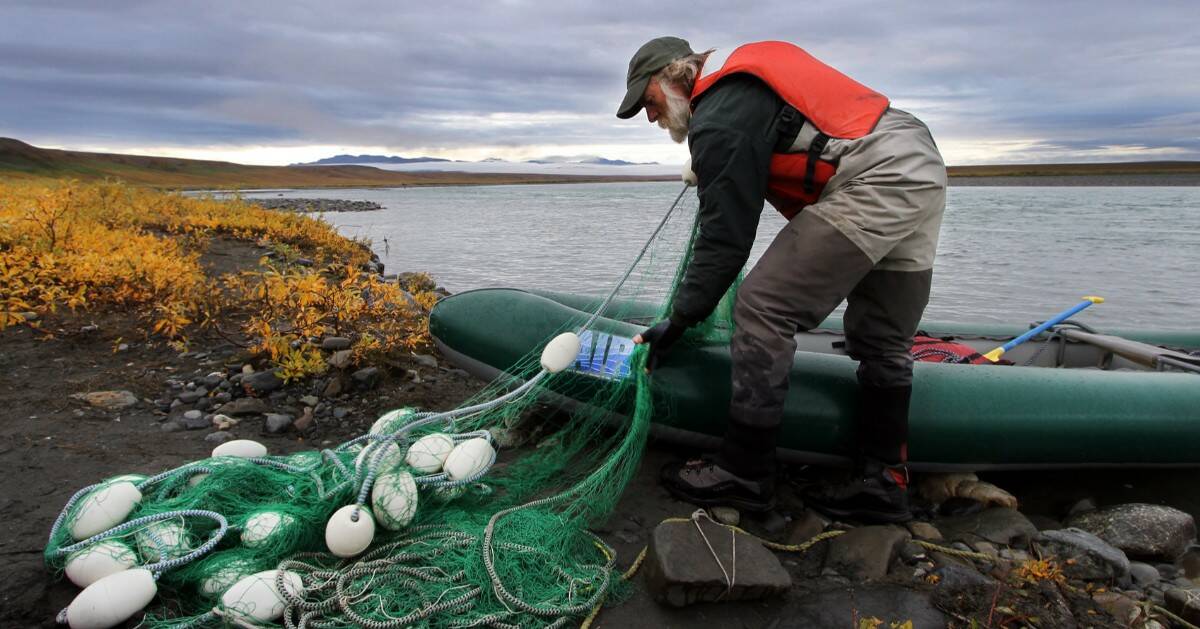
3. Fisheries biologist Randy Brown of the U.S. Fish and Wildlife Service in Fairbanks handles a net used for dolly varden trout in northern Alaska. Photo by Katrina Liebich.
