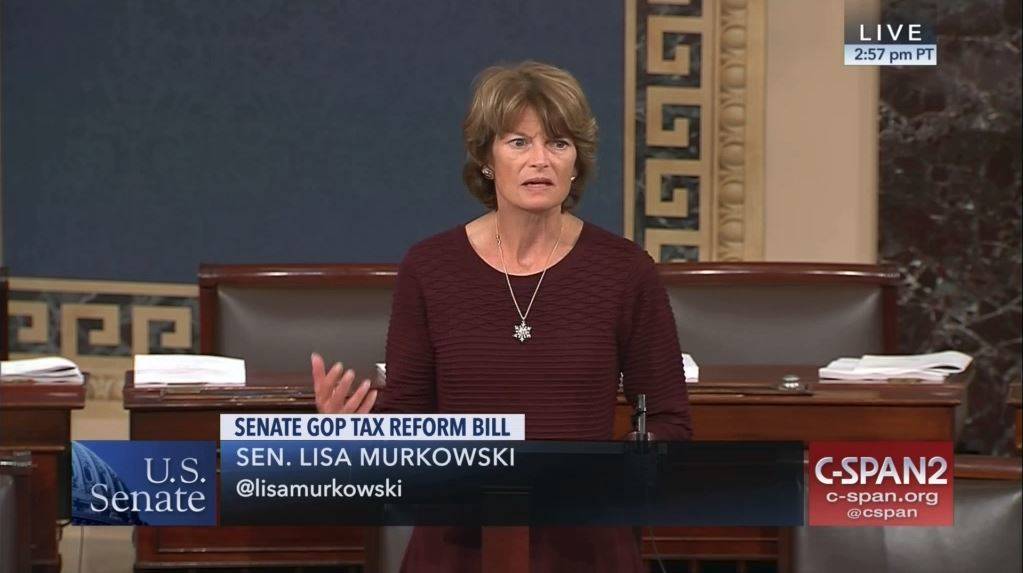
Image from C-SPAN video  Sen. Lisa Murkowski, R-Alaska, speaks on the floor of the U.S. Senate on Thursday.

Image from C-SPAN video Sen. Lisa Murkowski, R-Alaska, speaks on the floor of the U.S. Senate on Thursday.

When the sparrow meets the horse

  • By THE JUNEAU EMPIRE EDITORIAL BOARD
  • Friday, December 1, 2017 7:15am
  • Opinion

We’ve been thinking a lot about Ronald Reagan this week.

We’ve also been thinking about William Jennings Bryan.

Back in 1980, when Reagan became president, he promoted the idea of trickle-down economics. It’s the notion that if you cut taxes on the rich, they’ll invest their newfound savings. Businesses will have more money for expansion and higher wages, so the tax break gets passed down to everyone in the country.

It wasn’t a new idea.

Back when William Jennings Bryant was running for president as a Democrat in 1896, his Republican rival, William McKinley (whose name was attached to a mountain around here) had the same idea.

Bryant didn’t buy McKinley’s theory. Bryant’s allies referred to McKinley’s idea as the “horse and sparrow theory.”

If you feed a horse enough oats, some of those oats are going to pass through the horse and become food for the sparrows.

That analogy’s been rattling around this week as we watch the U.S. Senate move toward a vote on a sweeping tax cut for the rich. Sure, there’s some cuts for us sparrows, but most of the oats are going to the horses.

We’re looking at a tax bill that will cost federal taxpayers more than $1.4 trillion over the next decade. Most of that money will go to people making more than $100,000 per year. Both figures come from the nonpartisan Congressional Budget Office.

U.S. Sen. Dan Sullivan, R-Alaska, points out that tax cuts will boost the nation’s economy, and we don’t argue with him there. We’d simply point out that the boost doesn’t in any way equal what this tax cut will cost. Horses eat a lot, after all.

According to Congress’ own Joint Committee on Taxation, the boost is only equivalent to about $400 billion over the next decade. That leaves Americans $1 trillion in the hole.

Sullivan thinks there will be a bigger boost, but he hasn’t shared his figures.

We’re not opposed to federal spending or federal deficits, but we are opposed to them when we think they’re wrongheaded.

For the cost of this tax bill, you could give every American household (all 126 million of them) $1,000 per year for a decade, and provide free college tuition for every high school student during that decade.

You could fund a universal national healthcare system. You could buy 26 Mars missions under NASA’s current funding schedule.

You might even be able to pay for a year of the War on Terror.

This bill isn’t all bad, of course.

Sen. Lisa Murkowski, Alaska’s senior U.S. senator, did a nice job inserting a pro-Arctic drilling provision into the tax measure, and it’s an idea that would benefit Alaska significantly.

The problem is that Murkowski’s effort is frosting on a much larger cake. Now that we’ve seen what the cake is made of, you’ll have to forgive us if we don’t take a bite.

More in Opinion

Web
Have something to say?

Here’s how to add your voice to the conversation.

Construction equipment operating at night at the White House. (photo by Peter W. Stevenson/The Washington Post)
Opinion: Gold at the center of power

What the White House’s golden ballroom reveals about Modern America

veggies
File Photo 
Community organizations that serve food at their gatherings can do a lot by making menus of whole, nutritious offerings according to health and wellness coach Burl Sheldon.
Food served by “groups for good” can be health changemakers

Health and wellness coach thinks change can start on community event menus

Win Gruening (courtesy)
Opinion: Affordability message delivered to Juneau Assembly; but will it matter?

On October 7, frustrated voters passed two ballot propositions aimed at making… Continue reading

Alaska Children’s Trust Photo
Natalie Hodges and Hailey Clark use the online safety conversation cards produced by the Alaska Children’s Trust.
My Turn: Staying connected starts with showing up

When our daughter was 11 and the COVID lockdown was in full… Continue reading

Telephone Hill as seen from above (Photo courtesy of City and Borough of Juneau)
Letter: For Telephone Hill, remember small is adaptable

Writer finds the finances don’t add up on planned development

Doug Mills/The New York Times 
President Donald Trump disembarks the USS Harry S. Truman before delivering remarks for the Navy’s 250th anniversary in Norfolk, Va., Oct. 5, 2025.
Opinion: Trump’s job is done

The ultra-rich have completed their takeover of America.

Google Maps screenshot
The star shows the approximate location of the proposed Cascade Point Ferry terminal by the Alaska Department of Transportation & Public Facilities in partnership with Goldbelt, Inc.
Opinion: An open letter to Cascade Point ferry terminal proponents

To: Governor Dunleavy, DOT Directors, and Cascade Point ferry terminal project consultants,… Continue reading

My Turn: Supreme Court decision treats Alaskans with mental illness worse than criminals

A criminal in Alaska who’s in custody must be presented with charges… Continue reading

Win Gruening (courtesy)
Gratitude for our libraries, museums and historians

The thanksgiving weekend is a chance to recognize those who preserve local history

photo by Peter W. Stevenson / The Washington Post 
President Donald Trump on Oct. 24.
Opinion: ‘Hang them,’ Trump said

A president’s threat against Congress and the duty of Alaska’s delegation.

Google Maps screenshot 
The star shows the approximate location of the proposed Cascade Point Ferry terminal by the Alaska Department of Transportation & Public Facilities in partnership with Goldbelt, Inc.
My Turn: Cascade Point terminal would not be efficient

I have enjoyed traveling on the Alaska State Ferries over the years… Continue reading