
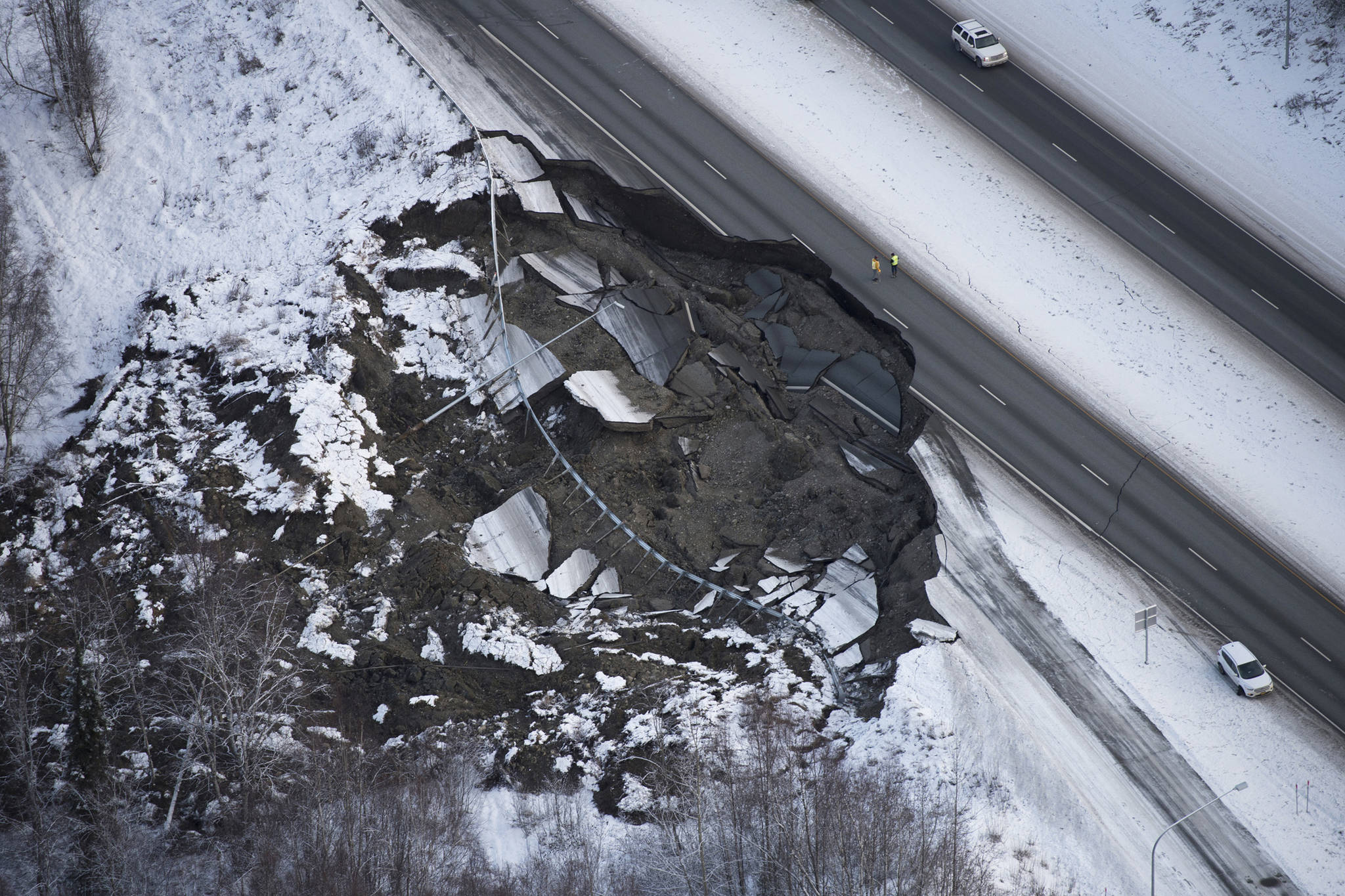
Most will agree that “Anchorage did this right,” as Mayor Ethan Berkowitz beamed after last week’s earthquake. But his suggestion “people around the country and around the world” will want to follow the city’s building codes and response training is Alaskan pride talking. Because much of what the state’s professionals learned about designing and preparing for these events came from full scale, real life earthquake laboratories like the state of California.
Recognizing that might help us look in the same direction for leadership in addressing climate change.
In 1988, while working for the Washington State Department of Transportation (WSDOT), I was tasked with performing a preliminary study of the seismic vulnerability of highway bridges along the Puget Sound corridor. I began by reading damage assessments from more than a dozen earthquakes around the world.
A piece of trivia that shaped my understanding about WSDOT’s reluctance to ask the legislature to fund serious research relates to the tsunami following the 1964 Alaskan Earthquake. It destroyed more bridges in Washington than the combined effects of 6.7 earthquakes that shook Puget Sound in 1949 and 1965.
I’m not implying WSDOT wasn’t committed to state-of-the-art seismic design. But having been spared severe damage and significant loss of life from those earthquakes meant it hadn’t developed the expertise. Which is why the project was assigned to a junior engineer such as me.
For similar reasons, Alaska wasn’t a leader either. Except for the 1964 earthquake, the rest had occurred well offshore or in remote, sparely populated regions.
Not so in California. The much more densely populated state had experienced eight catastrophic earthquakes between 1940 and the year I began my study. It’s where, in 1949, to address the growing risk to life and property, the Earthquake Engineering Research Institute (EERI) was founded. Today, with its worldwide membership that includes a small Alaskan chapter, EERI is one of the premiere research centers focused on advancing the science and practice of earthquake engineering.
Alaska building codes get upgraded every three years based on the discoveries made by organizations like EERI. Every change means higher construction costs. But that’s been accepted as far superior to spending the money later on massive relief efforts and reconstruction.
Now, California is taking a similar approach to climate change. Despite it adding $10,000 to the construction of new homes, the state is requiring most of them be equipped with solar panels. And electric utilities are supposed to start transitioning away from fossil fuels plants to ones generating power from renewable energy sources.
Unfortunately, the federal government and most states are dragging their feet on climate change. They’re enabled by polling that shows even though almost two-thirds of Americans believe global warming is caused by human activities, less than half think it will become a serious problem in their lifetimes. And marching alongside their apprehension about the immediate cost of reducing the fossil fuel emissions are politicians who prioritize free market economics and smaller government over environmental health and sustainability.
There would have been a lot more damage in Anchorage last week had similar arguments prevailed on the question of seismic safety. The state would have been heavily criticized for having codes that were too lax. And no matter who the politicians and news media chose as scapegoats, it would bring no consolation to the hundreds, perhaps thousands of families who lost loved ones.
Given how much of Anchorage was destroyed by the 1964 earthquake, it seems obvious that Alaska’s leaders had the foresight to choose the right path. But the scenario I alluded to above could have happened if trust in the country’s scientific institutions was the political football that it is today. And if the government’s role in public safety had already been labeled a socialist barrier to private sector growth and innovation.
What made it possible for Anchorage to limp away from last week’s quake with no fatalities and relatively little damage is a story bigger and older than the state of Alaska. We need to show our appreciation to the scientists, engineers and Californian officials who led the way. And while we’re looking south to thank them, we might just discover the unsung heroes our children and grandchildren can someday thank for having the foresight to tackle climate change.
• Rich Moniak is a Juneau resident and retired civil engineer with more than 25 years of experience working in the public sector. He contributes a weekly “My Turn” to the Juneau Empire. My Turns and Letters to the Editor represent the view of the author, not the view of the Juneau Empire.
