
To the People of Alaska,
For the past two years, Alaskans have been engaged in a robust discussion about the future of education in our state. At the heart of this conversation is a simple but powerful truth: Alaska’s traditional public education system is failing too many of our children. State assessment data and national rankings reflect this reality. Alaskan parents, both in rural and urban communities, recognize this and are increasingly choosing public education alternatives that give them more control over how and what their children learn.
Failure to adapt and innovate is harming public education
Changing demographics, advances in technology, increasing demand for flexibility from families, and growing distrust in the traditional public school model have all contributed to declining enrollment in neighborhood schools. Statewide, we now have fewer students today than we did 20 years ago. Some school districts have seen enrollment drop by 30% or more. This trend is not unique to Alaska; it is happening throughout the country.
Yet, many school boards and administrators appear to be more focused on keeping every school building open, every job intact, and every overhead cost unchanged instead of improving student outcomes. The idea that consolidating school buildings to adjust for fewer students might be necessary is treated as political heresy, even though we would never operate any other public service or private business this inefficiently.
Leading the fight against innovation and change are special interest groups that are wrongfully committed to the status quo. Organizations such as the Alaska Association of School Boards (AASB), NEA-Alaska (the state’s largest teachers union), and the Alaska Council of School Administrators (ACSA) continue to demand more funding even as enrollment declines and student achievement consistently ranks among the lowest in the nation.
Rather than meet the moral obligation and legal responsibility to improve student learning through innovation and flexibility, these organizations oppose reforms that would expand educational options for families. Their continued resistance raises an important question: Is the primary goal to improve educational outcomes for Alaska’s students, or to preserve the existing system? During a recent school board meeting, the superintendent of the state’s largest district stated that his goal was to “save jobs,” reinforcing the concern that the needs of students are being overshadowed by efforts to protect the status quo at all costs.
Options strengthens public schools by increasing enrollment and outcomes
While traditional public school enrollment has steadily declined, homeschooling and charter school enrollment have surged across Alaska. These models are public, not private, and are staffed by certified public school teachers and administrators. Many families are choosing public education alternatives over “traditional neighborhood schools” for a whole host of reasons. Some want different options because they know their children are not reading at grade level, are not proficient in math, and are not being prepared for life after high school. Others seek learning environments that better align with their values, accommodate medical needs, or unique family schedules.
Despite ongoing concerns about student outcomes in our traditional neighborhood schools, a 2023 Harvard University study found that Alaska’s public charter schools deliver better educational results than any other charter school system in the nation, delivering significant learning gains in reading and math. This is especially true for Alaska’s non-white and low-income students. Given this success, one would expect education leaders to support expanding these models. Yet many school boards and education associations that claim to support local control often oppose the growth of public charter schools — even when those schools are developed and led by public educators and families from their own communities. For those focused on student achievement, this contradiction is a real head-scratcher, especially when the data show these alternative school models are producing stronger outcomes for Alaska students.
Why would the effort to allow additional charter school authorizers face opposition when charter schools have waitlists created by far more applicants than available seats and often require a lottery system for admission? Is it because alternative models threaten the power some have in the traditional brick and mortar neighborhood school system? Is it because the educational outcomes of alternative models might highlight how poorly too many students in neighborhood schools are performing? If equitable access is the concern, the solution is to expand these high-performing public-school options so that every family can choose the school that best fits their child’s needs.
One of the loudest attacks against choice in the past two years came from these same special interest groups claiming that certain statutes governing Alaska’s correspondence programs are unconstitutional. They filed a frivolous lawsuit creating turmoil for thousands of families throughout the state, which had the potential to upend the education choices of over 20,000 Alaskan students. This lawsuit was nothing more than an effort to restrict a legal public education option and attempt to force families into neighborhood schools.
The good news is that in July 2024, the Alaska Supreme Court gave a unanimous opinion that our homeschool laws are constitutional, confirming what many educators and parents already knew: education funding belongs to students, not to the special interests. It was a victory for parental rights and educational freedom.
There are some education leaders who recognize that the key to a thriving school district in their community is to meet the demands of their customers, their parents, and students. They continue to support charter school applications and develop homeschool and blended learning models that attract families. They see the trends and are exploring creative education solutions that offer the flexibility that families want because they know that any choice away from their district reduces funding.
We commend these school district leaders for their efforts. Rather than presenting themselves as victims, like the special interests focused on preserving the status quo, they have embraced the reality that attracting families requires strong schools and responsive programs. As a result, they have increased enrollment and, in turn, increased funding. Their innovation and leadership should be a model for other school districts in Alaska.
Strong policy and targeted funding drive better results
Alaska spends more per student than most states in the nation — over $21,000 per student annually, and significantly more in some rural districts. Yet our academic results are among the lowest in the nation. According to the most recent NAEP data, fewer than 25% of Alaska fourth graders are proficient in reading and less than 20% of eighth graders are proficient in math. Alaska consistently ranks last, in combined educational achievement.
Some opponents of education reform continue to argue that Alaska’s public schools are struggling due to inadequate funding from the state. They continue to call for more funding without clearly explaining how it will lead to better outcomes. However, the claim that state funding has been cut is not supported by the facts.
Since 2019, total state funding for public education has increased by nearly $1.5 billion. Despite this substantial investment, Alaska’s performance in reading remains near the bottom nationally. The recently approved $500 increase to the base student allocation is the largest since the funding formula was established. Still, even the Anchorage Daily News editorial board warned against increasing the BSA without structural reform, noting, “But simply rubber-stamping a large BSA increase doesn’t make sense — Dunleavy and like-minded legislators rightly mistrust school districts’ tendency to grow administration with money meant for the classroom.”
Clearly, funding alone is not a solution. If it were the solution, there would be no need for this education discussion. In its 2005 Moore v. State opinion, the Alaska Supreme Court pointed out that simply increasing the flow of money into a system with poor outcomes does not fulfill the state’s constitutional duty. The Court emphasized that student achievement, not dollars alone, must be at the center of Alaska’s public education mission. Those advocating for more funding without reforms to improve educational outcomes are ignoring a constitutional mandate.
The Reads Act passed and signed in 2022 is an example of how strong policy combined with targeted funding improves results. The Reads Act is a reading intervention and early literacy law designed to address our catastrophic reading proficiency numbers. The law emphasized tools supported by decades of research such as phonics-based instruction, screening for reading difficulties, and early intervention.
But getting this common-sense legislation passed was no easy task because of those who wanted to protect the status quo. As a matter of fact it only passed by one vote. The Reads Act is a clear example of how strong policy, paired with targeted funding, leads to measurable improvement in student outcomes. In the first two full years of implementation, Alaskans primary grade readers exceeded the national growth rate in early literacy outcomes.
A message to parents and students
Some might be asking, “So what’s the point of communicating all of this to the people of Alaska?” We believe it is necessary to communicate directly with Alaskans so that you better understand our experience as educators and what we believe is the best way to improve results. Together, we have over 50 years of experience in both rural and urban public schools in Alaska. We were teachers, principals, and superintendents. We are certainly not anti-education as opponents of education reform would like you to believe. We know what works and what does not. More funding for education without strong, learning-centered policy will not improve student outcomes, but targeted funding and reforms will.
We’re pro teacher because we were teachers, and we know that Alaska has thousands of great teachers. We know that retaining and recruiting the best teachers is necessary to improve education results. We proposed additional pay for teachers (which their own union opposed) to keep and attract the best for your students. We are pro children and are both parents ourselves. We worked in public schools, sent our children to public schools, and desire that all children have access to the best education possible.
The reforms for which we were advocating during this past legislative session and will continue to fight for are supported by a significant majority of Alaskans. We all recognize that our current system is not providing the education that many of our young people need and deserve. If states like Mississippi can achieve stronger academic outcomes despite significantly higher poverty rates — where even their lowest-income students outperform many students in Alaska’s urban districts — then Alaska can and should do the same.
The hysterical reactions from some education leaders, such as the superintendent of the Anchorage School District, are merely rhetoric that distract from the urgent need for reform. The partial veto of the BSA increase was carefully considered and necessary given falling oil prices resulting in less funding available. The partial veto represented a 1% reduction to the district’s overall budget — approximately $4.5 million — which, according to the district’s own finance director, could be covered through attrition or the more than $40 million the district has in reserves from the 2024–2025 school year alone.
Rest assured that regardless of what you hear from your local school district, class sizes will be reasonable, teachers will teach, and school activities will continue. It is also important to understand that while the Legislature and governor determine overall education funding, local school districts decide how that funding is spent. Some make better decisions about how to spend those resources than others.
State revenue remains uncertain, and in good conscience, no one should approve a blank check to a system where more than 65% of rural and urban students are not meeting grade-level expectations. Rather than continue to take the PFD from teachers, families, students saving for college, and the elderly, to fund the status quo, we must tie any future funding increases to meaningful reforms. Education in Alaska should be about achievement, not just appropriations.
To the school boards, unions, and administrators who are ready to partner in real reform: Our door is open. To those who argue that our proposals will not work — despite clear evidence of success in other states, we ask: Can you provide Alaskans with data, not just rhetoric? Please understand this, if you continue to block policies that improve outcomes for kids, the people of Alaska will go around you by continuing to remove their children from your schools and school districts.
We have been told by the special interest groups that oppose education reform to give up because we are outnumbered. That the will to fight for better education outcomes is a “fool’s errand” and we should just move on. If anything, we say the fight has just begun because we have a moral imperative to improve public education. We owe our children more than what the system is currently offering. They deserve a future full of opportunity, literacy, and success. And we will not rest until that becomes the reality for every student in every part of our great state.
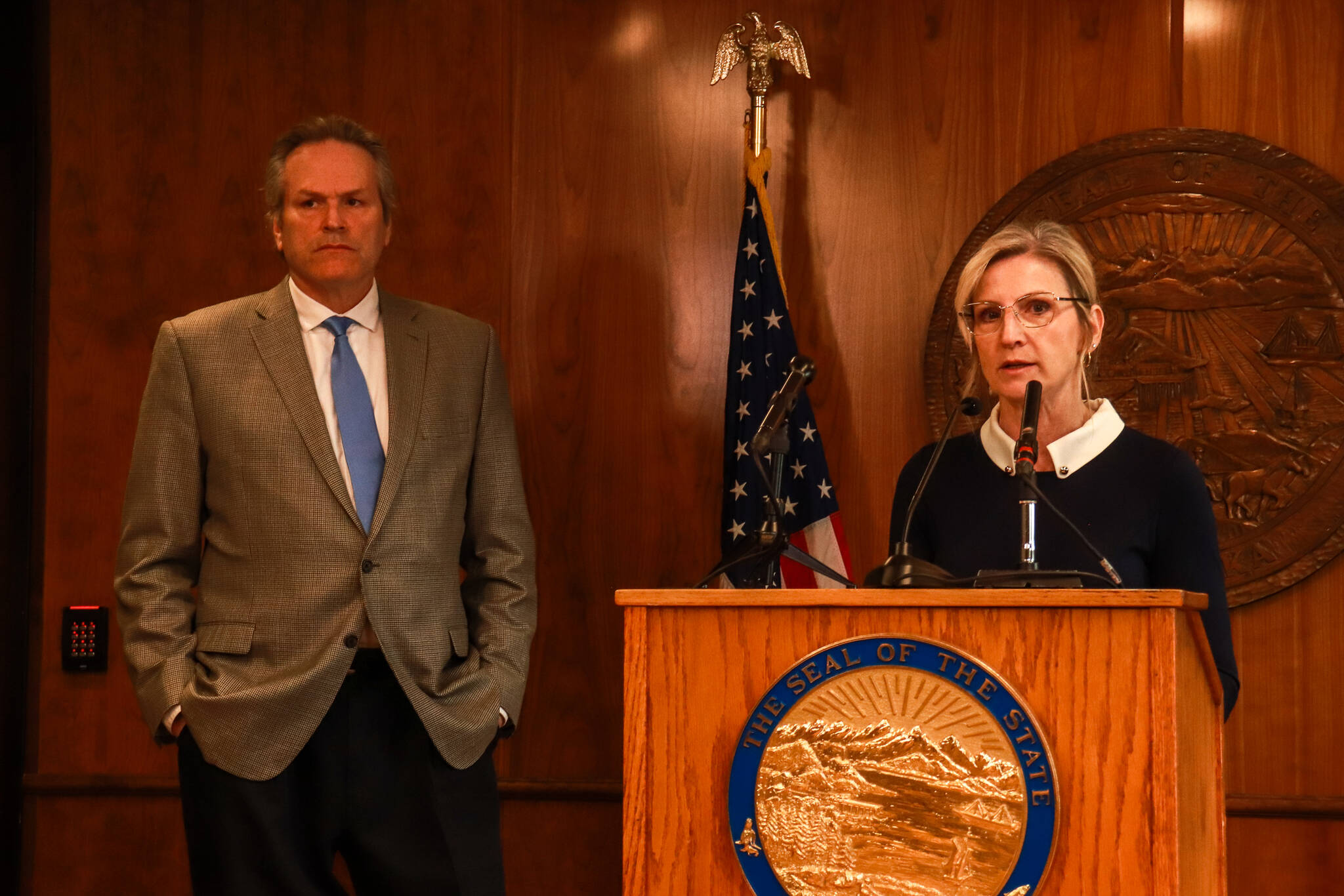
Mike Dunleavy is the 12th governor of Alaska. Deena Bishop serves as the commissioner of the state Department of Education and Early Development.
