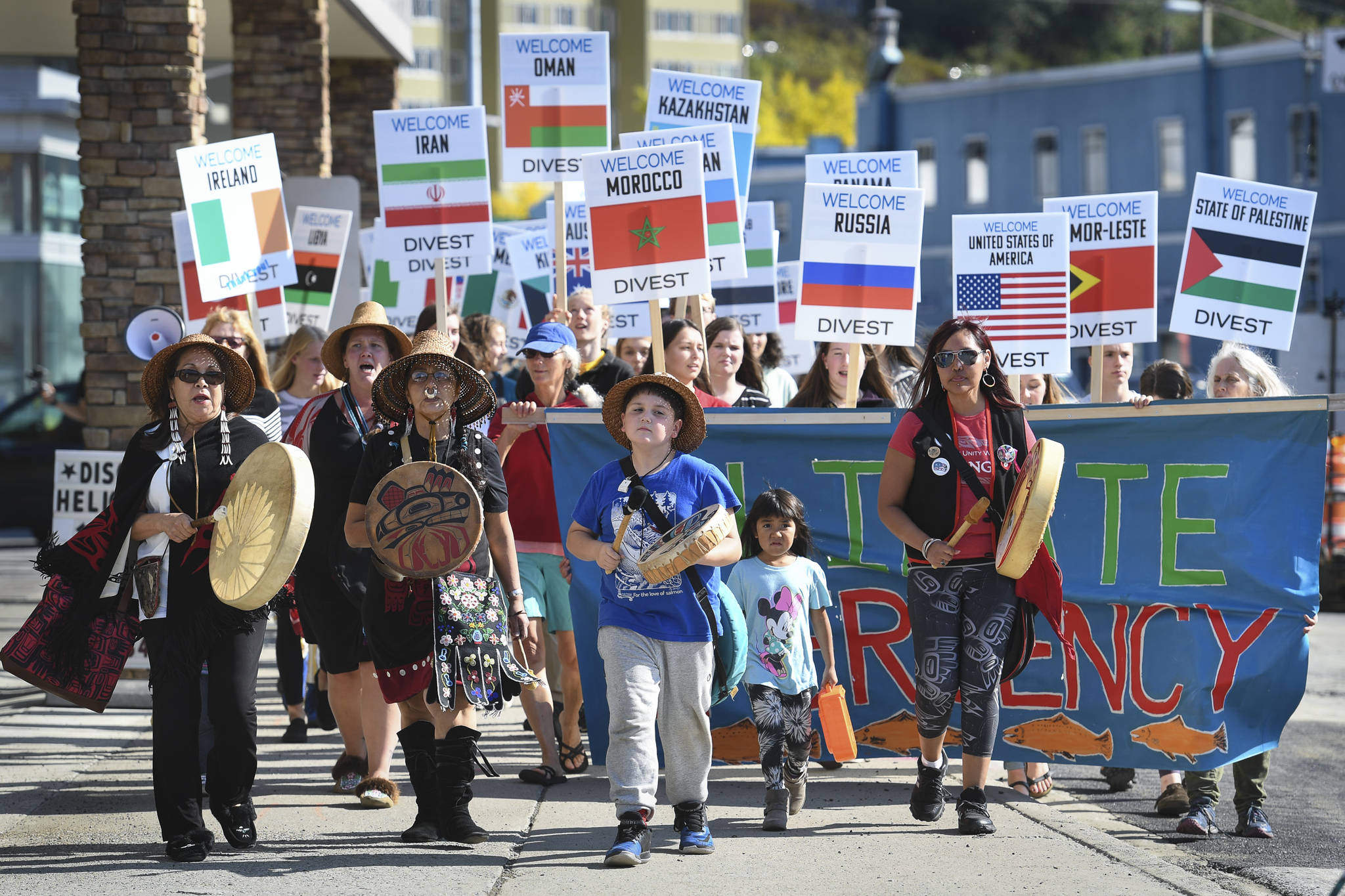
Juneau students and residents, led by members of the Yees Ku Oo Dance Group, march to Centennial Hall during a “Stand Strong for Climate” rally on Tuesday, Sept. 10, 2019. The International Forum of Sovereign Wealth Funds is holding four days of meetings at Centennial Hall. The rally was organized by 350Juneau, a local chapter of an international climate advocacy movement, 350.org. (Michael Penn | Juneau Empire File)

Juneau students and residents, led by members of the Yees Ku Oo Dance Group, march to Centennial Hall during a “Stand Strong for Climate” rally on Tuesday, Sept. 10, 2019. The International Forum of Sovereign Wealth Funds is holding four days of meetings at Centennial Hall. The rally was organized by 350Juneau, a local chapter of an international climate advocacy movement, 350.org. (Michael Penn | Juneau Empire File)

Opinion: COVID-19 offers lessons and hope, if we act smart

  • Tuesday, April 21, 2020 9:42am
  • Opinion

In the midst of this unprecedented pandemic, I am finding a small amount of hope in the fact of spring. Here in Juneau, we’re hearing the first songs of the year: dark-eyed junco, sooty grouse, and varied thrush. Seedlings are starting on my windowsill. As Bill McKibben writes, a key lesson of coronavirus is that the world is still a physical place, even if we now interact with it mostly through screens. We are still enmeshed in the web of life, however much we pretend otherwise: dependent on its bounty, lost without its clean air and water, vulnerable to its pathogens. Luckily, we are also nourished by its beauty, and experts tell us that during this pandemic, we can still go for a hike in the mountains or a ramble down to our local park — just stay six feet apart.

Our hearts go out to those who have lost loved ones or livelihoods. Here in Southeast Alaska, the tourism industry has ground to a halt before the season ever started, and seafood prices are plummeting amid a global recession. Everything is changed right now. The big question is, when this is over, will we stay mired in the status quo — where a handful of billionaires control more wealth than half the planet, our communities are fractured by inequity, the climate continues to worsen, and the already vulnerable are continually placed on the front lines — or will this emergency shake us into building a better world?

Perhaps the most salient lesson of coronavirus is a renewed sense of the possible. Nations around the world, from South Korea to the Netherlands, have shown they are capable of drastic and immediate intervention in the face of crisis. Those successful interventions have been early, swift, centralized, and people centered. Nations that aren’t meeting these criteria, a list that unfortunately includes the United States, are suffering disproportionately. We are fortunate to have mostly strong leadership here in Alaska to control the spread of COVID-19. But like climate change, COVID-19 is not a crisis we can escape alone, we must address it together, globally, or it will continue to haunt us.

The COVID-19 Pandemic is both a test of, and a lesson in, our ability to cope with crisis. Like climate change, it is both too big and overwhelming to fully understand, yet gut-wrenchingly personal once it is perceived. Both crises demand the same fundamental responses. They demand strong, resilient communities. They demand clean air to breathe and clean water in every home. They demand universal healthcare and strong labor movements, and governments that prioritize people over profits. They require us to ask: will our response to today’s crisis make us more resilient for the crisis of tomorrow? Or will it make us more dependent on old, brittle systems? Will we double down on dirty fossil fuels or invest in a future of clean energy? Do we concede that healthcare is a business or insist that it is a human right? Will we prioritize the practice of democracy or the development of coal mines? These are questions we will have to face in the coming months, and if we have learned anything from the COVID-19 pandemic the answers should be clear.

This pandemic is the defining moment of a generation, and our response to the crisis of today will shape our future for years to come. It’s already shaping how our response to the (arguably larger) crisis of climate change will play out over the coming years. As I look out the window at the thawing landscape around me, and see the first signs of spring, I also see a cause for hope. If we seize the full potential of this moment, we have the opportunity to kill two viruses with one vaccine.

• Suzanne Cohen is a member of grassroots climate group 350Juneau. Columns, My Turns and Letters to the Editor represent the view of the author, not the view of the Juneau Empire.

More in Opinion

Web
Have something to say?

Here’s how to add your voice to the conversation.

Doug Mills/The New York Times 
President Donald Trump disembarks the USS Harry S. Truman before delivering remarks for the Navy’s 250th anniversary in Norfolk, Va., Oct. 5, 2025.
Opinion: Trump’s job is done

The ultra-rich have completed their takeover of America.

Google Maps screenshot
The star shows the approximate location of the proposed Cascade Point Ferry terminal by the Alaska Department of Transportation & Public Facilities in partnership with Goldbelt, Inc.
Opinion: An open letter to Cascade Point ferry terminal proponents

To: Governor Dunleavy, DOT Directors, and Cascade Point ferry terminal project consultants,… Continue reading

My Turn: Supreme Court decision treats Alaskans with mental illness worse than criminals

A criminal in Alaska who’s in custody must be presented with charges… Continue reading

Win Gruening (courtesy)
Gratitude for our libraries, museums and historians

The thanksgiving weekend is a chance to recognize those who preserve local history

Google Maps screenshot 
The star shows the approximate location of the proposed Cascade Point Ferry terminal by the Alaska Department of Transportation & Public Facilities in partnership with Goldbelt, Inc.
My Turn: Cascade Point terminal would not be efficient

I have enjoyed traveling on the Alaska State Ferries over the years… Continue reading

photo by Peter W. Stevenson / The Washington Post 
President Donald Trump on Oct. 24.
Opinion: ‘Hang them,’ Trump said

A president’s threat against Congress and the duty of Alaska’s delegation.

Telephone Hill as seen from above. (photo courtesy of City and Borough of Juneau)
My Turn: Telephone Hill Concept C vs Concept D – could we see Pro Forma?

It is standard that before a municipality undertakes a construction project for… Continue reading

Sen. Dan Sullivan, R-Alaska, speaks during a Senate Armed Services Committee hearing on Capitol Hill on March 7 in Washington. (AP Photo/Carolyn Kaster)
Opinion: Senator Sullivan supports $500,000 Grift

A hidden clause in Congress’s spending bill turns public service into personal profit.

Win Gruening (courtesy)
Opinion: Sen. Dan Sullivan – promises made, promises kept

The senator has promised and delivered on red-tape slashing solutions

U.S. Rep. Nick Begich III, R-Alaska, addresses a joint session of the Alaska Legislature. (Mark Sabbatini file photo)
My Turn: Sullivan and Begich Will Lose in 2026

Supporting Trump’s Agenda Is Highly Unpopular… Even in Alaska

The star shows the approximate location of the proposed Cascade Point Ferry terminal by the Alaska Department of Transportation & Public Facilities in partnership with Goldbelt, Inc. (Google Maps screenshot)
My Turn: The case against Cascade Point Ferry Terminal

I am writing to say that I think the State of Alaska’s… Continue reading