
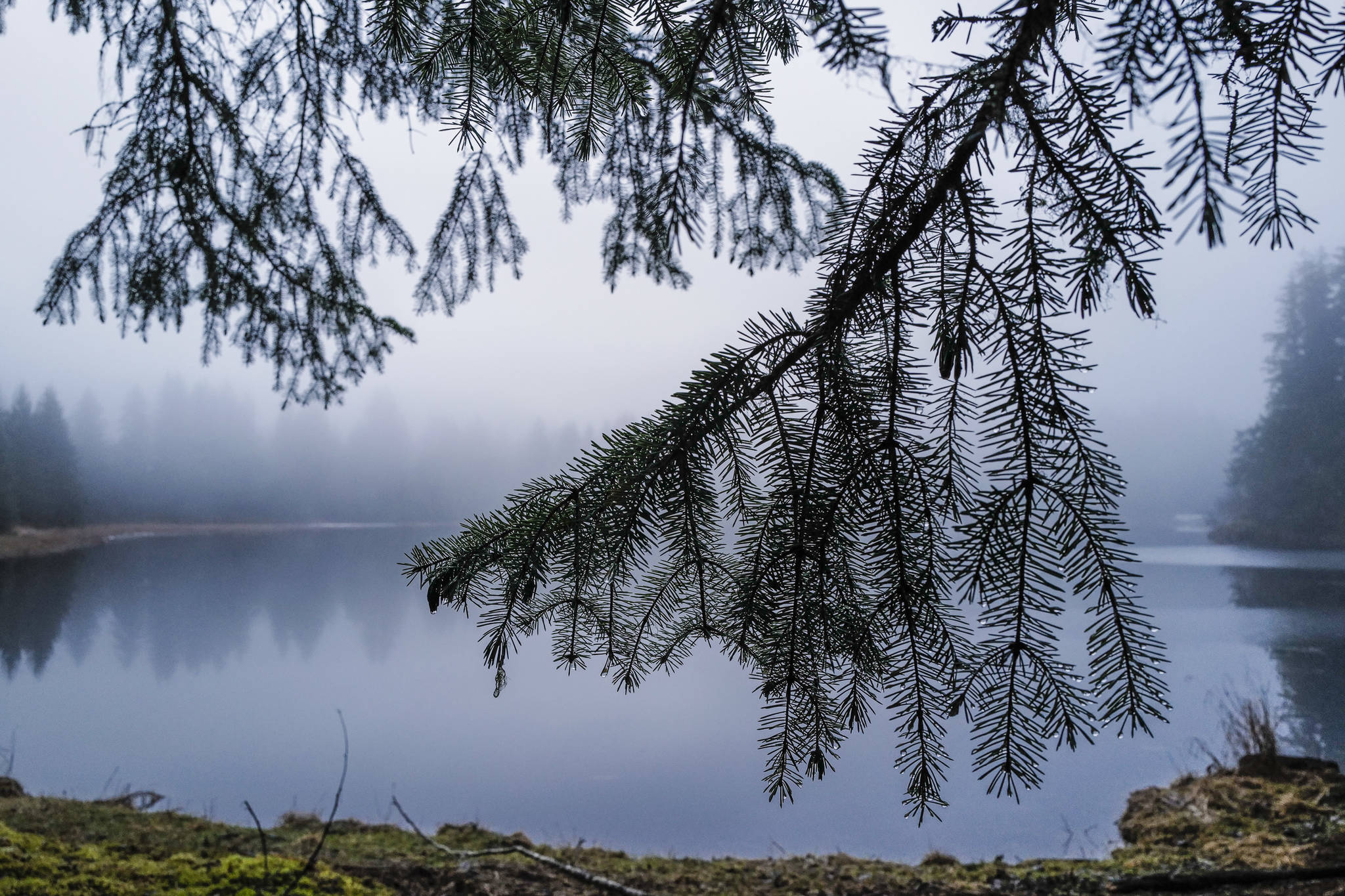
Spruce boughs hang near a pond in the Tongass National Forest on Monday, Dec. 9, 2019. (Michael Penn | Juneau Empire)

Spruce boughs hang near a pond in the Tongass National Forest on Monday, Dec. 9, 2019. (Michael Penn | Juneau Empire)

Opinion: A tale of two forests

Old-growth forests differ from second-growth in terms of wildlife habitat

  • By Mary F. Willson and Katherine M. Hocker
  • Friday, December 13, 2019 7:00am
  • Opinion

The My Turn by Wayne R. Nicolls, published in the Empire Dec. 5, states that “Old-growth has limited value as habitat. It provides cover, very little forage…”

Research has shown that, indeed, old-growth forest can provide cover (e.g., for wintering deer). Furthermore, the big trees intercept lots of snow, creating snow-free patches under the trees where understory plants (such as bunchberry, goldthread, five-leaf bramble, and blueberry) actually provide more deer forage than is available in most second-growth.

But deer are just one species; what about other wildlife?

Old-growth forest provides a variety of resources that second-growth lacks. The cone crops on mature trees support birds and squirrels. The dying and dead trees bemoaned by Nicolls are fine places for nesting woodpeckers and chickadees. When those old trees fall, the logs add structure to the understory, which is useful for cover and foraging for wrens and small mammals; stumps and logs can provide favorable habitat features for red-backed voles and marten. Marten and flying squirrels generally occur in higher densities in old-growth forest than in second-growth, because more food, nesting sites (tree cavities for the squirrels), and winter resting sites (decaying stumps and logs for marten) are available.

Large fallen trees also open up a gap in the canopy—a light gap that allows the growth of deciduous shrubs, including berry bushes whose fruits feed bears, marten, some small mammals, and many birds. A good-size light gap may encourage occupation by sparrows and other birds that like that kind of habitat. In short, the heterogeneity of old-growth forest fosters wildlife diversity.

In contrast, young post-clearcut second-growth forest is low in diversity and wildlife. The even-aged trees form a dense, closed canopy that blocks sunlight, so critical understory food plants are scarce. Habitat diversity is severely limited: standing-dead trees are rare or absent; light gaps are typically absent; decaying logs are scarce; shrubs for nest sites of some birds are rare. These conditions are not good for wildlife, which is one reason why forest managers sometimes thin second-growth stands.

A walk through an old-growth forest and a walk through young second-growth forest are two entirely different experiences for anyone that pays attention to the surroundings. Research has documented the obvious (and some not-so-obvious) differences between the two kinds of forest in the value for wildlife.


• Mary F. Willson is a retired professor of ecology, with many years of research experience, who lives in Juneau. Katherine M. Hocker is a naturalist, with many years of exploring the Tongass forest, who lives in Gustavus. Columns, My Turns and Letters to the Editor represent the view of the author, not the view of the Juneau Empire.


More in Opinion

Web
Have something to say?

Here’s how to add your voice to the conversation.

Photo by Nathaniel Herz/Northern Journal
Text messages between Alaska Gov. Mike Dunleavy and President Donald Trump.
Commentary: Alaska’s governor said he texts Trump. I asked for copies.

A couple of months ago, I was reporting on the typhoon that… Continue reading

Faith Myers stands at the doors of the Alaska Psychiatric Institute in Anchorage. (Photo courtesy Faith Myers, file)
Alaska’s system of protecting Trust beneficiaries is 40 years behind best practice

The lower 48 has a 3-century headstart on protecting people in locked psychiatric facilities.

veggies
File Photo 
Community organizations that serve food at their gatherings can do a lot by making menus of whole, nutritious offerings according to health and wellness coach Burl Sheldon.
Food served by “groups for good” can be health changemakers

Health and wellness coach thinks change can start on community event menus

Construction equipment operating at night at the White House. (photo by Peter W. Stevenson/The Washington Post)
Opinion: Gold at the center of power

What the White House’s golden ballroom reveals about Modern America

Win Gruening (courtesy)
Opinion: Affordability message delivered to Juneau Assembly; but will it matter?

On October 7, frustrated voters passed two ballot propositions aimed at making… Continue reading

Alaska Children’s Trust Photo
Natalie Hodges and Hailey Clark use the online safety conversation cards produced by the Alaska Children’s Trust.
My Turn: Staying connected starts with showing up

When our daughter was 11 and the COVID lockdown was in full… Continue reading

Telephone Hill as seen from above (Photo courtesy of City and Borough of Juneau)
Letter: For Telephone Hill, remember small is adaptable

Writer finds the finances don’t add up on planned development

Doug Mills/The New York Times 
President Donald Trump disembarks the USS Harry S. Truman before delivering remarks for the Navy’s 250th anniversary in Norfolk, Va., Oct. 5, 2025.
Opinion: Trump’s job is done

The ultra-rich have completed their takeover of America.

Google Maps screenshot
The star shows the approximate location of the proposed Cascade Point Ferry terminal by the Alaska Department of Transportation & Public Facilities in partnership with Goldbelt, Inc.
Opinion: An open letter to Cascade Point ferry terminal proponents

To: Governor Dunleavy, DOT Directors, and Cascade Point ferry terminal project consultants,… Continue reading

My Turn: Supreme Court decision treats Alaskans with mental illness worse than criminals

A criminal in Alaska who’s in custody must be presented with charges… Continue reading

Win Gruening (courtesy)
Gratitude for our libraries, museums and historians

The thanksgiving weekend is a chance to recognize those who preserve local history