
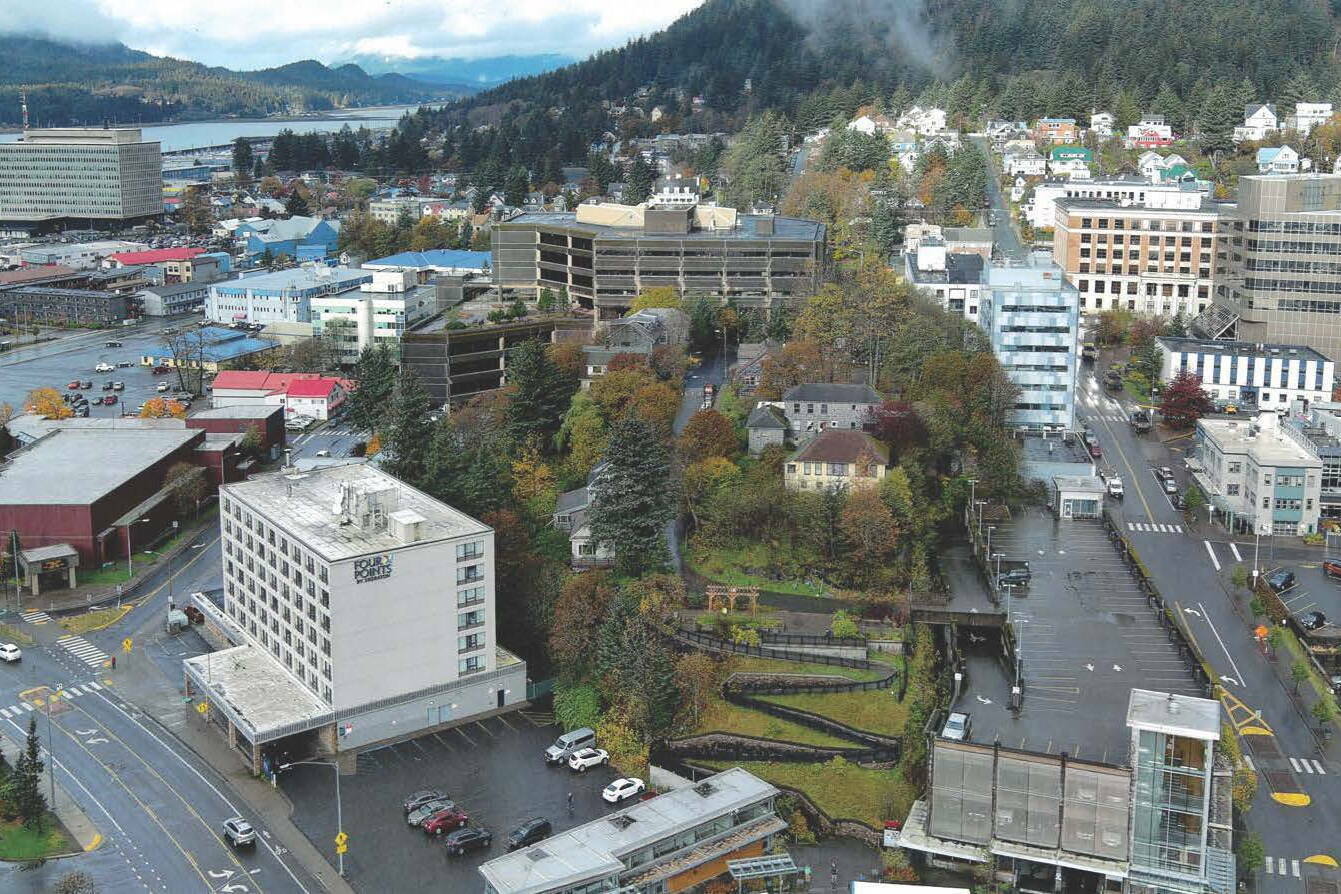
I applaud the City and Borough Assembly for a sincere desire to make meaningful improvements to Juneau’s housing crisis. Assembly members are pursuing a lofty goal: high density housing on Telephone Hill. Unfortunately reality shows this goal to be financially infeasible.
In 2023 the city engaged Leland Consulting Group to conduct a market analysis for Telephone Hill Redevelopment. In a section titled “Feasibility Analysis” the Leland Report states: “Despite the assumption that market rent would be significantly higher than is typical in the Juneau market, there is still quite a large feasibility gap in most scenarios. Assuming development costs between $450 and $550 per square foot, there is no scenario that breaks even. However, there are some scenarios that result in a funding gap of less than $100,000 per housing unit. In the scenarios that include short term rental units, the gap is less than $50,000 per housing unit in higher-rent, lower-cost scenarios.”
Please consider carefully what CBJ’s consultants said in 2023:
No scenario breaks even.
Only short term rentals (that can earn $5,000 per month) combined with high rents and lower construction costs can bring the feasibility gap to less than $50,000 per unit.
Development costs in 2026 and 2027 will be higher than $450-550.
No scenario broke even in 2023. Have construction costs gone down since 2023? Or perhaps rents have gone up? How confident are you in “high rents and lower construction costs?”
The Terner Center for Housing Innovation within the College of Environmental Design at the University of California, Berkeley publication titled “Making It Pencil: the Math Behind Housing Development – 2023 Update” explains that “underlying every housing project is a pro forma—the financial analysis a developer uses to estimate total development costs relative to projected income (e.g., the revenue from monthly rents or sales) in order to determine financial feasibility” and “regardless of building type, the financing principles of any new housing development are the same: any project must demonstrate the ability to meet an acceptable financial return in order to obtain the capital necessary to pay for the construction and operation of the project.” (p. 3)
The City and borough of Juneau hasn’t published a pro forma for Telephone Hill Redevelopment. Even without such an analysis, the Leland Consulting Group confidently stated, “there is no scenario that breaks even.” CBJ needs to publish the economic analyses that have been developed to date that have given the Assembly enough confidence to proceed on this project which they describe as “risky, but bold”.
There is still time within the current project schedule, to consider alternative development plans for Telephone Hill. Fairbanks recently held a seminar on incremental infill development that could be replicated in Juneau to look at our community wide housing crises through a new lens. Please review the attached brochure.
The team behind this seminar has a saying: “small is adaptable”, further explained: “Scale makes all the difference. The small-scale developer is limited by their size to a certain scope of project. They don’t have the team or the resources for mega-developments; they need to stick with small, simple buildings in a fairly concentrated area so they can easily keep an eye on things. Instead of large apartment blocks or a subdivision of single-family homes, small developers are more likely to build duplexes, triplexes, quadplexes, live-work buildings, backyard cottages etc. These buildings are too small for a conventional developer whose profits depend on an economy of scale. Small developers depend on economies of resourcefulness and relationships, and that economic model is what makes small developers so adaptable in times of trouble.” – https://www.incrementaldevelopment.org/philosophy
Infill and incremental development is the theme of the Telephone Hill Place Guide’s Concept D, which was tied in the survey with Concept C that is currently being pursued. Concept D is the only option that considers the existing site (and history) an asset rather than a liability. It offers substantially less risk through lower CBJ costs and future subsidies, and enhances Juneau through owner-developers rather than outside ownership.
Let’s bring the infill and incremental development seminar to Juneau and learn how to leverage local resources to address Juneau’s housing crisis.
Larry Talley
