
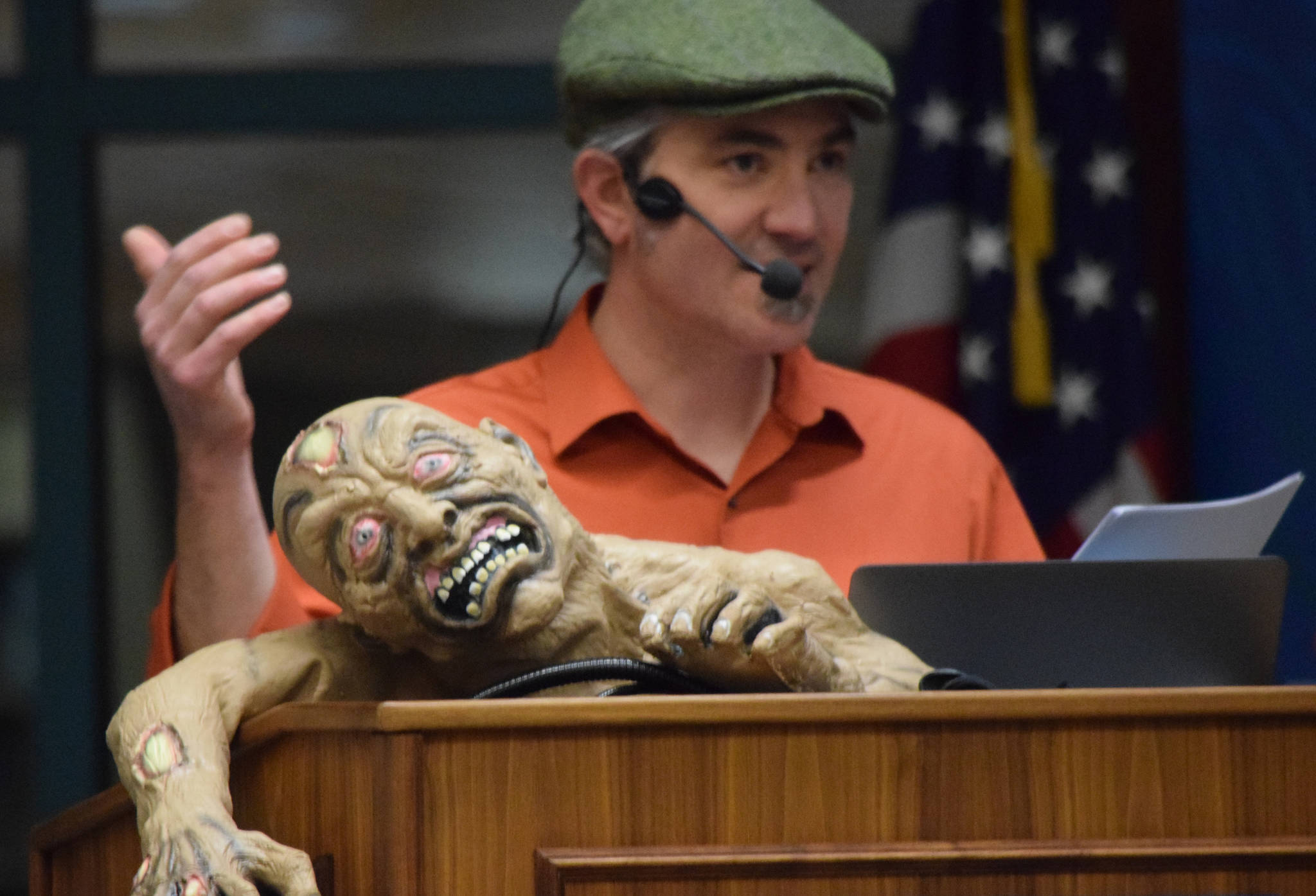
Mindless marauders with a taste for grey matter. Bloodthirsty, reanimated beasts intent on destruction. Gruesome, restless ghouls.
An allegorical commentary on the Vietnam War, capitalism and consumer culture?
To University of Alaska Southeast professor of English Dr. Sol Neely, zombies are all of these things and more.
Neely presented his public lecture “Zombies! A Monstrous Allegory in a Time of Disaster” at Friday’s Evening at Egan lecture at UAS.
Zombies occupy a unique position in American culture, he explained. On one level, they’re at the center of dangerous misrepresentations of voodoo practices in Haiti and the subject of a series of shameless exploitation films from the 60s, 70s and 80s.
But on another level, zombies in popular culture can be understood as a rich allegory for a laundry list of societal ills including war, famine and consumerism. Americans read zombie films and literature that are “already reading us,” Neely said.
Neely took George A. Romero’s landmark film “Night of the Living Dead” as an example.
Premiered in 1968, “Night of the Living Dead” is considered by many as the first modern horror film. Its depictions of carnage came at a time when Americans were dying by the thousands in Vietnam.
“Just as you see this awful carnage in black and white on TV, as you might see those images coming back from the Vietnam War,” Neely said.
The film is also a satire of media and race relations. Main character Ben Huss, played by African American actor Duane Jones, is shot in the end by a posse, lead by a town sheriff. The scene calls to mind images of police brutality in the Jim Crow era.
But if zombie stories can help Americans work through cultural problems, they’ve also created problems of their own.
Zombies originated as an American misrepresentation of Haitian voodoo practices, Neely said.
Haitians and their cultural practices were “exoticized,” during America’s occupation of the country from 1915-1934.
Early zombie literature, much of it written by ex-military forces who served in Haiti, depicted voodoo practices — from which the notion of the zombie arises — as evil. A whole genre of fear-mongering books came out of the military occupation.
Neely said early zombie novels and films were, in part, used to justify the military occupation of Haiti and contributed considerably to the “cultural abjection” of Haitians.
Taking questions after the talk, an audience member posed to Neely the age-old question of the role of violence in media and culture. Does it provide a catharsis, a safety valve which allows us to blow off steam to avoid becoming ourselves monstrous? Or does violence in film and literature encourage humanity’s basest instincts?
“I’m a little bit confused,” an audience member asked. “Do you feel (these films) really serve a positive purpose or do they detract from the general advancement of society?” an audience member asked.
Neely, who is currently working with prisoners at Lemon Creek Correctional Center on a zombie story, said it’s hard to come down one way or the other.
“Films and video games are not the origins of violence. … The point is that we live in a society that’s already violent, it’s spread out there. These films are commenting on that violence,” Neely said.
• Contact reporter Kevin Gullufsen at 523-2228 or kevin.gullufsen@juneauempire.com.
