
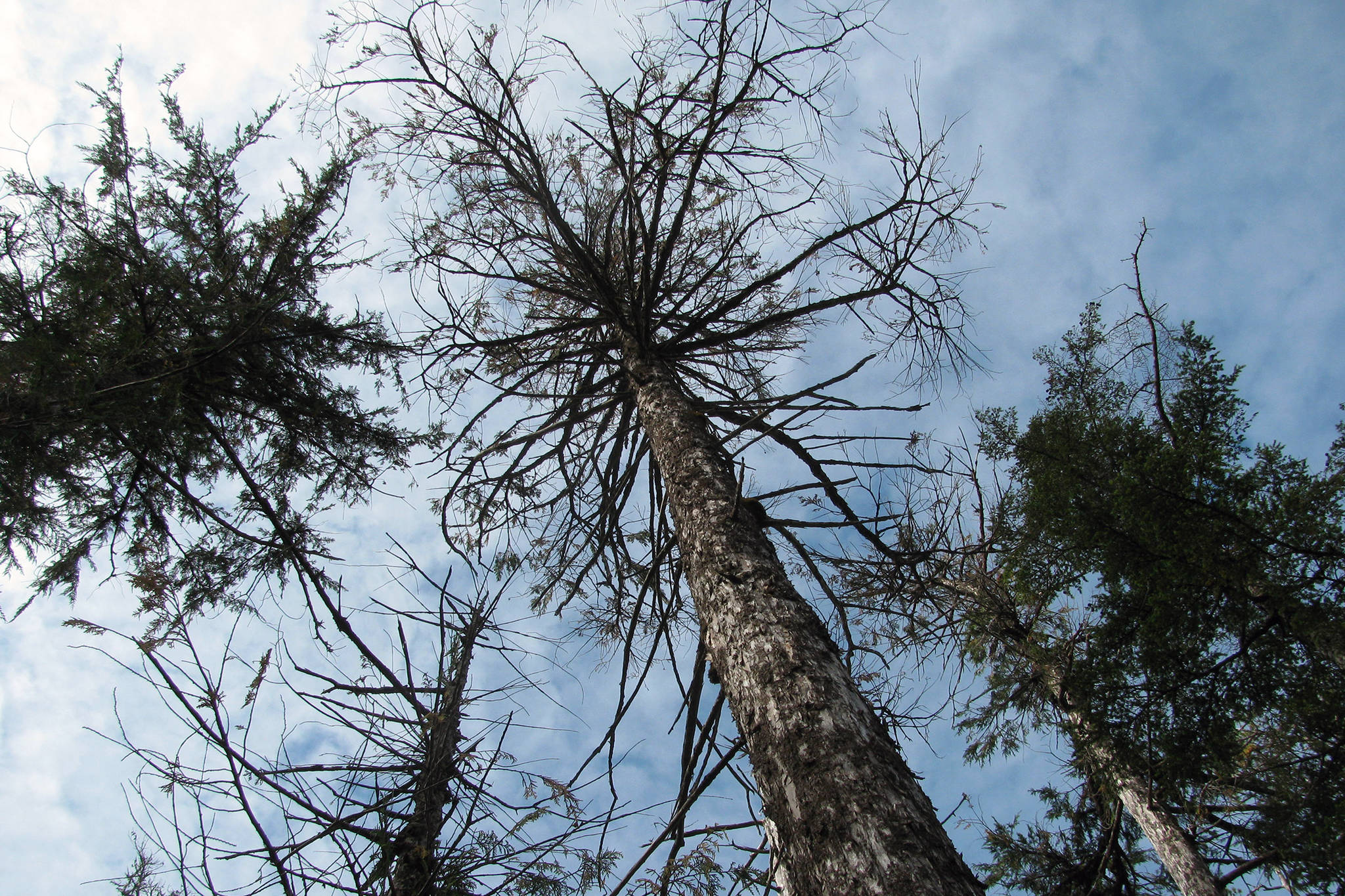
The yellow cedar, a tree native to Southeast Alaska and culturally significant to Alaska Native communities, was denied protected status under the Endangered Species Act Friday.
According to a press release from the U.S. Fish and Wildlife Service, the tree does not warrant listing under the act based on a review of the best available science for the species.
Yellow cedar decline has been noted by ecologists for years, and a petition to list the tree under the ESA was submitted in 2014. However, while noting the tree is indeed in decline, the Service said that only 6 percent of the species’ range is currently impacted.
“Despite impacts from effects of climate change, timber harvest, fire, and other stressors,” the Wildlife Service’s findings report says. “The species is expected to persist in thousands of stands across its range, in a variety of ecological niches, with no predicted decrease in overall genetic diversity into the foreseeable future.”
But Shaye Wolf from the Center for Biological Diversity disagrees. The Center was one of the petitioners which originally submitted the request to list the tree in 2014.
“There are large parts of Alaska where 70-80 percent of yellow cedar are dead,” Wolf told the Empire in a phone interview Friday. “Yellow cedar is particularly vulnerable to climate change because its roots are very shallow and can experience freezing.”
The roots of the yellow cedar are freezing because of lack of snow. Warmer temperatures are reducing the amount of snow in areas where the cedar grows and that is leaving the tree’s roots exposed to subzero temperatures.
“Snow is an effective thermal insulator for soils,” a paper co-authored by Brian Buma, an assistant professor of biology at the University of Colorado, Denver. Buma previously taught at the University of Alaska Southeast. “The loss of snow exposes tree roots to potentially lethal temperatures during freezing events.”
The Wildlife Service acknowledges this, but feels that the die-off of yellow cedar is occurring in low enough numbers as to not threaten the overall species.
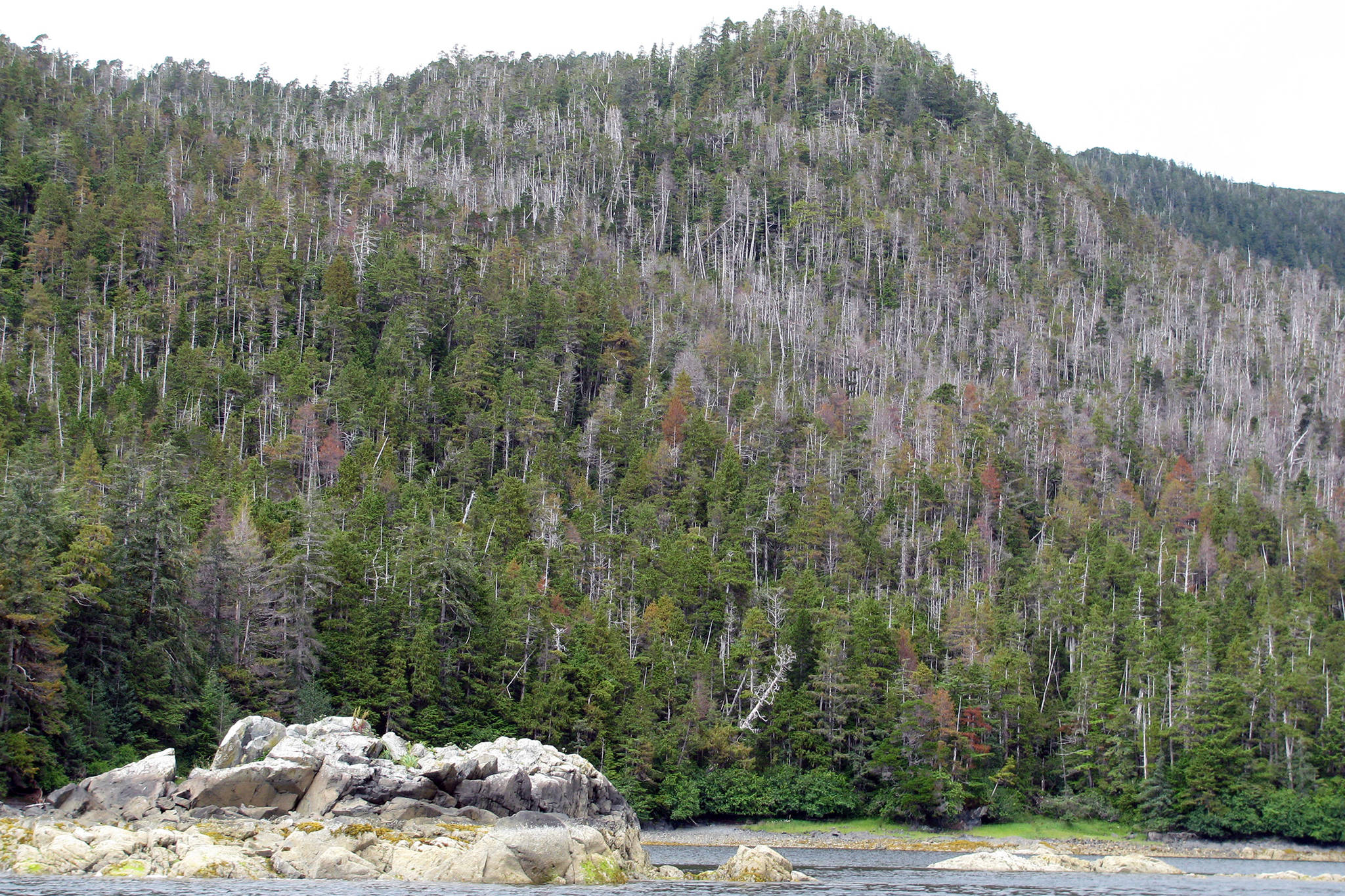
Yellow-cedar decline, Peril Strait, Chichagof Island. (Courtesy photo | U.S. Fish and Wildlife Service)
But Wolf sees this as part of a general attack on climate protections by the Trump administration. Trump, she says, “has recklessly rolled back climate protections,” and tried to open up more federal lands for resource extraction.
She cited logging operations on Prince of Wales Island and attempts by the administration to remove the Roadless rule which would allow for more timber harvest.
“That’s the pattern that we’re seeing, (the Trump administration) is sacrificing the nation’s wildlife for corporate interests, and this supports their climate change denial,” Wolf said.
The report does acknowledge the threat of climate change, but says that those threats are manageable and that logging operations in areas with yellow cedar are “sustainable.”
In 2016, the Forest Service had crafted a conservation plan for the yellow cedar, but that plan was updated in 2018 to say the rate of decline of yellow cedars had decreased. The Wildlife Service denied protected status to the yellow cedar and 11 other plant and animal species deemed not significantly threatened.
In response to a request for comment, the Fish and Wildlife Service provided the Empire with a pre-written, question-and-answer document.
“Research into areas that could further increase yellow-cedar viability on the landscape is also being conducted,” the document says under the section about conservation efforts. “Development of a browse resistant strain of yellow-cedar that would make seedlings less palatable to deer; thereby reducing the amount of browse that occurs in areas replanted post-logging operations,” as well as planting operations are options being pursued by the Forest Service, the document says.
• Contact reporter Peter Segall at 523-2228 or psegall@juneauempire.com.
