
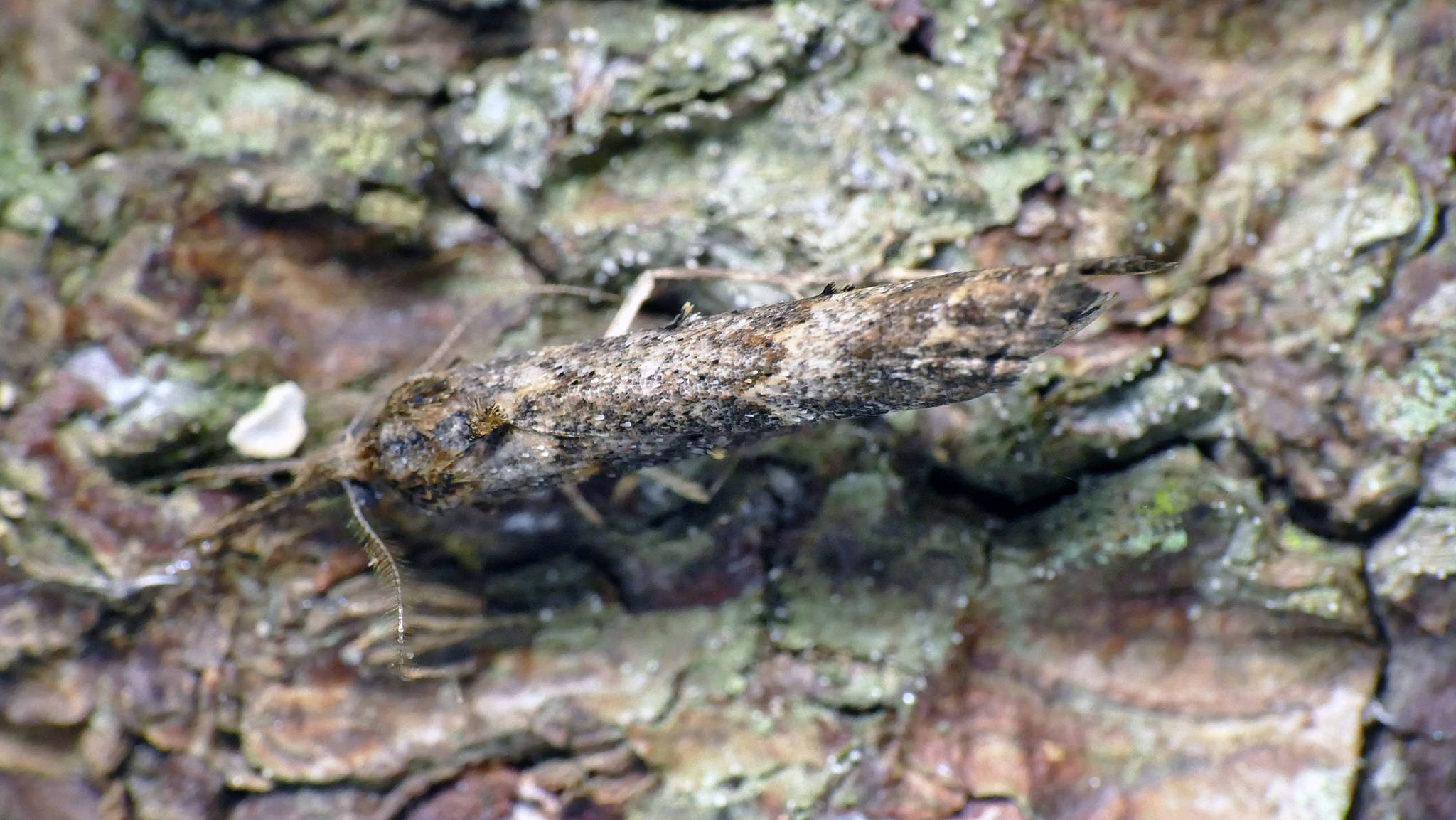
When the presence of an animal is difficult to detect or it is hard to locate, it is said to be cryptic. Think of a female mallard sitting on her nest; her mottled brown feathers are good camouflage — they make her look like a little heap of old leaves, not readily distinguishable from the background. We may actually be seeing her but be unable to register her presence; we just don’t detect her, much less locate her nest. She is not out of sight, like bunny in a burrow; she is hidden plain sight.
A famous case of background matching was very well documented. The peppered moth (Biston betularia) in the UK likes to rest on lichen-covered tree trunks and branches. The typical form of this moth has white wings speckled with black spots. The wings also reflect UV light, but even that has a speckled pattern. The speckled pattern makes the resting moth almost invisible as it sits on the tree bark.
During the Industrial Revolution in England, beginning in the mid 1800s or so, pollution from factories killed off many of the lichens and the tree bark became blackened with soot. Then the typical form of the moth was very conspicuous against the dark bark and they were readily picked off by hungry birds. A mutant form with black wings, much less noticeable on the sooty trees, then became more common. Natural selection in action!
More recently, industry has become environmentally somewhat cleaner, the trees are not so dark, and the black form is vulnerable to predation. As a result, the white, typical form of the moth is again becoming common.
Because we humans are so heavily oriented to visual things, we usually think of visual cryptic-ness (or crypsis). But why not think of crypsis that relates to other sensory systems? There are several studies suggesting that there may acoustic or olfactory crypsis, and hints for other sensory modalities.
• Acoustic signals are used by many animals for courtship or other communication among individuals of the same species. For instance, males of a neotropical frog make complex calls to attract females, especially when several males are calling simultaneously. But in the presence of predatory bats, they simplify their calls, even though the females prefer the complex ones. At the price of reduced attractiveness, the simpler call appeared to make the male callers less detectable to the bats. They didn’t completely stop calling—which would be acoustically hiding. They just became less detectable.
Many small birds produce a high-frequency, thin alarm call (“seet”), which does not carry very far. This is thought to be more difficult to locate than the usual contact or distress calls. Experiments with captive hawks indicated that these predators had trouble locating the source of the sound and attacked less often, when the potential prey used the high-frequency calls. The small birds can hear the call and be on the watch for trouble, but they don’t need to know the exact location of the caller.
• The leaf-eating caterpillars of another moth (that’s closely related to the peppered moth) look a lot like little twigs, which might protect them from birds but not from predatory ants that hunt primarily by smell. Yet such ants just walked over the caterpillars as if they weren’t there at all and didn’t attack them. However, if the caterpillars were transferred to a different food plant, the ants attacked them readily. Then, after the caterpillars had fed on the new food plant for a while and molted to the next larval stage, they were again ignored by the ants. In this case, the protection comes from matching the chemical constitution of the food plant.
Some elaborate studies of herbivorous pine bark beetles compared the chemical signals and the responses of predatory beetles in different areas (California and Wisconsin). Pine bark beetles use chemical signals called pheromones to attract others of the same species. Predatory beetles cue in on those signals. As might be expected, California pine bark beetles liked their own pheromones better than the Wisconsin ones, and vice versa. But the California predators homed in better on the Wisconsin pheromones, and the Wisconsin predators homed in on the California pheromones better than on the local ones of each population. In other words, the prey were less apparent to local enemies than distant ones, suggesting they were chemically somewhat cryptic.
Birds have a preen gland just above the tail that produces oils and waxes that the birds use to dress their feathers. A fascinating study revealed that the normal waxes are replaced by less volatile waxes during the nesting season of several ground-nesting shorebirds. Furthermore, if only the female of these species does the incubating, then only the females show the shift in wax composition. Ground-nesting birds are particularly vulnerable to predation by mammals, and experiments with a search dog trained to the smell of these waxes showed that the dog was less able to detect the waxes produced in the nesting season.
• In addition, there are hints — but only hints — that shifts in electrical fields, or in production of wakes by swimming animals, or in substrate vibrations have the potential to be used by prey animals to whom crypsis could be advantageous. There are, potentially, many ways to be hidden in plain “sight.” And many investigations are needed. In the meantime, it is useful and interesting to contemplate things beyond our usual kin.
A big thank you to the gracious CBJ librarians who promptly obtained a necessary reference for me!
• Mary F. Willson is a retired professor of ecology. “On The Trails” is a weekly column that appears every Wednesday.
