
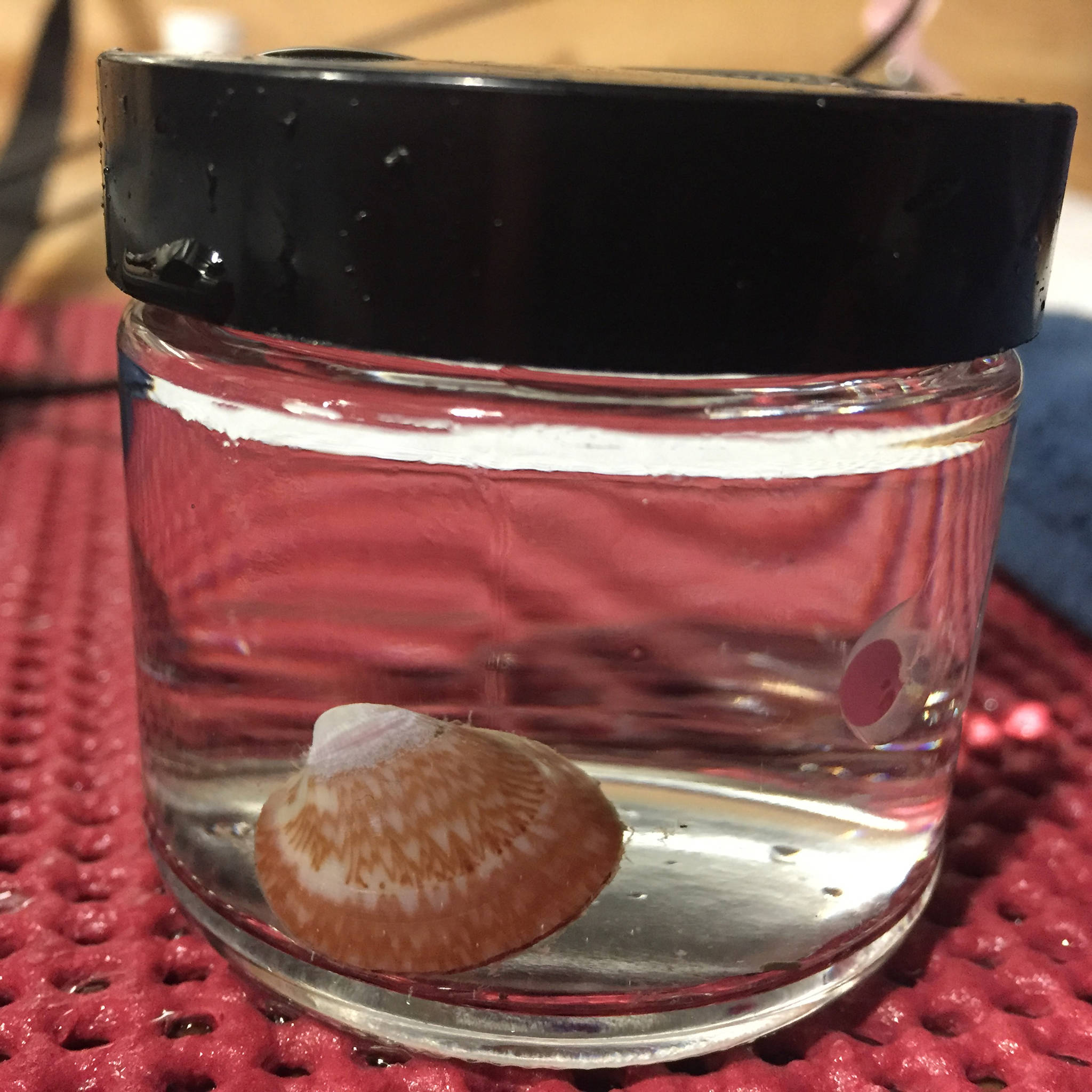
A clam from the seafloor off the coast of western Alaska is pictured in a jar that scientists use to measure respiration. (Courtesy Photo | Brittany Jones)

A clam from the seafloor off the coast of western Alaska is pictured in a jar that scientists use to measure respiration. (Courtesy Photo | Brittany Jones)

Why should anyone care about clam breath?

Respiration rates are numbers scientists can plug into ecosystem models.

To learn more about one of the largest environmental changes of our lifetimes, Brittany Jones studies clam breath.

Jones is a student earning her Ph.D. at the University of Alaska Fairbanks. She is an expert on creatures that live in the muck covering the underwater continental shelf off western Alaska. There, sea ice waxes and wanes on the relatively shallow waters covering the former Bering Land Bridge.

The drastic shrinkage of that jigsaw puzzle of blue ice during the last few decades, and especially the last few years, is like the sudden loss of a solar reflector the size of Texas, with California pasted on.

“The sea ice loss has been unbelievable,” said Jones’s colleague, oceanographer Seth Danielson, who sailed in the Bering and Chukchi seas the last three summers. “To see that much open water this time of year is not something we’d have expected to see this decade or next, or the decade after that.”
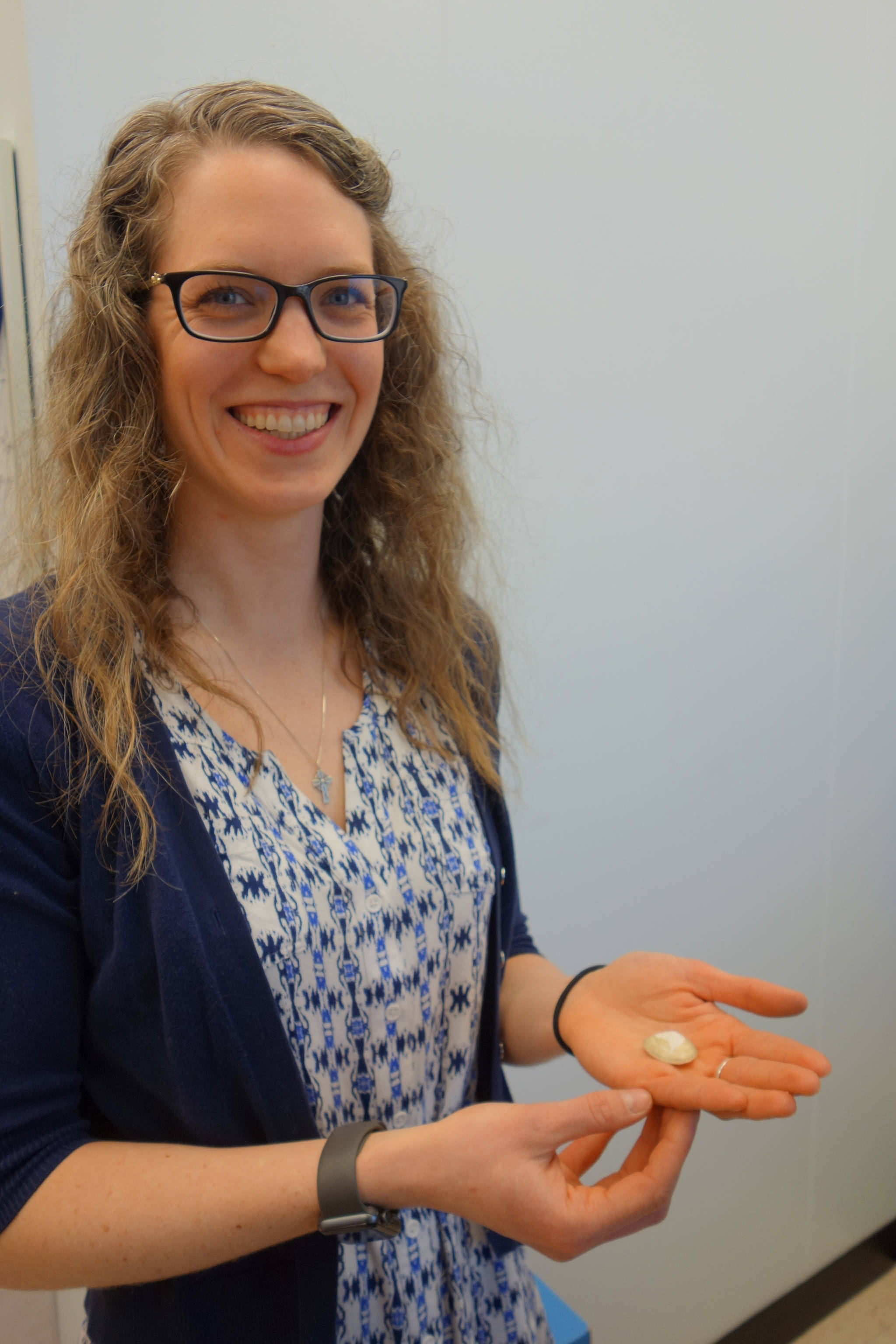
University of Alaska Fairbanks graduate student Brittany Jones displays the shell of a clam from the seafloor off western Alaska. (Courtesy Photo | Ned Rozell)

University of Alaska Fairbanks graduate student Brittany Jones displays the shell of a clam from the seafloor off western Alaska. (Courtesy Photo | Ned Rozell)

All the new heat absorbed by a dark northern ocean has had big effects on creatures great and small, from whales that can now travel and feed way farther north than before to seabirds mysteriously dying of starvation on what had been the richest ocean waters on Earth.

To get a better picture of what is happening, scientists like Jones and Danielson have boarded a research ship during the past few summers and sailed through the Bering Strait on the Bering and Chukchi seas. They have sampled everything from seawater to copepods — crustaceans the size of dust specks — on June cruises of the 261-foot RV Sikuliaq.

One of Jones’s tasks was to determine the respiration rates of clams found on the seafloor, about 120 feet beneath the salty gray surface. Her work confined her to a windowless shipboard lab, kept at the temperature of an ice cube. The cool room might have helped her avoid seasickness, she said.
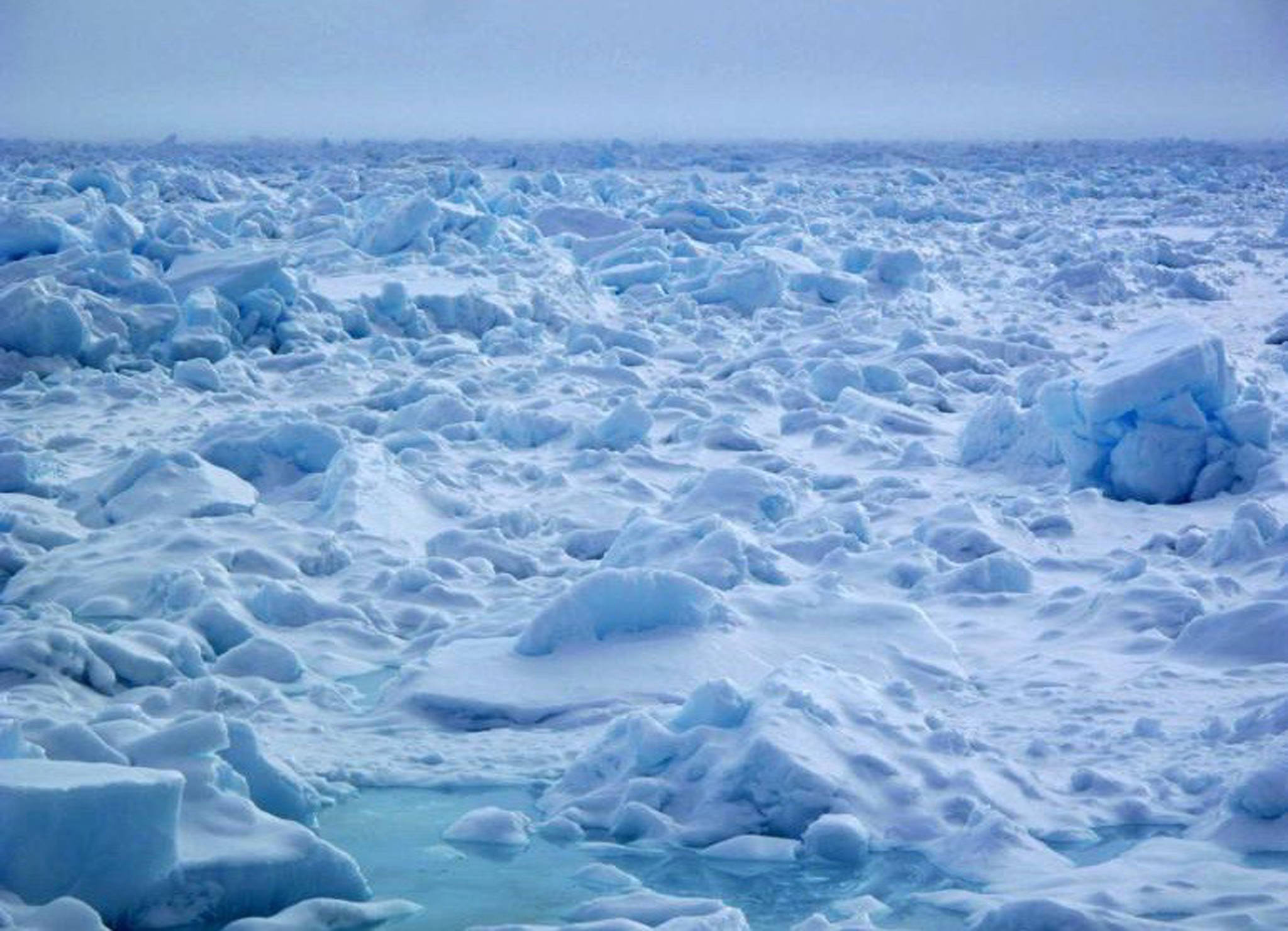
Sea ice is pictured off the coast of northern Alaska. (Courtesy Photo | Ned Rozell)

Sea ice is pictured off the coast of northern Alaska. (Courtesy Photo | Ned Rozell)

There, she would set on a table clams scooped from the sea floor that ranged in size from a pumpkin seed to a chicken egg. Using a toothbrush, she scrubbed algae from shells and placed each clam in its own glass jar. Using sensitive instruments, she measured how much oxygen each clam was taking in with its primitive set of gills.

Like us, the clams use oxygen to help convert their food, in this case “algae mush,” into energy.

Jones’s goal is to find out the respiration rates of five species of clams. And why should anyone care about clam breath?

The respiration rates of clams and other animals are numbers scientists can plug into ecosystem models. The computations might help them figure how much food the entire suite of creatures affected by sea ice needs to survive.

As the ocean is warming — the Bering Strait area has for the past four years been several degrees above the long-term average — living things need more food. Jones and others have found that creatures of the sediment increase their respiration rates with warmer temperatures.

In a lab back at UAF, Jones also studies worms and shrimp-like amphipods that populate the vast ocean floor of the Bering and Chukchi seas. Hundreds of miles inland, Jones is now squinting through a microscope, learning more about what the tiniest creatures are telling us about a change so massive it is hard to comprehend.


• Since the late 1970s, the University of Alaska Fairbanks’ Geophysical Institute has provided this column free in cooperation with the UAF research community. Ned Rozell (ned.rozell@alaska.edu) is a science writer for the Geophysical Institute.


More in News

Map showing approximate location of a 7.0-magnitude earthquake on Saturday, Dec. 6, 2025. (Courtesy/Earthquakes Canada)
7.0-magnitude earthquake hits Yukon/Alaska border

Earthquake occurred about 55 miles from Yakutat

A commercial bowpicker is seen headed out of the Cordova harbor for a salmon fishing opener in June 2024 (Photo by Corinne Smith)
Planned fiber-optic cable will add backup for Alaska’s phone and high-speed internet network

The project is expected to bring more reliable connection to some isolated coastal communities.

Gustavus author Kim Heacox talked about the role of storytelling in communicating climate change to a group of about 100 people at <strong>Ḵ</strong>unéix<strong>̱</strong> Hídi Northern Light United Church on Wednesday, Dec. 3, 2025. (Mari Kanagy / Juneau Empire)
Author calls for climate storytelling in Juneau talk

Kim Heacox reflects on what we’ve long known and how we speak of it.

The Juneau road system ends at Cascade Point in Berners Bay, as shown in a May 2006 photo. (Michael Penn / Juneau Empire file)
State starts engineering for power at proposed Cascade Point ferry terminal

DOT says the contract for electrical planning is not a commitment to construct the terminal.

Members of the Alaska Air and Army National Guard, Alaska Naval Militia, and Alaska State Defense Force work together to load plywood onto a CH-47 Chinook helicopter, in Bethel, Alaska, Nov. 2, 2025, bound for the villages of Napaskiak, Tuntutuliak, and Napakiak. The materials will help residents rebuild homes and restore community spaces damaged by past storms. (U.S. Army National Guard photo by Spc. Ericka Gillespie)
Gov. Dunleavy approves Alaska National Guard assisting ICE in Anchorage

The National Guard said five service members will assist with administrative support; lawmakers and civil rights advocates worry that the move signals a ramping up of immigration enforcement operations in Alaska

A cruise ship, with several orange lifeboats visible, is docked in downtown Juneau. (Laurie Craig / Juneau Empire file photo)
CBJ seeks input on uses for marine passenger fees

Public comment period is open for the month of December.

Browsers crowd into Annie Kaill’s gallery and gift shop during the 2024 Gallery Walk. (Juneau Empire file photo)
Gallery Walk guide for Friday, Dec. 5

The Juneau Arts & Humanities Council announced community events taking place during… Continue reading

The Alaska State Capitol is seen on Tuesday, Nov. 25, 2025. (Photo by James Brooks/Alaska Beacon)
Alaska Senate Republicans confirm Rauscher, Tilton and open two vacancies in state House

The Alaska Republican Party is moving quickly after Republicans in the Alaska… Continue reading

Downtown Skagway, with snow dusting its streets, is seen in this undated photo. (Photo by C. Anderson/National Park Service)
Skagway’s lone paramedic is suing the city, alleging retaliation by fire department officials

This article was reported and published in collaboration between the Chilkat Valley… Continue reading

Most Read