
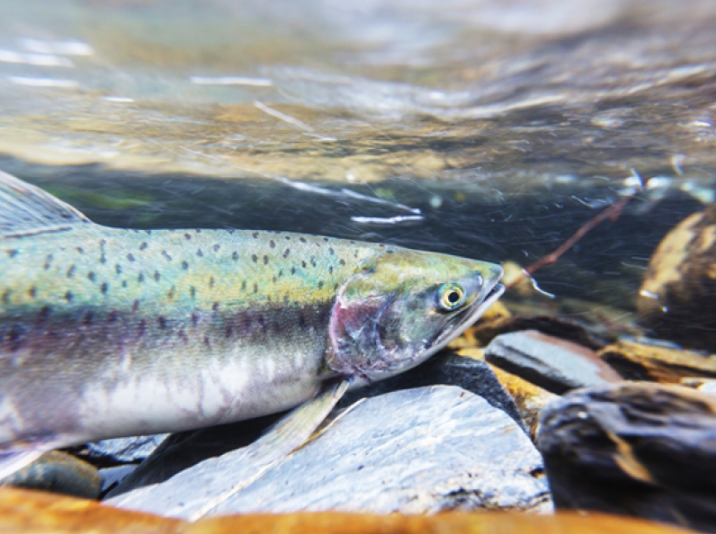
KENAI — If any fish population in Upper Cook Inlet could be considered in trouble, Shell Lake’s sockeye could.
The lake in the Matanuska-Susitna region, located northwest of the village of Skwentna between the Skwentna and Yentna rivers, has long supported a population of sockeye salmon. When the Cook Inlet Aquaculture Association first studied the sockeye returns there in the 1980s, the lake seemed to sustain a reasonable smolt outmigration and adult return each year. A 1989 Alaska Department of Fish and Game study indicated that the Shell Lake produced about 10 percent of the total sockeye population returning to the Susitna River.
That’s not the case any more. In 2015, only three sockeye returned to the lake, according to CIAA’s counts. The total is an estimate, though, because of partial video loss from the video weir the association uses, according to its 2015 report on Shell Lake. A total of 59 smolts left the lake the same year.
Compared to the lake’s historical data, the decrease is drastic. In 2006, approximately 69,800 adults returned to the lake and about 80,600 smolts outmigrated in 2007.
CIAA studied the lake again around 2006 and has watched the population decline since, said Gary Fandrei, the organization’s executive director.
“After a few years (of declining returns), we said if this goes on one more year, it would be doomsday for the fish population,” he said.
The dwindling population has the Mat-Su Borough Fish and Wildlife Commission alarmed enough to ask the state to step in. The commission, which represents the Mat-Su Borough on fish and wildlife issues, submitted a non-regulatory proposal to the Board of Fisheries to designate Shell Lake sockeye a stock of conservation concern, the most severe designation in the Alaska Sustainable Salmon Fisheries Policy.
The concern is that without intervention, Shell Lake’s sockeye will die out completely, said Terry Nininger, a member of the Mat-Su Borough Fish and Wildlife Commission who also testified at the Board of Fisheries’ work session in Soldotna Oct. 18.
“There’s not a lot of local angler effort except for the locals that live around the lake,” he said. “… It’s more of a concern about the fish, not about the angler effort.”
There are likely a number of factors in the decline, chief of which is invasive northern pike predation. The infestation of pike in the northern Cook Inlet area is fairly well documented and pike populations have been identified in more than 100 lakes in the broader Susitna and Matanuska drainages. Though the freshwater fish are native to Alaska north and west of the Alaska Range, they are invasive in Southcentral and Southeast Alaska and can devastate salmon populations because they are voracious predators on juvenile salmonids. Individual pike have been discovered with dozens of juvenile salmon in their stomachs.
CIAA, which collects eggs from returning Shell Lake sockeye, rears them to smolt in its Moose Pass-based Trail Lakes Hatchery and returns them to be released in the lake, also nets the pike for population control. However, because of the nature of netting, they catch mostly the larger pike while the younger, smaller pike are still a problem, Fandrei said. There have also been problems with two diseases that affect salmon and beaver dams blocking passage. Though the diseases, both caused by parasites, seemed to have abated for a little while, they were detected again this summer, he said. CIAA regularly surveys the area and creates notches in beaver dams that could be blocking fish passage, he said.
More fish returned this summer — approximately 215 according to a record copy Nininger submitted to the Board of Fisheries — and CIAA was able to collect eggs again, Fandrei said. However, when fish populations dwindle down to a certain point, they can’t sustain themselves, he said.
“(The egg-take and stocking effort was) an effort to save the gene pool, to keep the gene pool alive in that stock of fish,” Fandrei said. “We had seen a very small number of fish coming back. Less than 10 fish might just be strays that wander up there from somewhere.”
The Mat-Su Fish and Wildlife Commission wants to see the state switch the designation to a stock of conservation concern and restrict harvest on the sockeye stock across the board for all user groups: commercial, sportfishing and personal-use, as well as a more aggressive program to deal with the pike infestation, Nininger said.
“If the department decided to take a step of making it a conservation concern, they could restrict the fish harvest both commercially and the fish going up that stream both for sport fishing and personal use,” he said. “They could restrict the catch … and that would certainly help.”
Through the Alaska Sustainable Salmon Fisheries Policy, Fish and Game designates stocks of concern if a particular fish population fails to meet its management goals. There are three categories: yield concern, management concern and conservation concern. There are currently 13 stocks of concern statewide, according to Fish and Game’s website, and eight are in Cook Inlet.
The Shell Lake stock would be the only one of conservation concern in the state. The challenge would be for Fish and Game to determine how to reduce harvest on those sockeye specifically, especially in the marine fishery, where set gillnet and drift gillnet fishermen can harvest sockeye of mixed stocks. Fish and Game has conducted genetic studies on the mixed stocks of sockeye salmon in Cook Inlet, but a conservation concern designation would come with additional restrictions.
The Mat-Su Borough Fish and Wildlife Commission also asked the Board of Fisheries to consider upping the stock of concern designations on the Susitna River sockeye salmon stock from yield concern to management concern, though the Central Peninsula Fish and Game Advisory Committee asked for the Board of Fisheries to repeal the stock of yield concern designation on the Susitna River sockeye stock, saying the designation was based on a faulty sonar estimate and repealing the designation would open up more commercial fishing. The Matanuska Valley Fish and Game Advisory Committee also asked for upgrades on multiple king salmon stocks of concern.
A recent court ruling has thrown a wrench into state management of Cook Inlet’s marine fisheries as well. A three-judge panel of the U.S. Ninth Circuit Court ruled in favor of the United Cook Inlet Drift Association in a lawsuit over the 2011 removal of several Alaska salmon fisheries from the federal fishery management plan. No decision has yet been made on how the fishery will proceed next season.
Both Nininger and Fandrei said the stock of conservation concern on Shell Lake’s sockeye salmon could help bring needed attention to the issue, and both said the conditions should be better studied.
“We feel the state needs to raise awareness across the board,” Nininger said. “There’s a variety of different ways that could be approached. We are concerned that the management concern level isn’t getting the attention it needs.”
• Elizabeth Earl is a reporter for the Peninsula Clarion. She can be reached at elizabeth.earl@peninsulaclarion.com.
