
Take a dozen eggs, one by one, out of their carton. Shatter them on the floor behind your refrigerator. Mix the mess with moldy cat food and a used diaper. Let it sit for a week.
For the past few months, residents of Lemon Creek and drivers on Egan Way have been coping with a stench that resembles that appetizing mixture. Now, a solution appears to be in smell.
On Monday, City and Borough of Juneau architect Michele Elfers wrote in a memo to the Juneau public works committee that Waste Management, the owner of Juneau’s landfill, is nearing completion on a series of wells that will draw odiferous gas out and send it away for burning. The eight new wells, added to 30 already existing, promise to greatly reduce the stench coming from the Lemon Creek landfill.
“I think that Waste Management is putting their best foot forward and trying to keep a handle on the situation,” said Jim Penor, the CBJ’s manager for solid waste.
Ironically, the effort to reduce the stench may be contributing to the recent increase in bad smells.
To understand why the landfill has smelled so bad recently, it helps to understand why the landfill stinks in the first place. Most of the stinks emitted by the Juneau landfill are caused by decaying food waste. A half-eaten Costco hotdog, a moldy head of lettuce — these end up in the landfill, where they’re compacted into bales and piled in the landfill. Bacteria eat the food waste, generating heat and gas as byproducts. Beneath the frost-covered surface of the landfill is a mass of garbage and bacteria cooking away at about 150 degrees.
“The more the mass grows, the more it does its biological process,” Penor said.
Rainfall doesn’t dampen the process. The bacteria love moisture; in rainy weather, they produce more gases including methane and sulphur, which causes the rotting-egg odor.
“Normally, in a landfill down south, you get gas in 3-5 years,” said Sandy Woods, who oversees Southeast landfills for the Alaska Department of Environmental Conservation. “Here in Juneau, Alaska, we get it and it takes about 1-3 months.”
Last year was the second-wettest in Juneau’s history, which meant plenty of moisture for landfill bacteria. That rainfall wasn’t the whole story, however.
On Tuesday afternoon, landfill manager Eric Vance hosted the Empire for a tour of the work ongoing at the landfill.
As Vance explained, late last fall, crews began constructing a new ramp to the top of the landfill. The ramp is needed for future landfill work and to carry drilling equipment to the top of the landfill. To build the ramp, workers used material they had on hand — waste. They dug into older sections of the landfill rife with hot bacteria and methane, then compacted it into the ramp.
“Definitely the odors coincided with that,” Vance said of the construction.
Throughout the fall and early winter, a pile-driving crane slammed well pipes 30 feet down into the heart of the landfill. The wells are crucial for draining methane from the landfill, but until they are connected to the landfill’s burner, they are highways for stinking sulphur and methane. Visible from one well Tuesday was gas flowing in transparent waves, like heat radiating from a highway in summer.
The smell? As bad as the smell can be for cars and trucks on Egan Drive, standing at one of the new, unconnected wells was akin to the stench of Satan’s mudroom.
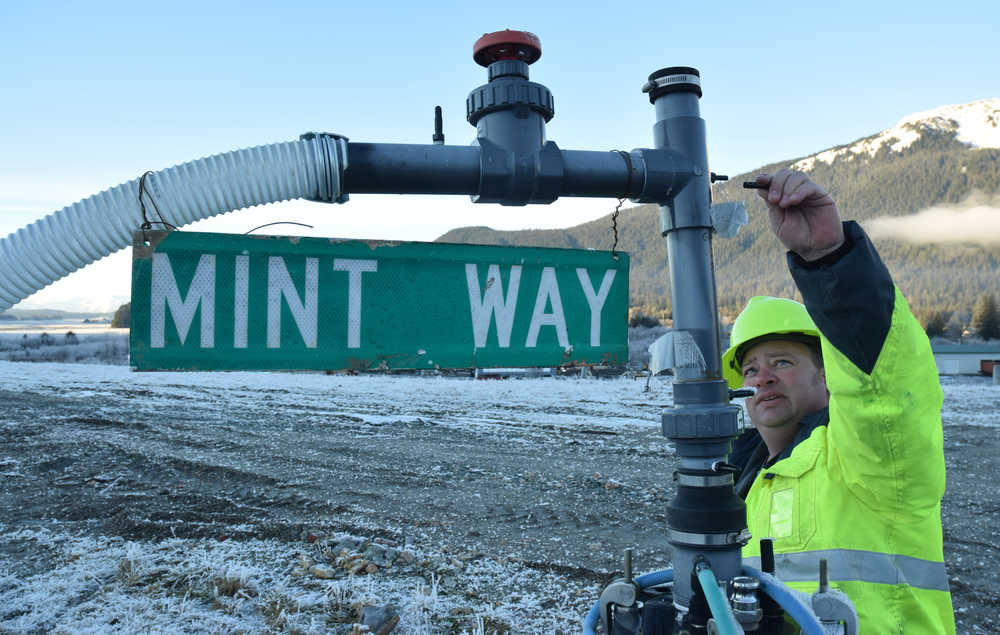
Standing next to one of the older, connected wells bearing an ironic “Mint Way” faux street sign, there wasn’t a smell of fresh mint, but there wasn’t the horror of an unconnected well, either.
Seven of the eight new wells have already been drilled, and Vance expects that within the next two to three weeks, the last well will be completed and all eight will be piping gas to the burner installed in 2007. Vance would like to burn the gas for energy but said the landfill doesn’t produce enough to make that economically viable.
In addition to inspecting landfills for the state, Woods lives in Lemon Creek. She has fielded the complaints of nearby residents but knows first-hand the problems they’re smelling.
“They are responding to the complaints,” she said of Waste Management, “and I wish it were resolved quicker.”
Vance toured the landfill the same day as the Empire. She said the well work looked promising, but she had one suggestion: The next time Waste Management does work like this, they might want to consider notifying people first.
“If people know that it’s going to happen and they know there’s a reason for it, they might be more tolerant,” she said.
Sidebar: Who owns the landfill?
Juneau’s landfill is not owned by the City and Borough of Juneau. It is owned by Waste Management, a national firm. Waste Management operates the landfill under a permit from the state, which regulates landfills in Alaska. If someone has a complaint about a landfill, it’s the state that handles it.
The CBJ also doesn’t handle garbage collection. That’s the work of Arrow Refuse, a separate company that carries garbage from your curb to the landfill and bills you. Waste Management only bills you if you dump something directly at the landfill.
The CBJ oversees recycling, the disposal of household hazardous waste, and junk vehicle disposal, not general garbage.
