
A walk on the Boy Scout beach/Crow Point trail is almost always rewarding. There’s a variety of habitats, each of which changes with the seasons in its own way.
In late September, there were no geese to be seen in the big tidal meadow or in the river’s estuary. A northern harrier in brown plumage (female or juvenile) coursed low over the river and meadows, spooking at least one crow. A bit above the highest part of the beach, the last flowers of wild strawberry shone on a background of dark green. Several flocks of pine siskins flitted over the seed heads of meadow plants or zoomed between stands of conifers.
On the way from the parking lot to the beach, in the first riverside meadow, the trail had previously been re-routed to accommodate bank erosion. But this time, another large chunk of the bank had fallen into the river, leading to another trail diversion.
Rather than walk the long beach, I chose to weave my way in and out of the spruce groves that line the berm along the shore. These groves sometimes produce interesting finds, such as a bear skeleton or a flourishing stand of orchids.
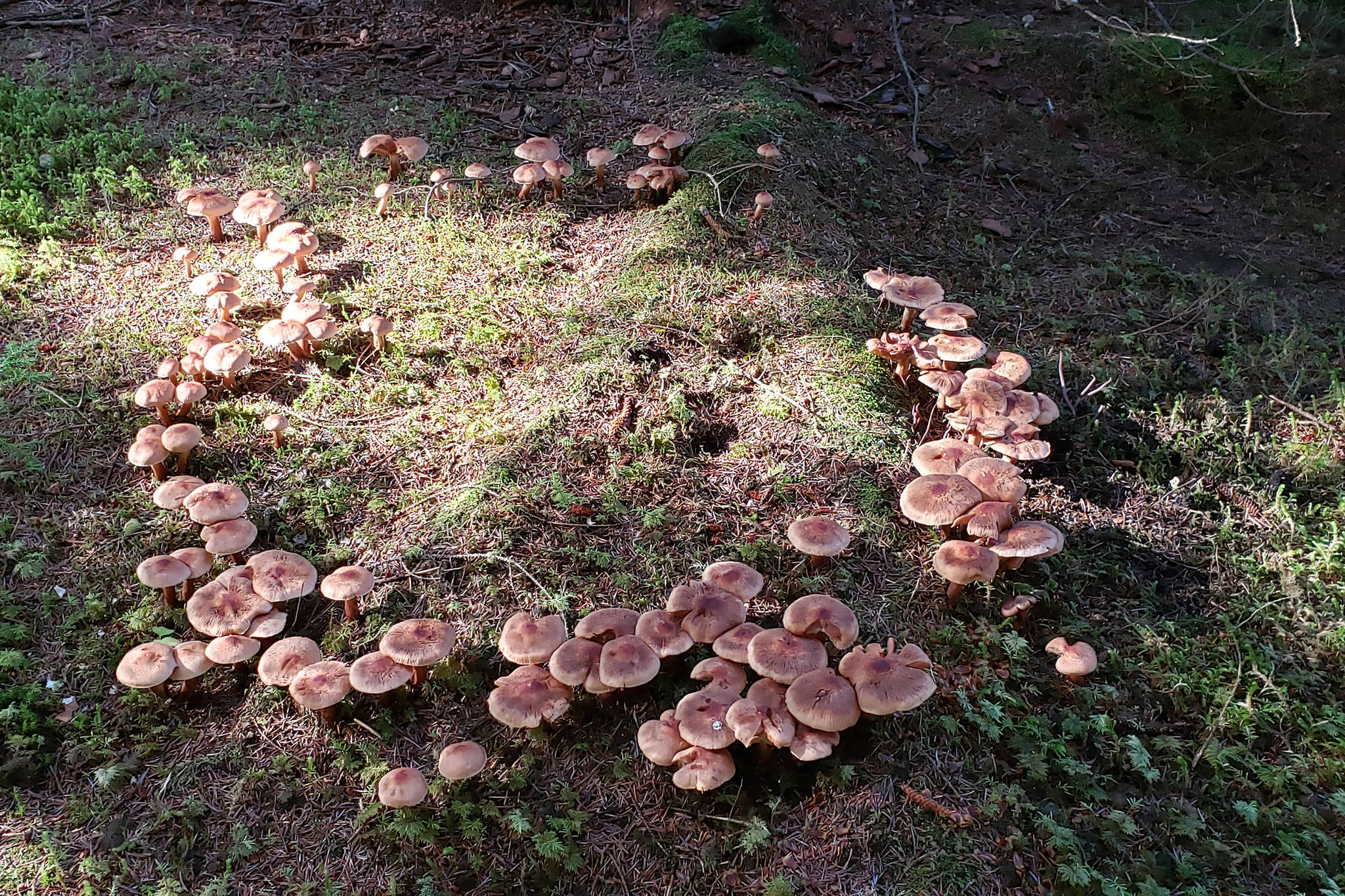
This time, it was a mushroom show. I know next to nothing about mushrooms, unfortunately. But I was attracted to three in particular. A medium-sized brown one typically grew in long, curved chains. Troops of very small white ones clustered between spruce roots. (I called these “armies,” and a friend saw them as pilgrims on a mission, but ‘troops’ is an accepted informal term, I’ve read). My favorites were tiny yellow ones with orange centers on the cap. These usually grew in troops on the berm, especially in some of the groves.
To give me some guidance, I enlisted the help of a friend who does know a lot about mushrooms, and we went out there again a few days later. We made only slow progress as we walked along, because there were so many different mushrooms to look at and discuss. There were lots of Amanita muscaria (common name: fly agaric), both red and yellow varieties. They had the customary whitish “warts” on the cap — except when they’d been washed off by heavy rain. (I call the white bits scattered on the cap “streusel,” like the crumbly mixture often scattered on muffins or coffee cake). We found huge boletes, now aged and no longer desirable for eating by humans but other critters had been feasting. There were more kinds of brown-capped mushrooms than my old brain could begin to assimilate.
I learned that the curved chains of brown-capped mushrooms belonged to the genus Tricholoma (I decided, early on, that getting the name of the genus was enough for now; species names could wait). Tricholoma fungi form mycorrhizal associations with tree roots, providing soil nutrients to the trees and obtaining carbohydrates made by the trees’ green leaves. The long sweeping arcs sometimes exceeded fifteen feet in length. Shorter arcs made nearly complete rings. So-called “fairy rings” of mushrooms are well-known in both mythology and mycology (the study of fungi), but I have not found a coherent explanation of why they form these arcs in some cases but not in others.
The numerous troops of small whitish mushrooms turned out to be of several species, mostly in the genus Mycena, but a few in the genus Collybia. They are not mycorrhizal but rather decompose fallen plant parts such as old leaves and flowers.
Those tiny, bright yellow mushrooms belong to the genus Mycena, sometimes called fairy bonnets. I would love to know why troops of these were very common in some groves but not in others.
As usual, I am left with many questions. For instance, how does a fungus decide when to produce sporing bodies? The main part of a mushroom-producing fungus is an underground network (mycelium) of thread-like hyphae; the network may be very extensive. When the time is right, the fungus puts up sporing bodies that we call mushrooms. The mushroom cap releases ripe spores that disperse, potentially starting new individual fungi. (Although they are not the same as the seeds of plants, they have the same function). But what makes one time “right” and others not? This year was said to be one of great bolete production — but what were the conditions that made it so?
And why are some mushrooms purple — what is the function of that pigment? Ditto for red, or yellow, or browns. Some mushrooms have massive thick stalks, almost as wide as the cap, while other perch their caps on feeble, spindly stalks. How come? There is so much to be learned!
• Mary F. Willson is a retired professor of ecology. Thank you to Jenifer Shapland for a primer on local mushrooms. “On The Trails” is a weekly column that appears every Wednesday.
