
Update Wednesday at 3:30 p.m.:
The flood threat from Suicide Basin has ended, officials said Wednesday afternoon, and waters have receded. Evacuated areas are now open to residents only. Back Loop Bridge remains closed. Crews will continue to move through affected areas to assess damage and other impacts. Residents are advised to exercise caution around damaged areas and avoid riverbanks, as well as avoid standing water. Driving through standing water can generate waves that cause additional damage to nearby structures.
Information about recovery resources such as debris disposal will be shared as soon as it is available on bit.ly/JuneauFloodRecovery, as well as through email updates and social media. You can sign up for email alerts at bit.ly/CBJAlerts or follow CBJ and Tlingit & Haida on Facebook.
The Flood Information Hotline remains open. You can call 907-500-0890 for non-emergency questions. You can find tips for safely entering flood-damaged homes at bit.ly/JuneauFloodRecovery. To sign up to volunteer or request help, visit unitedwayseak.org/2025-flood-relief.
Original story:
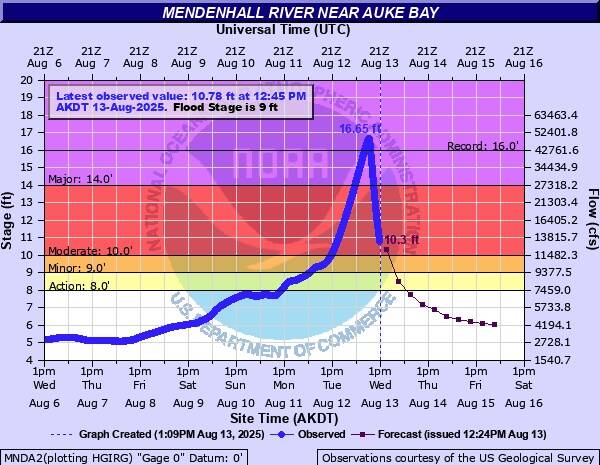
After cresting at a record-breaking 16.65 feet at 7:15 a.m., the Mendenhall River level is falling “very quickly” following the Suicide Basin glacial outburst, Nicole Ferrin with the National Weather Service in Juneau.
As of 12:45 p.m. Wednesday, the river height was 10.78 feet and falling, according to NWS.
Sam Russell with Capital City Fire and Rescue, reiterated that despite the retreat, the flooding is still an active incident, with standing water and debris threaded through neighborhoods in the Mendenhall Valley. Today, responders will work to go through the area and create areas of reentry after the HESCO barriers are more closely assessed.
Russell reminded the public not to walk through standing water, as it is impossible to tell what’s in the water or where the bottom is.
“Stay away from the river and off of the HESCO barriers,” he said in a press conference Wednesday morning.
Russell said there were no significant incidents or rescues needed during the flood event, and noted that last year CCFR performed several emergency evacuations.
Sabrina Grubitz, Tlingit & Haida public safety manager, said that as of Wednesday morning, more than 75 calls came through on their non-emergency helpline. She said that just because the river is receding, it does not mean it is safe to reenter those areas, as responders need time and space to prepare for recovery assessment and efforts. As the water recedes, they will begin preliminary damage assessments and debris cleanup. Grubitz said that at this time, the shelter at Floyd Dryden will remain open. Nine people have accessed the Red Cross-run shelter since it opened Tuesday afternoon.
The Unified Command will communicate with the public when it is safe to return to different sections of the inundated area, and urged affected Juneauites to sign up for emergency alerts and stay tuned to emergency notification channels for updates.
Ryan O’Shaughnessy, City & Borough of Juneau emergency programs manager, said Wednesday morning that they’re currently seeing flooding on at least Meadow Lane, the Safeway parking lot, Meander Way, Marion and View Drive, Parkview and Center Court, and Long Run Drive.
O’Shaughnessy reiterated that these areas are to be avoided and that until JIC issues an all-clear, both the inundated areas, HESCO barriers, and the river should be avoided.
“Don’t drown,” he said. “Turn around.”
Power, which AELP shut off early this morning as the flood levels began to rise, is being gradually restored as areas are further assessed.
Seepage has been observed from the preventative HESCO barriers in certain locations, but O’Shaunnessy said that by and large, they were effective, although tree strikes still need to be assessed.
Christopher Goins with the Department of Transportation said that the Back Loop Bridge has suffered damage from the flood and was officially closed at 7:30 p.m. last night. Goins said the east side of the bridge was struck by tree debris on the upstream side, and that in the very early morning on Wednesday, trees under the bridge were striking where pedestrians could have been on the upstream side. Goins said that a power pole and wing abutment have begun to lean on the southeast side of the bridge. The bridge itself remains in “great condition” as it stands, although the closure will continue until the water drops further, allowing several bridge engineers to make greater assessments of any potential damage.
The USCG said that they will aid in pollution impact assessment and have begun to warn mariners of the potential of debris coming down the river and into the Gastineau Channel. Michael Downs with the Forest Service said that the Mendenhall Recreational Area remains closed, with the west side of the area underwater. It will take five to six days to assess the road and any impacts to infrastructure, with outfitters and guides cautioned to avoid the area in the interim. The road will be closed until 5 p.m. today. Power was shut off to the visitor’s center at the 16-foot level, but has since been reinstated. The east side of the area, where the Mendenhall Glacier Visitor Center rests, is “all good,” according to Downs.
Chief Bos said he was thankful for everyone being “calm and patient out there,” and recognized that safety is paramount, even now as the water recedes.
“As you’re interacting with road closures, please be patient,” he said on Wednesday morning. “Please be calm. Please don’t be angry. Everyone out there is doing their job, and they’re trying to do the best that they can.”
Frank Hauser, superintendent for the Juneau School District, said that on Thursday, Aug. 14, all school district locations will be closed, while three schools in the Valley area are assessed. The new start date for the 2025-26 school year is expected to be Friday, Aug. 15. Hauser said kindergartners will still start school on Aug. 19, as planned. The district will notify parents of any additional changes to scheduling as the situation continues to be assessed.
City Manager Katie Koester said the area is not entirely out of the woods, but the HESCO barriers “really have protected our community,” stating that “if it weren’t for them, we would have hundreds and hundreds of flooded homes.” She said she was grateful to have Brig. Gen. Joseph Goetz with the U.S. Army Corps of Engineers present, to assist CBJ with technical expertise and aid in mitigation efforts and long-term solutions.
“We will be learning a lot from this event, and we will spend the next year working on ways to improve both our mitigation efforts and working on a long-term solution,” she said.
Tlingit & Haida COO, Roald Helgesen, said that tribal liaisons have been embedded in operations and have ensured that decisions “honor our sovereignty, and protect our access to traditional foods, medicines and our cultural sites.”
“When governments work together, respecting each other’s authority, knowledge and responsibilities, our communities are safer, they’re stronger and they are more resilient,” said Helgesen. “This is what government partnership looks like, and what a success that we have seen.”
JIC said the next expectation will be an all-clear alert once responders can assess and make sure water levels have gone down.
They said at this time they are not aware of major impacts to municipal infrastructure, municipal utility, the wastewater treatment or water delivery systems.
