
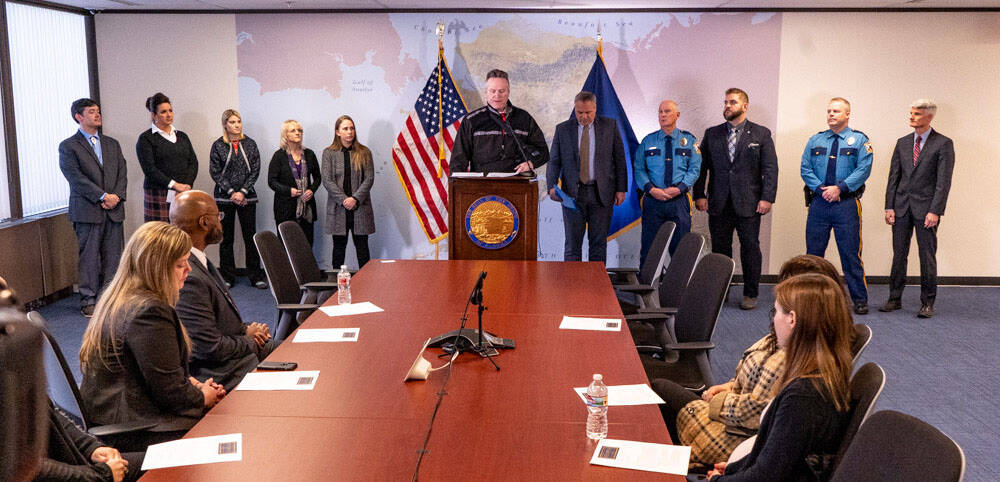
Gov. Mike Dunleavy announced his proposed fiscal year 2023 budget in a press conference Wednesday afternoon, calling for more than $4.6 billion in state funding.
The proposed budget includes increased spending for public safety, infrastructure and a potential $2,564 Permanent Fund dividend for 2022 and a $1,200 payment to “complete” 2021 dividends. The sums are based on a 50-50 plan Dunleavy wants added to the Alaska Constitution. Dividend size has long been a divisive issue.
“The future will always be uncertain but we can establish certainty with the PFD.” Dunleavy said during the news conference. “Most Alaskans like most people in this world are looking past this pandemic. We’re focused on the future.”
The proposed budget totals $4.6 billion in unrestricted general funds, $912 million in designated general funds, $792 million in other state funds, and $4.6 billion in federal funding, according to figures released by the governor’s office, with the total of all funds at $10.9 billion. According to a funding summary from the Alaska Office of Management and Budget, it’s a decrease overall from last year’s budget but marks an increase in unrestricted general fund spending.
[Juneau police chief recognized at Alaska Federation of Natives convention]
“We don’t anticipate this being a yearly occurrence. But we do understand why this money is coming to Alaska as it was for other states,” Dunleavy said of the federal funds. “We focus on the primary functions of government. Public safety, transportation, making sure we can develop our resources, education.”
Dunleavy said that his proposed budget, which did not include recommended revenues, is balanced and would not require consideration of new revenues to fund. Over the course of marathon special sessions this summer, new revenues were part of the call for the Legislature. Revenues were also a recommendation of a legislative work group tasked with finding long-term financial solutions for the state.
Of the spending plan, at least $10 million is dedicated to “statehood defense,” and $4.9 million is dedicated to pushing back on permitting for the Clean Water Act, trying to bring wetlands permitting in under the control of the state, rather than the federal government.
“As part of my administration’s statehood defense initiative, I’ll seek an additional $10 million to continue this effort,” Dunleavy said. “Statehood defense is paying off as we join other states to stop the Biden administration’s vaccine mandates for employers, for health care workers and for federal contractors. We must challenge this administration’s efforts to stop resource development in places like (Alaska National Wildlife Refuge) and Southeast Alaska.”
Public safety has a number of proposed items, including money for more Village Public Safety Officers, Alaska State Troopers, body and vehicle cameras, and positions in the Department of Law and the Department of Corrections.
“The governor’s proposed budget is a significant investment in public safety in rural Alaska,” said Department of Public Safety Commissioner James Cockrell during the news conference. “This budget proposal, and I believe this from the bottom of my heart, will save people’s lives in this state.”
Transportation and infrastructure were also significant portions of the budget, with ports, highways and the Alaska Marine Highway System all highlighted. Those efforts would be buttressed by federal funding.
“This budget continues with the great work begun over the last three years with some new focus points,” said Department of Transportation and Public Facilities Commissioner Ryan Anderson. “All of our infrastructure, we’ve heard from Alaskans, needs to get into better shape.”
Included in the hundreds of millions proposed for transportation spending is $25 million from general obligation bonds for the Juneau Access project.
In February 2020, Dunleavy’s then-Chief of Staff Ben Stevens said progress was being made toward a seasonal terminal at Cascade Point. However, Anderson said the funds would go toward evaluating needs.
“What this allows us to do is reevaluate, see what the transportation system needs are down there in the Southeast and Juneau and move forward from there,” Anderson said.
The interim head of the University of Alaska system said she was excited to see a modest increase for the school’s budget as the third year of the compact with the state was nullified, forgoing further cuts to the state college system’s budget. Dunleavy touted the college’s drone piloting, rare earth research and oil extraction programs, citing a desire to make Alaska the “Drone capital of the U.S.” A total of $94 million in federal grants is dedicated to the University of Alaska Fairbanks Seward Marine Research Center.
“For the first time in many years, our operating budget will see a modest increase,” said interim UA president Pat Pitney in an email to the UA community. “The governor’s budget for the university includes a $4 million increase toward stabilizing state general fund operating support and $22.8 million in one-time federal American Recovery Plan Act funding for specific areas of investment that will contribute to the state’s economic recovery.”
Other notable items include full funding of the Power Cost Equalization Program, $79 million for 100% school bond debt reimbursement to 18 local governments, $72 million for clean water systems in rural communities, and $54 million for the replacement of a school in Napakiak threatened by river erosion.
“The Alaska House Majority certainly supports a number of the priorities and projects discussed by the Governor today. However, we need to carefully review his budget proposal to ensure that it pencils out, uses federal funds wisely, and that the new revenue projections are realistic,” said House Speaker Louise Stutes, R-Kodiak, in a news release. “It is important to remember that a slight rise in the price of oil, changes in the stock market, and one-time funding from Washington do not fundamentally change Alaska’s fiscal reality. We need to make the tough decisions on a fiscal plan in order to provide sustainability in budgeting and the PFD.”
• Contact reporter Michael S. Lockett at 757-621-1197 or mlockett@juneauempire.com.
