
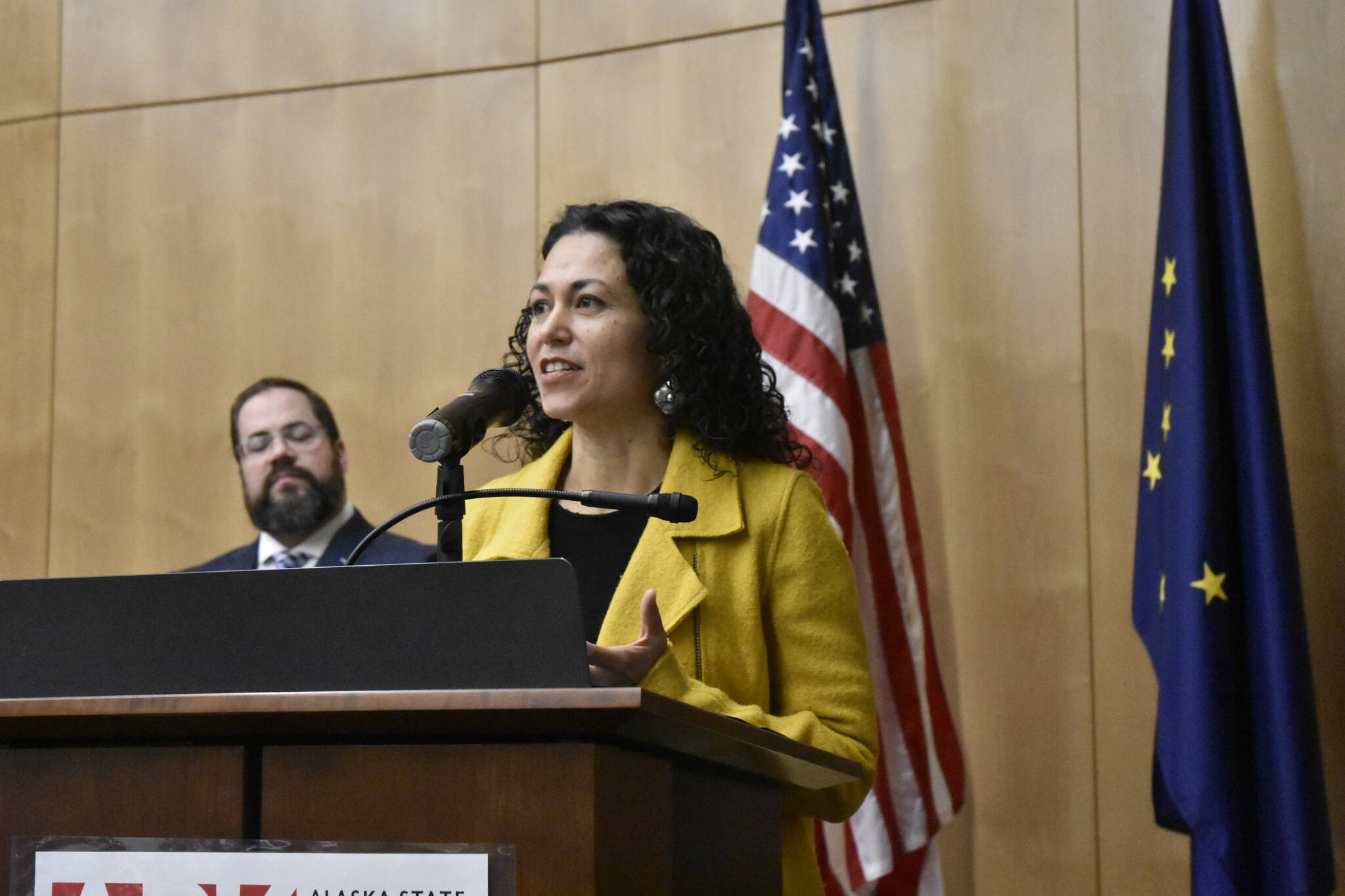
Officials from the U.S. Department of Agriculture Thursday announced roughly $9 million in investments to various entities in Southeast Alaska, part of the department’s Southeast Alaska Sustainability Strategy.
High-ranking officials from USDA — which oversees the U.S. Forest Service — have been in Southeast Alaska for several days touting the benefits of the Southeast Alaska Sustainability Strategy, an effort by the Biden administration to stimulate long-term economic development in the region.
The program was announced with a promise of $25 million in investments, and on Thursday officials announced roughly $9 million in grants to 25 different local programs.
Among the awards announced Thursday were:
— $440,000 to the Sealaska Heritage Institute and Trail Mix Inc. for design and installation of 200 Indigenous heritage place name and interpretive signs along trails in Juneau.
— A combined $1.7 million to the Central Council of the Tlingit Haida Indian Tribes of Alaska, including $750,000 for a Youth Stewards program; $500,000 for cultural interpretive training program and $525,000 for a wildland fire program.
— $1 million to Southeast Conference for a regional biomass strategy and pellet mill for biomass heating pellets.
The Biden administration announced the initiative last year, at the same time it reinstated environmental protections on the region. But USDA officials stressed the program was about more than just a one-time investment and was very much a pilot program for the department’s approach to rural development.
In an interview with reporters Tuesday, USDA Under Secretary for Rural Development Xochitl Torres Small said the department wanted to look at how it could better meet the needs of communities and decided to focus on community-driven projects.
”It’s locally driven solutions that we’re trying to find ways to support, that’s crucial for a sustainable economy,” Torres Small said.
[Public safety employees promote pension plan]
USDA opened public comment for the strategy last September and ultimately received about 300 proposals with a total of $276 million in investment opportunities, said Homer Wilkes, USDA’s under secretary for Natural Resources and Environment. Speaking at a news conference at the Alaska State Library and Museum Thursday, Wilkes said the $25 million pledge was only the first part of what will be a longterm strategy.
“These are short-term investments based on local priorities to advance economic, ecological and cultural sustainability,” Wilkes said. ”This is an initial investment, these projects are the first in a series.”
Local partners have said they’re encouraged by the program, and welcome the collaborative approach.
Robert Venables, executive director of regional development corporation Southeast Conference, said high-ranking officials have come to Southeast Alaska before, but it’s rare.
“You’ve got 3-4 federal agencies that are often seen in their own silos,” Venables said of the Forest Service, Rural Development and the Natural Resources Conservation Service, all of which are part of USDA.
“Seemingly, they have come together to make this program happen and working together has been an interesting approach,” Venables said.
Part of the sustainability strategy included reinstating the 2001 Roadless Rule on the Tongass National Forest. That rule limits development in the forest which supporters say helps protect the region’s fragile ecosystem, particularly salmon habitats, which are critical to the local seafood industry and culturally significant for Alaska Native people. Critics of the rule say it places unnecessary burdens on much-needed development in the region, including critical infrastructure projects.
But Venables, who in the past has criticized the Roadless Rule, said those tensions were separate from this effort.
“I think a lot of times the permitting angst is because it’s being regulated so far removed,” Venables said. “Having these individuals come and see the types of projects, that gives us a whole different context.”
When the initiative was announced, Alaska’s Congressional delegation issued a joint statement saying the economic potential lost by reinstating the Roadless Rule was worth more than $25 million.
“Let me be clear: $25 million doesn’t even come close to covering the economic damage that this administration’s policies will inflict on Southeast Alaska,” said Sen. Lisa Murkowski, R-Alaska, in a July 16, statement.
USDA also announced a separate grant of $740,000 to Spruce Root, the community development branch of the Sealaska Corp., for workforce training programs. In an interview with the Empire, Ralph Wolfe, director of the Sustainable Southeast Partnership, said the recent consultations with federal agencies felt different than in the past.
“I’m in Juneau with them, it’s been three days now,” Wolfe said.
Several tribal governments pulled out of consultations with the Forest Service regarding the Roadless Rule in 2020, and tribal leaders have been critical of the relationship with the federal government. But Wolfe said he could see a lot similarities between work that Spruce Root had done and what USDA was promoting.
“It’s good to see them not copying, but mimicking of our programs,” Wolfe said. “You’ll see a lot of similarities, and a lot of recognizable key terms, its very refreshing.”
• Contact reporter Peter Segall at psegall@juneauempire.com. Follow him on Twitter at @SegallJnuEmpire.
