
US wants to strengthen agreement to ban Arctic Ocean fishing

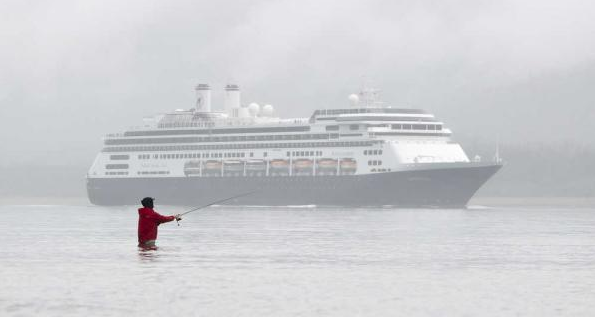
In this file Aug. 24 photo, a fisherman casts a lure at the mouth of Sheep Creek as Holland America’s Amsterdam arrives in Juneau.

In this file Aug. 24 photo, a fisherman casts a lure at the mouth of Sheep Creek as Holland America’s Amsterdam arrives in Juneau.

PORTLAND, Maine — The United States is trying to broker an agreement between a host of nations to prohibit unregulated fishing in the international waters of the Arctic Ocean.

Such an agreement would be binding and include more countries than a non-binding agreement that the U.S. entered into with Norway, Denmark, Russia and Canada last year to avoid fishing in the area.

Adm. Robert Papp, the U.S. special representative for the Arctic, said a binding, multinational agreement would prevent fishing in the Arctic high seas before scientists can determine what is sustainable. He said the issue is especially important as Arctic ice melts, making the area more open to potential commercial fishing.

“We don’t want people fishing in there until we have the science of what’s happening,” Papp said. “It’s a pre-emptive effort to be able to sustain fisheries into the future.”

The U.S. would like to get nations such as China, Korea, Japan and members of the European Union on board with the fishing shutdown, Papp said. He estimated that such an agreement is most likely a couple of years away.

The issue of Arctic Ocean fishing was one of many Arctic issues discussed this week at a diplomatic meeting of the Arctic Council’s Senior Arctic Officials in Portland, Maine, that ended Thursday.

Arctic fishing also is on the radar of environmental organizations, such as The Pew Charitable Trusts, which has argued for a binding agreement signed by many nations to shut down fishing. Pew has called the current non-binding agreement “laudable” but also said a broader deal is needed because unregulated fishing could do damage to the Arctic Ocean’s ecosystem as waters continue to warm.

The U.S. State Department said last year that the non-binding agreement, signed in Oslo, acknowledged that commercial fishing in the central Arctic Ocean — an area bigger than Alaska and Texas combined — is unlikely to happen soon. But it also acknowledged that the reduction of Arctic sea ice and the limited scope of scientific knowledge about marine life in the area make it necessary to prevent unregulated fishing.

Signers agreed not to fish in the area until international fishing management measures are in place for the Arctic’s high seas. More than 200 species of fish thrive in the Arctic, some of which have commercial value, such as the Arctic cod.

Read more news:

‘There’s no fighting back’: Hoonah hunter recalls being in the grip of a brown bear

City election turnout trends upward

With payout today, PFD deals abound in Juneau

More in News

The northern lights are seen from the North Douglas launch ramp late Monday, Jan. 19. A magnetic storm caused unusually bright northern lights Monday evening and into Tuesday morning. (Chloe Anderson/Juneau Empire)
Rare geomagnetic storm causes powerful aurora display in Juneau

The northern lights were on full display Monday evening.

The Alaska State Capitol building stands on Tuesday, Jan. 20, 2025. (Mari Kanagy/Juneau Empire)
Rep. Story introduces bill aiming to stabilize education funding

House Bill 261 would change how schools rely on student counts.

Weekly events guide: Juneau community calendar for Feb. 9 – 15
Juneau Community Calendar

Weekly events guide: Feb. 9 – 15

teaser
Juneau activists ask Murkowski to take action against ICE

A small group of protesters attended a rally and discussion on Wednesday.

A female brown bear and her cub are pictured near Pack Creek on Admiralty Island on July 19, 2024. (Chloe Anderson for the Juneau Empire)
Pack Creek permits for bear viewing area available now

Visitors are welcome from April 1 to Sept. 30.

Cars pass down Egan Drive near the Fred Meyer intersection Thursday morning. (Clarise Larson / Juneau Empire file photo)
Safety changes planned for Fred Meyer intersection

DOTPF meeting set for Feb. 18 changes to Egan Drive and Yandukin intersection.

Herbert River and Herbert Glacier are pictured on Nov. 16, 2025. (Mari Kanagy / Juneau Empire)
Forest Service drops Herbert Glacier cabin plans, proposes trail reroute and scenic overlook instead

The Tongass National Forest has proposed shelving long-discussed plans to build a… Continue reading

A tsunami is not expected after a 4.4-magnitude earthquake northwest of Anchorage Wednesday, Feb. 4, 2026. (U.S. Geological Survey)
No tsunami expected after 4.4-magnitude earthquake in Alaska

U.S. Geological Survey says 179 people reported feeling the earthquake.

ORCA Adaptive Snowsports Program staff member Izzy Barnwell shows a man how to use the bi-ski. (SAIL courtesy photo)
Adaptive snow sports demo slides to Eaglecrest

Southeast Alaska Independent Living will be hosting Learn to Adapt Day on Feb. 21.

Most Read