
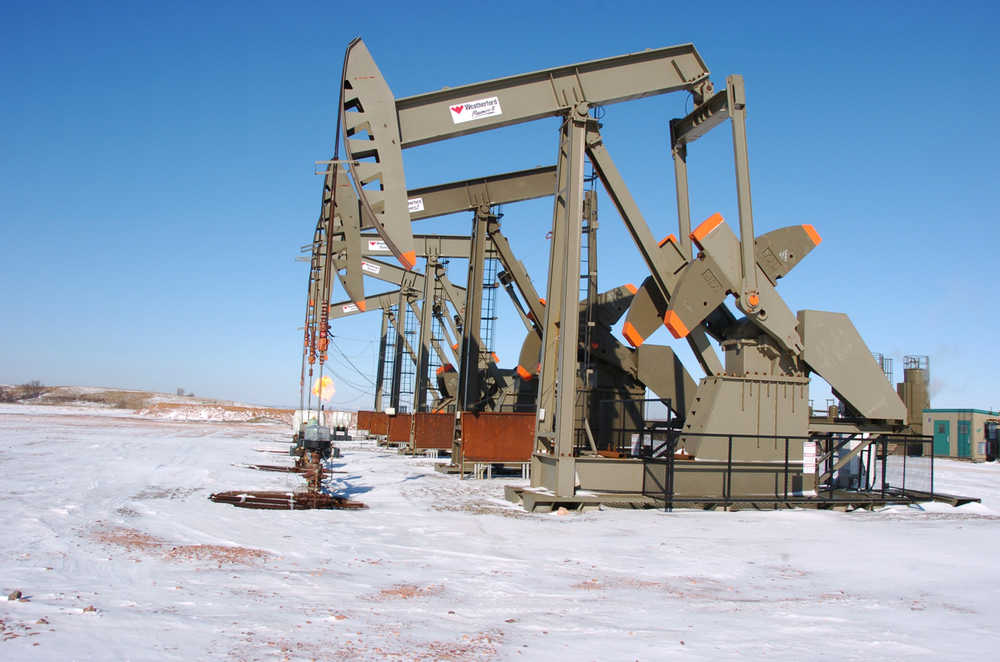
This Feb. 26, 2015 photo, shows an oil well on the Fort Berthold Indian Reservation near Mandaree, North Dakota. U.S. officials announced plans Thursday, July 28, 2016, to speed up permitting for oil and gas drilling on federal and American Indian lands to reduce delays, as applications were projected to be down amid an ongoing price slump. (AP Photo/Matthew Brown)

This Feb. 26, 2015 photo, shows an oil well on the Fort Berthold Indian Reservation near Mandaree, North Dakota. U.S. officials announced plans Thursday, July 28, 2016, to speed up permitting for oil and gas drilling on federal and American Indian lands to reduce delays, as applications were projected to be down amid an ongoing price slump. (AP Photo/Matthew Brown)

US to speed oil, gas permits amid sharp drop in applications

BILLINGS, Mont. — U.S. officials announced plans Thursday to speed up permitting for oil and gas drilling on federal and Indian lands to reduce delays, as applications were projected to be down 40 percent versus their historical average amid an ongoing price slump.

Low energy prices already have curtailed domestic energy exploration, driving down revenue. That’s put a crimp in budgets for the major energy producing states, including Wyoming, New Mexico, Colorado, Alaska, North Dakota and Montana, which receive a substantial share of revenue from oil and gas activity on U.S. lands.

In an attempt to streamline drilling approvals and reduce costs for companies, U.S. Bureau of Land Management Director Neil Kornze said all drilling applications would have to be filed online under the new proposal.

The move follows years of criticism from the energy sector over the Obama administration’s handling of drilling applications. Companies say lengthy delays have driven up costs.

Online-only permitting would allow 90 percent of drilling applications to be completed within 115 days, bureau spokeswoman Beverly Winston said. The average time in 2015 was 220 days.

“The new system is a big improvement over the current, hard copy-based application system,” Kornze said in a statement.

Industry representatives welcomed the attempt to make permitting more efficient and said they have worked with Kornze’s agency to fix glitches that emerged in the automated system in the past few months.

But Kathleen Sgamma with the Western Energy Alliance voiced doubt about the potential time savings. She said the long time to process permits is driven in part by environmental studies and other requirements not counted in the administration’s 220-day processing average.

As an example, she said a drilling application could be filed in January, but surveys of whatever plants are present at the site might have to be done during the summer when the plants are blooming. The intervening months are not included in the government’s processing time estimates, she said.

“We’re a bit skeptical that the (automated) system will result in significant time savings,” Sgamma said. “Generally companies avoid public lands if they can, because they know there’s no certainty on getting through all the leasing.”

It’s uncertain how much the move could stimulate new exploration, which is driven predominantly by oil and gas prices that have fallen dramatically over the past two years.

Oil was selling for less than $43 a barrel Thursday on international markets, versus more than $100 a barrel as recently as mid-2014.

Royalties, rents, bonus payments and other government revenue from oil, natural gas and natural gas liquids topped $12 billion just two years ago.

That figure dropped below $9 billion in 2015. Onshore production from federal lands and American Indian reservations held under government trust accounted for about half the amount.

More in News

The emergency cold-weather warming shelter is seen in Thane on Thursday, April 10, 2025. (Jasz Garrett / Juneau Empire file photo)
Man charged for alleged rape at warming shelter

Staff have increased the frequency of safety rounds, and are discussing potential policy changes.

Photo by James Brooks/Alaska Beacon 
Alaska Gov. Mike Dunleavy speaks during a news conference in Juneau on Thursday, April 27, 2023. To his side is a screen displaying significant budget deficits and exhausted savings accounts if oil prices perform as expected.
Disasters, dividends and deficit: Alaska governor unveils first-draft state budget

In his final year, Gov. Dunleavy again proposes to spend from savings in order to pay a larger Permanent Fund dividend

Eaglecrest Ski Area as seen in a photo posted to the hill’s Facebook page on Tuesday, Dec. 11, 2025. (Eaglecrest Ski Area photo)
Eaglecrest boots up for a limitted opening this weekend

15 degree highs usher in the hill’s 50th season.

Sen. Jesse Bjorkman, R-Nikiski, speaks Wednesday, April 23, 2025, on the floor of the Alaska Senate. (Photo by James Brooks/Alaska Beacon)
State senators express skepticism about proposed Juneau ferry terminal backed by Dunleavy

In a Friday hearing, members of the Alaska Senate spoke critically about… Continue reading

SouthEast Alaska Regional Health Consortium is one of the primary health care providers in Juneau, accepting most major public and private insurance plans. (Mari Kanagy / Juneau Empire)
Marketplace health premiums set to rise in 2026

Here’s what you need to know about how coverage is changing, and for whom.

Capital City Fire/Rescue completes last season’s ice break rescue training at the float pond near Juneau International Airport. (photo courtesy of Capital City Fire/Rescue)
On thin ice: Fire department responds to season’s first rescue at Mendenhall Lake

This week’s single digit temperatures have prompted dangerous ice ventures.

Brenda Schwartz-Yeager gestures to her artwork on display at Annie Kaill’s Gallery Gifts and Framing during the 2025 Gallery Walk on Friday, Dec. 5. (Mari Kanagy / Juneau Empire)
Alaska artist splashes nautical charts with sea life

Gallery Walk draws crowds to downtown studios and shops.

A totem pole, one of 13 on downtown’s Totem Pole Trail in Juneau, Alaska, Nov. 27, 2024. (Christopher S. Miller/The New York Times)

Most Read