
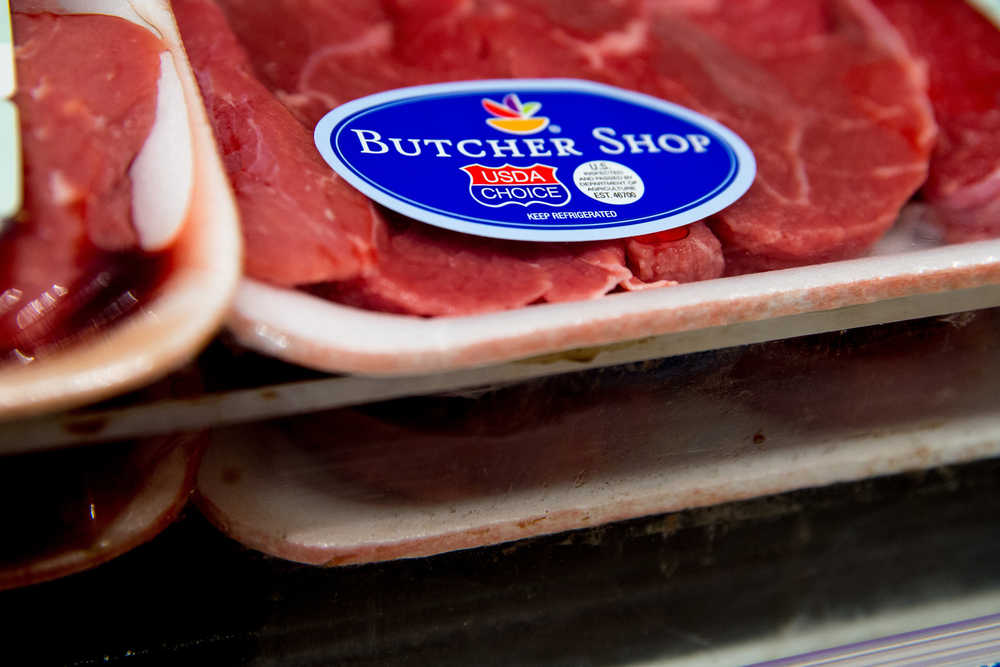
WASHINGTON — It’s now harder to find out where your beef or pork was born, raised and slaughtered.
After more than a decade of wrangling, Congress repealed a labeling law last month that required retailers to include the animal’s country of origin on packages of red meat. It’s a major victory for the meat industry, which had fought the law in Congress and the courts since the early 2000s.
Lawmakers said they had no choice but to get rid of the labels after the World Trade Organization repeatedly ruled against them. The WTO recently authorized Canada and Mexico, which had challenged the law, to begin more than $1 billion in economic retaliation against the United States.
“U.S. exporters can now breathe a sigh of relief,” said Republican Sen. Pat Roberts of Kansas, chairman of the Senate Agriculture, Nutrition and Forestry Committee. The longtime opponent of the labels helped add the repeal to a massive year-end spending bill. After the law was passed, Agriculture Secretary Tom Vilsack said the government immediately would stop requiring the labels.
Consumer groups say the repeal is a disappointment just as consumers are asking for more information on their food packages. Advocates say the labels help people make more informed buying decisions and encourage purchases of American meat.
Before repeal, the labels told shoppers that a particular cut of meat was “born in Canada, raised and slaughtered in the United States” or “born, raised and slaughtered in the United States.” Congress first required the labels in 2002 amid fears of mad cow disease from imported cattle. The labels weren’t on most packages until 2009, though, due to delays pushed by the meat industry.
Repeal became inevitable once the United States lost all its WTO appeals and the retaliation became a possibility. But the consumer groups criticized Congress for repealing the law for ground meat and pork in addition to the fresh cuts of meat that were the subject of WTO concerns.
The bill was “a holiday gift to the meatpacking industry from Congress,” complained the advocacy group Food and Water Watch. Meatpackers who buy Mexican cattle were some of the law’s most aggressive opponents.
The repeal also was a big defeat for lawmakers from northern border states where U.S. ranchers directly compete with Canadian ranchers. Those lawmakers insisted on including the labeling in the 2002 and 2008 farm bills and this year fought to replace it with a voluntary program once the WTO rulings came down. But after years of success, this time they were not able to find enough support.
Roger Johnson of the National Farmers Union, which has heavy membership in those states, said the group was “furious” about the repeal.
“Packers will be able to once again deliberately deceive consumers,” Johnson said.
Still, there was some good news for food labeling advocates in the spending bill. Despite an aggressive push by the food industry, lawmakers decided not to add language that would have blocked mandatory labeling of genetically modified ingredients. Also, a provision by Sen. Lisa Murkowski, R-Alaska, would require labeling of genetically modified salmon recently approved by the Food and Drug Administration.
The issue is expected to come up again in 2016, with Vermont set to require labeling on genetically modified food this summer.
The day the spending bill passed, Vilsack said he would try to help Congress come up with a middle ground on labeling of engineered foods “in a way that doesn’t create significant market disruption, while at the same time recognizing consumers’ need to know and right to know basic information.”
___
Follow Mary Clare Jalonick on Twitter at http://twitter.com/mcjalonick
