
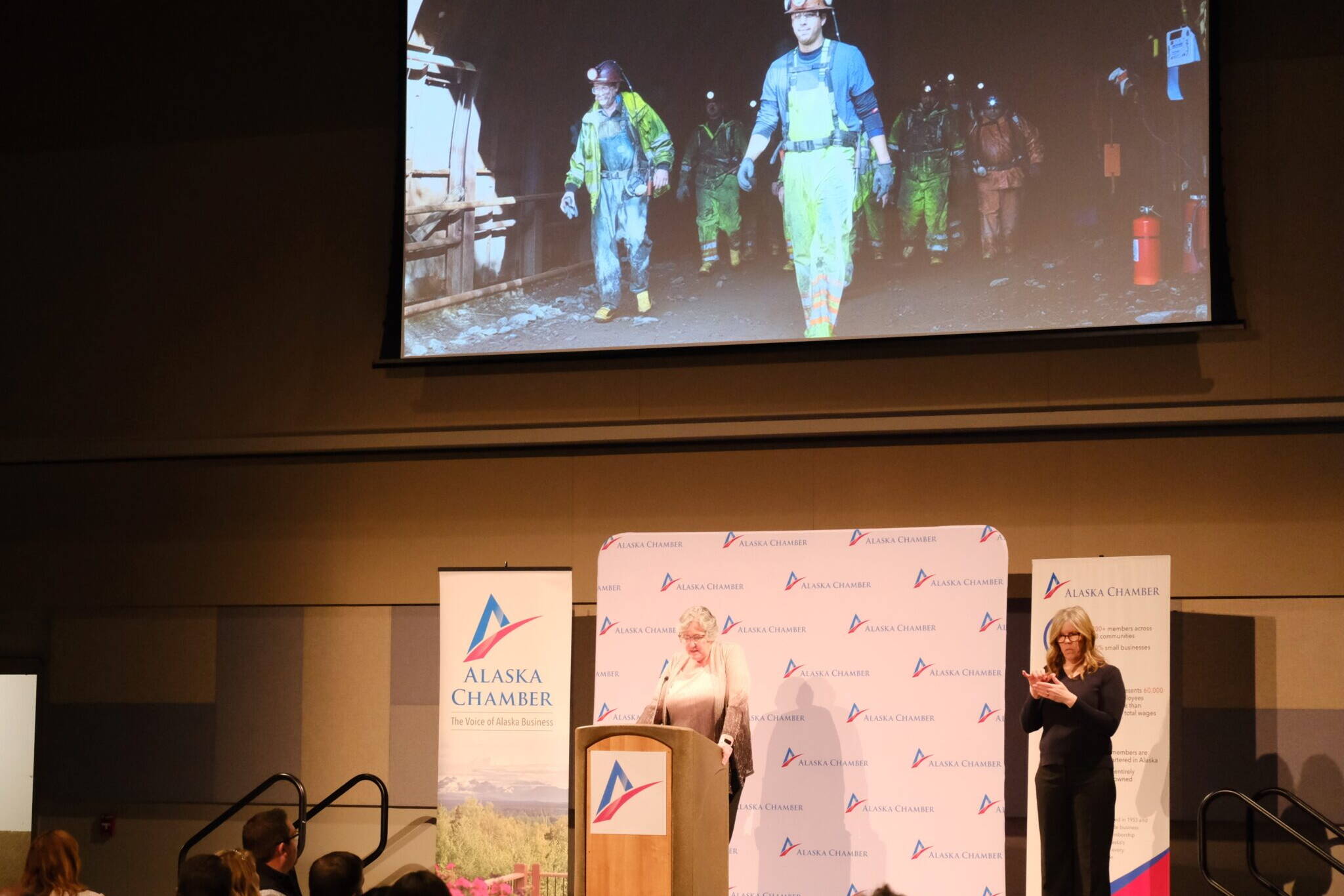
University of Alaska President Pat Pitney focused on the university’s critical role in retaining talent and driving the state’s research, workforce and economic development in the recent annual State of the University address.
But Pitney acknowledged in the Jan. 30 speech that there are “headwinds” and challenges, like the numbers of high school graduates declining, rising costs, and the uncertainty ignited by recent federal executive orders and potential budget cuts.
“I’m confident that together we can overcome these challenges,” she said. Pitney delivered the speech at the Alaska Chamber’s Legislative Fly-In Luncheon at Centennial Hall in Juneau.
“Investing in and engaging with the University of Alaska is necessary to build a skilled workforce in our state,” she said. “With vocational and industry certificates, to baccalaureate and graduate degrees, we’re not just educating, we’re ensuring a brighter future for Alaska.”
She said the university is focused on investing in growing enrollment, improving retention, and speeding student’s time to graduation.
Beginning last year, student enrollment increased for the first time since 2011, and continued to rise 3% in the fall semester, to an estimated 19,600 students.
The university system offers a variety of academic and vocational programs, she said, From short-term work development to doctoral programs, the university provides a wide range of opportunities for Alaskans, to stay living and working in-state.
“But in our state, fewer students choose to go on to higher education, not just here, but anywhere,” she added, in an interview after the speech. “Then of the people who go to higher education, a lot feel like it’s time to go outside. But we have many programs where a student can start with us and go on a national student exchange to almost any university in the nation, on in-state tuition.”
The surge in Alaska Performance Scholarship awards is also helping Alaskans stay and study in-state, she said. Last year, 65% more scholarship-eligible students applied and enrolled in UA. Those awards were made larger this year, and can be used for any program, she added.
“They can use it for any degree level they want – a traditional degree such as biology, fisheries, computer science, engineering, finance, nursing, pre-med, or a 1- or 2-year workforce credential in health care, welding, aviation, process technology, construction management, and many others,” she said.
Pitney said these programs can help reverse the states’ population decline.
For the business audience she was addressing, she emphasized the university as essential to the state’s workforce development, as “Alaska’s largest and most comprehensive workforce provider, offering over 200 career and technical education programs.”
She highlighted the university continuing to build partnerships with industries, including construction management and mining.
She also emphasized scientific research projects. Research revenues have grown by 50% over the last five years to nearly $240 million. “For every one dollar of state funding we receive, we leverage eight in federal and other research funds,” she said. “That’s being noticed.”
The Arctic in particular, is a major center of research and economic development, she said, including for the maritime and aviation industries, national security and the new Arctic Leadership Initiative.
“In a changing and globalized Arctic, UA’s position as the only U.S. public institution in the region allows us to attract interest and knowledge from around the world to improve Alaska’s future,” she said.
But Pitney acknowledged “turbulence ahead” with the Trump administration’s threatened cuts to federal funding.
“As we navigate the federal executive orders, I want our researchers to know that I appreciate each of them, and the valuable work they do,” she said. “They and the incredible research they do positions UA to manage some of the current turbulence.”
A federal judge’s ruling temporarily blocked the presidential order last week.
When asked about the federal funding freeze in an interview, she pointed to some of that funding required by contract.
“If it does happen, we have about just over $600,000 a day in federal receivables,” she said. “It’s $16 million-plus a month, and $200 million across a year, that’s the amount of federal work we do across the system. If it’s a pause for a week, we just have a bigger receivable.”
Pitney said there’s “a very low chance” that the pause would become a full-blown cancellation of federal spending, “because these are contractual obligations.”
National Science Foundation grants are in limbo, as well as grants with the National Institutes of Health, with a freeze on grant reviews, communications, hiring and travel. But she said the NIH freeze would have a lesser impact on university research.
“We don’t have a lot of NIH research. We have some,” she said. “The existing grants will come through. The new grants will be delayed, but it’s a smaller portion of our overall research portfolio.”
Pitney expressed optimism a federal review would favor Alaska’s programs.
“So, you know, it’s really (about) the holding on to the receivables until they do pay,” she said. “But our emphasis in research is very much aligned with what the federal government wants to accomplish. So we will weather it as well as anyone.”
• Corinne Smith started reporting in Alaska in 2020, serving as a radio reporter for several local stations across the state including in Petersburg, Haines, Homer and Dillingham. She spent two summers covering the Bristol Bay fishing season. Originally from Oakland, California, she got her start as a reporter, then morning show producer, at KPFA Radio in Berkeley. This article originally appeared online at alaskabeacon.com. Alaska Beacon, an affiliate of States Newsroom, is an independent, nonpartisan news organization focused on connecting Alaskans to their state government.
