
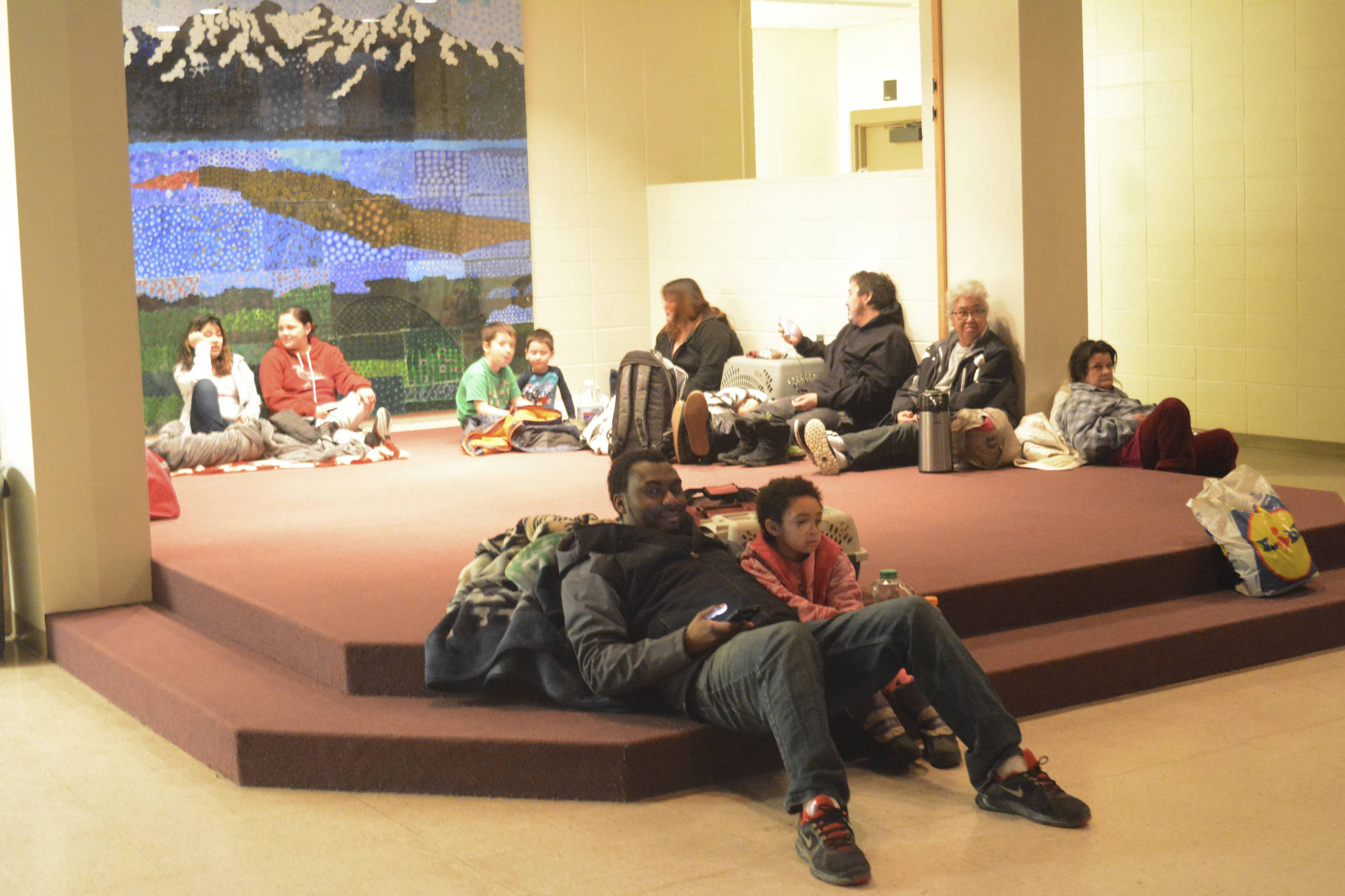
ANCHORAGE — A powerful undersea earthquake sent Alaskans fumbling for suitcases and racing to evacuation centers in the middle of the night Tuesday after a cellphone alert warned that a tsunami could smash into the state’s southern coast and western Canada.
The killer wave never materialized, but people endured several tense hours in shelters, waiting for a potential catastrophe that could wipe their communities away at any moment.
The magnitude 7.9 quake in the Gulf of Alaska triggered the jarring alert that awoke people shortly after midnight Tuesday. Fleeing motorists sometimes clogged the only highway in their rush to get to higher ground. Many took refuge at schools and other shelters.
For Alaskans accustomed to tsunami threats and regular tsunami drills, the early morning alert still created some fretful moments. The phone message read: “Emergency Alert. Tsunami danger on the coast. Go to high ground or move inland.”
Keith Perkins got the phone alert and later heard sirens going off in his hometown of Sitka. He said people on Facebook were talking about whether the threat was real and what they should do.
Given the magnitude of the earthquake, Perkins said, he thought it best to head to the high school, a tsunami evacuation point, even though in the past he felt his home was probably high enough.
“I figured I’d probably just better play it safe,” he said.
Hours later, the tsunami warning was canceled and people were allowed to return home for an hour or two before the normal workday began.
There were no reports of damage, not even on Kodiak Island, the closest land to the epicenter.
Only after the all-clear was sounded did a little levity emerge. In Kodiak, King’s Diner invited folks to breakfast on its website: “Hungry? Tsunami got you up early.”
The quake was recorded at 12:32 a.m. in the Pacific Ocean about 170 miles southeast of Kodiak, home to one of the nation’s largest Coast Guard bases.
The temblor prompted the warning across thousands of miles of Alaska’s southern coast, from Attu in the Aleutian Islands to Canada’s border with Washington state. Kodiak is about 200 miles south of Anchorage, the state’s largest city, which was not under a tsunami threat.
Elsewhere in the United States, Washington state, Oregon, California and Hawaii were under tsunami watches, which eventually were lifted. Officials in Japan say there was no tsunami threat there.
People reported on social media that the quake was felt hundreds of miles away, in Anchorage. Reports varied about how long the quake’s shaking lasted, depending on location.
In the popular cruise-ship town of Seward, about 110 miles south of Anchorage, Fire Chief Eddie Athey said the quake felt like a gentle rattle that lasted for up to 90 seconds.
“It went on long enough that you start thinking to yourself, ‘Boy, I hope this stops soon because it’s just getting worse,’” Athey said.
The earthquake woke Kodiak Police Lt. Tim Putney from a dead sleep. He said it shook for at least 30 seconds but acknowledged that his estimate might be skewed by sleeping through some of it.
“I’ve been in Kodiak for 19 years. That was the strongest, longest-lasting one I’ve ever felt,” he said by telephone.
The Alaska Earthquake Information Center categorized the shaking as light.
John Bellini, a geophysicist with the U.S. Geological Survey’s National Earthquake Information Center, said there had been more than two dozen aftershocks as of about 6:30 a.m. The biggest had a magnitude of 5.3.
The earthquake was initially reported as magnitude 8.2, but Bellini said as more data comes in, better calculations can be made. Earthquake waves take time to spread.
Kodiak was projected to get the first tsunami wave.
Larry LeDoux, superintendent of the Kodiak Island Borough School District, estimated that about 500 people took shelter at the high school. He described the atmosphere inside as calm, with people waiting for updates.
He said sirens go off in the community every week as a test to make sure they are working.
In Seward, at the southern end of Alaska’s Kenai Peninsula, residents retreated to higher ground or left on the only road out of the city, the fire chief said. He described it as a controlled evacuation and compared it to people driving home from a holiday fireworks show.
