
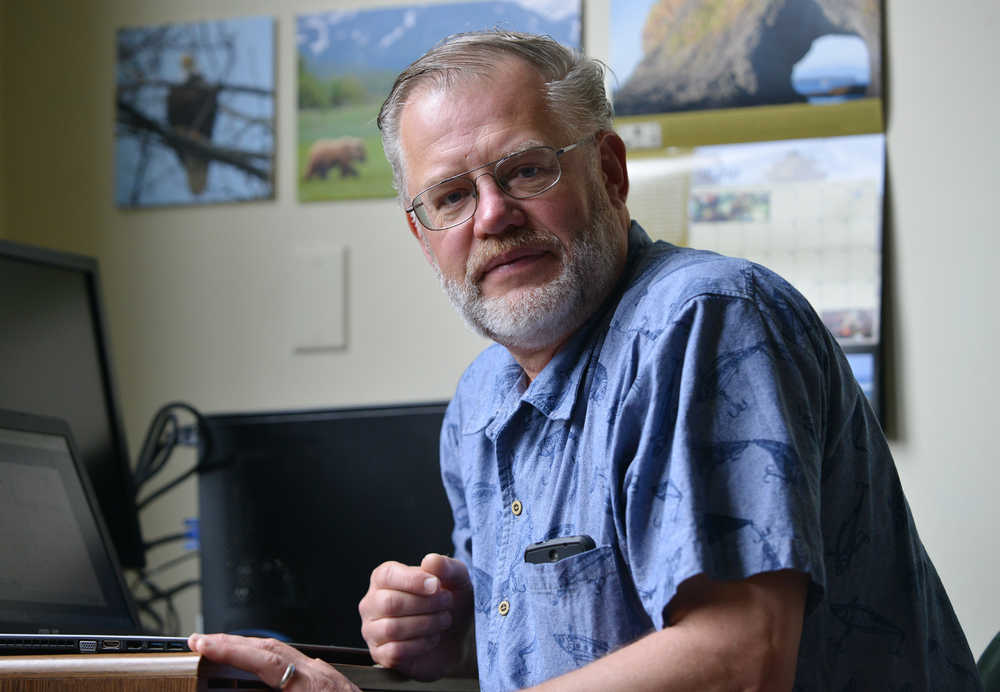
SITKA — Is Sitka interested in finding out about the presence of heavy metals, contaminants and nutrients in some of the subsistence foods we eat? Do organizations in Sitka want to collaborate on a project to find the answers?
Those were the questions Dr. Todd O’Hara of University of Alaska Fairbanks was hoping to answer on a scoping mission this week to Sitka and Hoonah, meeting with nonprofit, educational and tribal organizations.
O’Hara would like to find out the level of interest in expanding on the knowledge built up through a statewide fish tissue monitoring program, but focusing on Admiralty, Baranof and Chichagof islands.
“Are we welcome?” he asked.
O’Hara is coordinator of pre-vet and veterinary student services and professor of veterinary pharmacology and toxicology at the University of Alaska Fairbanks.
He’s applying for a grant from the National Institutes of Health for a new study, and says community participation by organizations in Sitka, Angoon and Hoonah will be key.
“I can’t accept it if I don’t have people from the community legitimately engaged,” O’Hara said.
In Sitka, he met with representatives from the University of Alaska Southeast, Sitka Sound Science Center, Northern Southeast Regional Aquaculture Association and Sitka Tribe of Alaska to gauge interest and see if those organizations would like to take part in the study.
He said the idea is to develop a community-based scientific approach to address the main foods of the ABC Islands, including fish, shellfish and marine mammals. The five-year study grant would have a budget of $1 million a year. The draft title is “Assessing Pathways of Contaminants: Diet and Ecology.”
“After looking at samples collected we would like a better representation of subsistence species, in particular mammals,” O’Hara said. “We want to have a balanced number of samples, if the communities are interested.”
He said the goal of the project is to develop a research approach and collect preliminary data, gather information, do team building and capacity building, and find out if any groups aren’t interested in collaborating.
O’Hara said the study will “assess a suite of chemicals of interest” in common foods collected through subsistence, recreational and sport fishing, including mining-related elements (metals), local chlorinated chemicals such as dioxins, PCBs, DDT, and biotoxins such as PSP and domoic acid.
The project should combine the strengths of each of the participating communities and link groups together in a common mission.
He plans to move ahead with applying for funding for the study of the ABCs only if he gets a definite “yes” from the communities. So far, those he’s met with have been receptive.
“It would appear people want to be engaged, but there’s always a negative with some of this,” O’Hara said.
O’Hara said currently there’s a collaborative fish tissue monitoring program between UAF and the state, started in 2001, to determine the presence of bioaccumulative contaminants in Alaska’s fish, and monitor spatial and temporal trends in the levels of those contaminants in fish tissue.
“Important commercial, recreational, and subsistence fish and shellfish species are analyzed for trace metals (methyl mercury, total mercury, arsenic, selenium, copper, lead, cadmium) as well as persistent organic pollutants (POPs) such as dioxins and furans, organochlorine pesticides, PCB congeners, brominated fire retardants, personal care products, and pharmaceuticals,” the state Department of Environmental Conservation website said, in a description of the program.
Fish and environmental samples have been collected from around the state, primarily in coastal marine waters and some coastal watersheds. Fish are collected from streams, rivers, and lakes in the Koyukuk, Kuskokwim, Yukon, Kobuk, Selawik and Susitna River drainages.
“Industry, regulators, scientists and the public benefit from this information by being able to make informed decisions about fish consumption and the impact of environmental contaminants on commercial and subsistence fisheries in Alaska,” the website states.
“It’s not evenly distributed over the state,” O’Hara said.
He said there does appear to be interest among the organizations he has talked to so far. He hopes the study will answer some concerns and provide information not only about heavy metals, chlorinated chemicals and biotoxins, but also nutrients that benefit those who consume the dozens of subsistence foods.
“Mercury is the one that has people concerned. We want to have balance in the number of samples if the communities are interested,” O’Hara said.
He spent a few days in Sitka before heading to Hoonah to talk with organizations there, then back to Sitka for more meetings before returning to Fairbanks.
