
The Trump administration is eying the possibility of oil leasing in Arctic Ocean areas more than 200 miles from shore, an area where U.S. territorial rights are unclear.
Information about the Trump administration’s plans to add a “High Arctic” planning area to the federal offshore oil and gas leasing program, announced two weeks ago, was provided Tuesday in a formal solicitation for public comment. The U.S. Bureau of Ocean Energy Management, a division of the Department of the Interior, said it will accept public comments for 45 days on its proposal to reorganize the federal offshore leasing program, including the addition of the High Arctic area.
The new area proposed for inclusion in the oil and gas leasing program is part of the ocean territory to which the U.S. government is claiming new rights following a sea-mapping program conducted over several years.
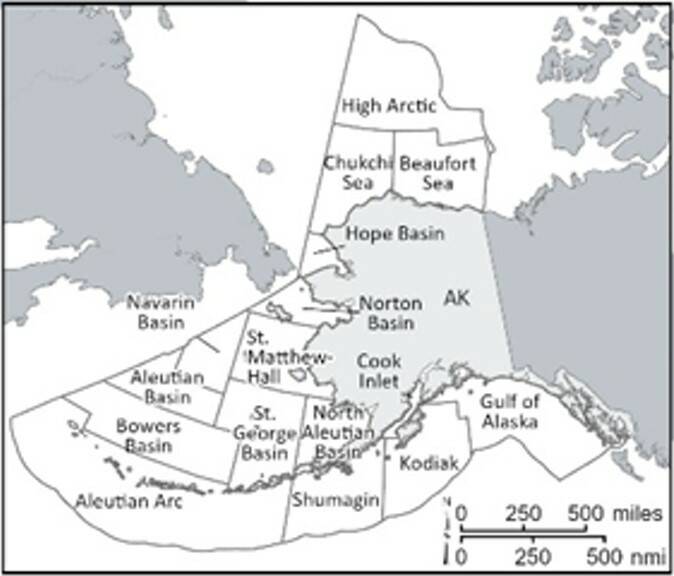
Revisions to U.S. Outer Continental Shelf planning areas off Alaska are shown in this map from the U.S. Bureau of Ocean Energy Management. The proposed High Arctic area is new and based on recent U.S. territorial claims. (Map provided by the U.S. Bureau of Ocean Energy Management)
The area is part of what is known as the extended continental shelf, which goes beyond exclusive economic zone borders that typically end at 200 nautical miles from shore.
The U.S. State Department in December 2023 began the process of claiming over 200,000 square miles of Arctic seafloor in the extended continental shelf. That area is more than twice the size of California.
Nations’ territorial rights in extended continental shelf areas beyond the 200-nautical-mile limits are limited to the seafloor and subsea areas, under international maritime law. They do not include any rights in the waters above, such as fishing rights.
Such territorial claims are normally evaluated for validity by a United Nations organization, the Commission on the Limits of the Continental Shelf. While State Department information expresses an intent to submit the U.S. territorial claims to the commission, the commission’s website shows no pending U.S. applications.
The U.S. has never ratified the treaty under which the commission operates, the United Nations Convention on the Law of the Sea. That puts U.S. claims to the Arctic Ocean territory in some doubt; Russia has already objected, arguing that the U.S. is not part of the ocean treaty and therefore not entitled to its benefits.
It is difficult to know whether the U.S. government has a right to sell oil leases in the newly claimed High Arctic territory, an Anchorage environmental attorney said.
“In the international realm, it’s not always clear all the time,” said Teresa Clemmer, litigation director for Trustees for Alaska, an environmental law firm.
As to why the Department of the Interior would designate an oil and gas leasing area in the High Arctic in murky legal circumstances, Clemmer said, there may be parallels in Russian and Canadian government actions that started exercising regulatory authority in Arctic areas where their territorial rights were not certain.
“That’s a way of getting a foot in the door and establishing that they have this authority,” she said.
Neither the Department of the Interior nor the State Department provided additional information to clarify the status of the territorial rights in the High Arctic or plans for oil development there.
Oil potential and industry interest also unclear
Mark Myers, a geologist and former director of the U.S. Geological Survey, said there is some indication of oil and gas potential in the High Arctic region designated for possible inclusion in the BOEM program.
He pointed to the Circum-Arctic Resource Appraisal released in 2008 by the USGS. The study used data collected by crews working on two icebreakers, the U.S. Coast Guard’s Healy and the Canadian Coast Guard’s Louis S. St-Laurent. But that information, too, is preliminary, Myers said.
“It’s possible that some of the southern area would have oil and gas potential based on the CARA study, but a more robust, technical evaluation of the area for oil and gas potential would be something that would be important for the federal government to do,” said Myers, who also served previously as commissioner of the Alaska Department of Natural Resources and director of the Alaska Division of Oil and Gas.
The CARA study also indicated the presence of critical minerals beneath the High Arctic seafloor, but any development of those would be outside of the oil leasing program, Myers said.
If BOEM winds up establishing a designated leasing region, it would not guarantee that any lease sales will follow, Myers noted. “It’s a very, very preliminary step,” he said.
To Clemmer, the idea of setting up a High Arctic leasing region is consistent with the Trump administration’s pro-resource-extraction policies and “wanting to open up every possible place to oil and gas development.”
But offshore exploration there might be unappealing to oil companies for reasons beyond legal uncertainty.
The High Arctic is very remote, harsh and distant from infrastructure support that oil companies might need, Clemmer noted. “I don’t see how the economics would be panning out for them,” she said.
Even the Arctic offshore areas that are within the U.S. exclusive economic zone — the Chukchi Sea and the Beaufort Sea — hold uncertainty for oil companies.
Litigation is underway over whether the Trump administration has the authority to reverse Biden administration and Obama administration decisions putting those areas off-limits to new leasing. A previous attempt in the first Trump administration was blocked in 2019 by the federal court in Anchorage.
Operations in the federal offshore areas in the Arctic have proved to be more expensive and difficult than onshore Arctic operations. The most recent attempt was by Royal Dutch Shell, which abandoned its program in 2015 after spending what it said was over $7 billion but drilling only one well to depth.
There has never been any commercial oil production in any federally managed outer continental shelf area off Alaska’s coastline except for a small portion of the Hilcorp-operated Northstar field, which lies mostly on state territory in the Beaufort Sea but overlaps a bit into federal territory.
Myers said industry interest in returning to federal Arctic offshore areas is yet to be determined.
If it exists, it would likely be focused on sites where oil has been discovered but never produced, he said. He cited the Liberty field in the Beaufort Sea, where development has been eyed since the 1990s but where plans by BP Exploration (Alaska) Inc. and Hilcorp have stalled. He also listed the Kuvlum and Hammerhead prospects in the Beaufort Sea, which date back to the 1980s. Both are very far from shore, and neither has been deemed commercially viable.
While the current administration may be favorable on offshore Arctic oil development, that could change in the future, presenting another risk for oil companies considering the idea, Myers said.
“People are always going to wonder about long-term changes in policy as administrations change,” he said.
Elsewhere in the Arctic Ocean, the U.S. and Canada have a longstanding dispute over territorial rights in the Beaufort Sea off the Alaska-Yukon border. That has affected some past U.S. oil lease sales in the Beaufort, in 2003, 2005 and 2007, for example. A few tracts in the disputed zone were offered for leasing in those sales.
Exploration in that disputed territory has not occurred, and the U.S. and Canada last year started new negotiations over the competing Beaufort Sea territorial claims.
• Yereth Rosen came to Alaska in 1987 to work for the Anchorage Times. She has reported for Reuters, for the Alaska Dispatch News, for Arctic Today and for other organizations. She covers environmental issues, energy, climate change, natural resources, economic and business news, health, science and Arctic concerns. This article originally appeared online at alaskabeacon.com. Alaska Beacon, an affiliate of States Newsroom, is an independent, nonpartisan news organization focused on connecting Alaskans to their state government.
