
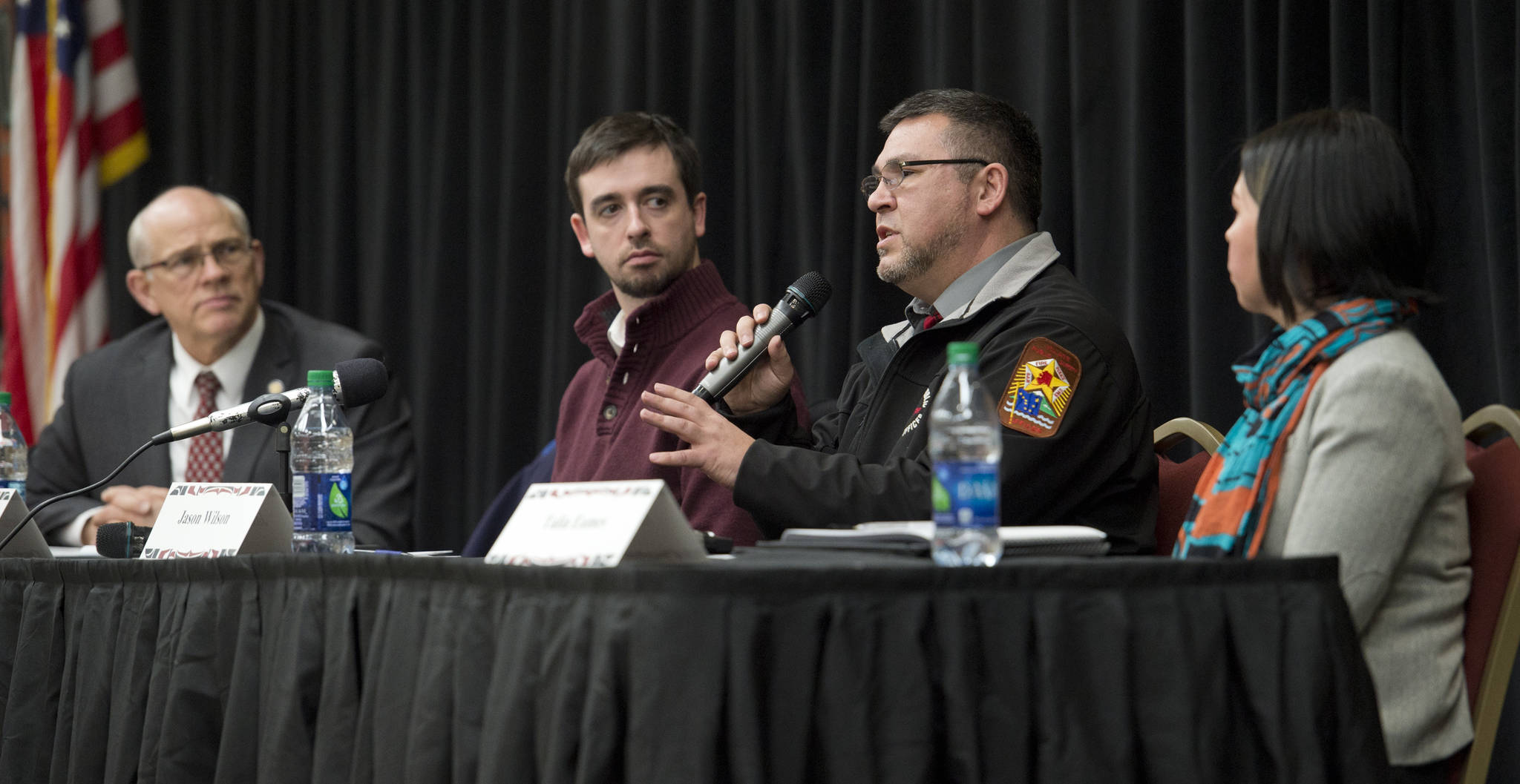
Hosting Native Issues Forums that are open to the public on topics such as criminal justice reform provides a great opportunity to hear presentations on political issues of interest to the Alaska Native community.
But that education goes both ways, stressed Richard Peterson, president of the Central Council of the Tlingit and Haida Indian Tribes of Alaska.
“It’s important not just for us, but for the legislators and decision-makers, to hear those valuable comments” from the community, Peterson said after Thursday’s forum on criminal justice reform.
The lunch-time forum featured Sen. John Coghill, R-North Pole, and Coghill’s legislative aide, Jordan Shilling, as well as Jason Wilson, the public safety manager for Central Council, and Talia Eames, the program coordinator of the Second Chance Reentry Program.
“You heard some things said (by community members during the question and answer period) that Sen. Coghill said were not even in his thought process,” Peterson noted.
Coghill and Shilling focused on Senate Bill 91, which was enacted in July of last year to address problems of recidivism and prison over-population, and on Senate Bill 54, which would roll back some of SB 91’s provisions. SB 54 currently is in the Senate Judiciary Committee, which is chaired by Coghill.
Coghill said he has focused on the two-pronged task of holding people accountable for their crimes and giving them avenues for success. He noted that criminal justice reform is “right in the middle of implementation,” and that many of the diversion programs are not yet in place.
The judiciary committee currently is hearing testimony from stakeholders in law enforcement, Coghill told the crowd at Elizabeth Peratovich Hall during Thursday’s forum. The result of that feedback, he said, was a move to restore more discretion to judges in sentencing and provide more tools to police.
Shilling said SB 54 consists of “tweaks” to the recommendations of SB 91, and said the priority is to get the bill passed this year.
Wilson, whom Peterson said was only the second Alaska Native to serve on the state parole board, spoke to the audience about that experience.
Wilson highlighted a positive change due to criminal justice reform in how offenders who violate conditions of parole get treated. Under the old system, he said, a defendant could languish in prison for up to 15 days before their hearing.
”We have people who are trying very hard to better their lives,” he said. “Part of treatment is relapse. If a person relapses, violates parole and goes to jail and loses their home and loses their job, they come back out and have to start all over.”
Under the new system, the first time a person violates parole, it’s an automatic three-day sentence, with steeper consequences for each successive violation.
”It’s a reminder, but hopefully they still have a home and a job,” he said.
Wilson also said there is a definite bottleneck in the ability to provide treatment, especially in smaller communities.
“If we refer (to a program), the person could be waiting a couple of months to even get an assessment,” he said. “That’s a problem we need to address.”
Wilson said it is easy to criticize the attempts to reform the criminal justice system, adding, “the way our system is set up right now is not working. … I think this will take time, but I’m looking forward to it.”
Eames quoted some sobering statistics about the disproportionate representation of Natives in the prison population to highlight the importance of reentry services.
The Second Chance program already is in place at Lemon Creek Correctional Center, she said, adding they hope to initiate a peer support program in the future.
The task for the Native community is to be compassionate while holding people accountable, Peterson told the audience, citing plans in the works to expand the tribal court.
The next Native Issues Forum is March 16 and will feature Reps. Dan Ortiz and Jonathan Kreiss-Tompkins. For more information go Central Council’s website at http://www.ccthita-nsn.gov/info/events/2017nativeissuesforums.html.
Contact reporter Liz Kellar at 523-2246 or liz.kellar@juneauempire.com.
