
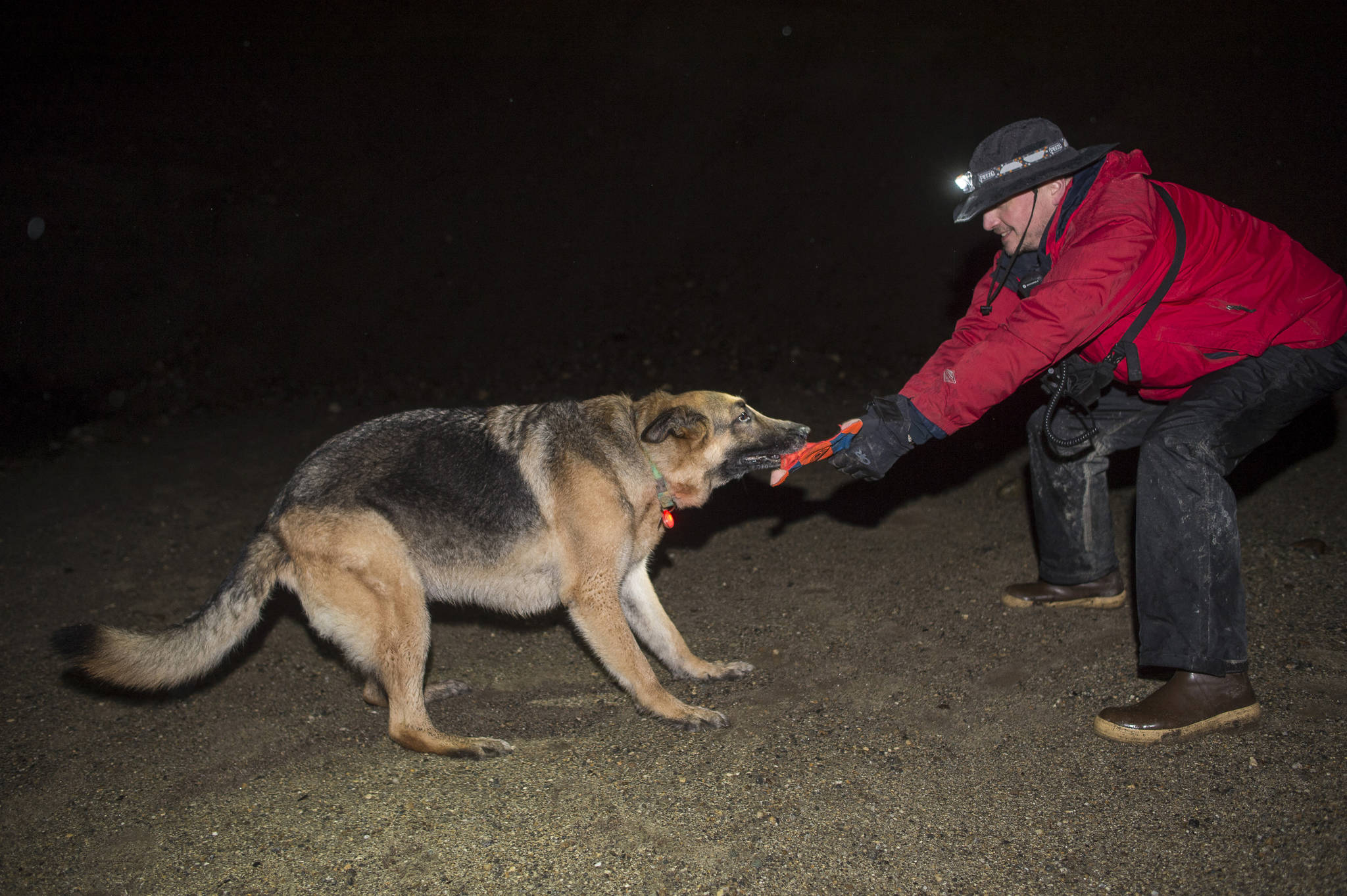
A German shepherd named Panzer, a golden retriever named Sage, a skinny, fast looking dog nicknamed the “brown bullet”: Just about any dog, so long as they like to play, can learn to track humans.
But it’s a lot of work to do so reliably. The Southeast Alaska Dogs Organized for Ground Search (SEADOGS) work once a week to stay sharp, and dogs not yet certified can expect to train every day with their owner.
If you get lost around Juneau, SEADOGS is part of a multi-agency search and rescue effort that includes the Alaska State Troopers, Juneau Mountain Rescue, Juneau Police Department, the U.S. Coast Guard and Capital City Fire/Rescue.
The Empire tagged along for a recent workout to learn how Juneau’s working dogs train to save lives. Learning to do so requires the same skill it takes to get to Carnegie Hall. Mostly, it’s just practice, practice, practice.
About 10 people and eight dogs met at the corner of The Home Depot parking lot on a recent Wednesday. They were there to sharpen their skills doing what’s called wilderness training. That’s the type of training dogs will use to clear an area, volunteer Stacey Poulson, owner of Sage, explained.
Dogs can be certified in several different skills, including finding human remains, avalanche search, and rescue and water training. SEADOGS trains at Eaglecrest and by the Mendenhall Glacier and other spots around town. Sage is trained to find human remains, people caught in avalanches, water and wilderness.
To get the SEADOGS certification, Sage had to clear a 60-acre area, finding each of the humans in the area. The dogs don’t know how many people they’re supposed to find. They also have to clear an empty area.
“They have to have two or more people that they find within a two-hour period,” Poulson explained. “They never know the number of people they’re looking for.”
The dogs’ job at the workout that night was to find three people hiding in separate spots in a large rock quarry next to The Home Depot.
The dogs learn by incentive. Owners typically take a toy away from the dogs and use a key phrase to let the dogs know it’s time to work. Dogs will naturally seek out new scents, which the hiding or lost humans have.
If they receive the toy after locating the source of the human scent, they start to learn that they’ll only get the toy back after finding a human.
Poulson takes a length of rope, used for tug-of-war, away from Sage and says the words “find him.” Sage knows she has to lead Poulson to any human in the area before she’ll get the toy back.
Sage puts her nose to the ground and starts moving quickly. Dogs search by scent. Their eyesight isn’t great but their noses are approximately 20 times more sensitive than humans.
Human scent does one of two things: It’ll drop to the ground to be caught by vegetation or float up in the air. Ground scents offer the dog a straight line to a human. Scents in the air form “cones” that spread out behind a human. Dogs will follow an air scent in a zig-zag pattern, bouncing from one side of the cone to another until it narrows close to the location of the human.
Panzer, a 96-pound German shepherd owned by U.S. Coast Guardsman Liam Higgins, tracked his third find of the night through an air cone scent. It was tough going for the energetic 7-year-old: swirling air currents carried Panzer far away from where Higgins was pretty sure the human volunteer was hiding, on the bank of a creek next to an old truck weigh station.
Panzer had found the first two humans quickly, but the third human was much tougher to locate.
Panzer looked to Higgins for clues. He’ll do that if he doesn’t know where to look next but Higgins doesn’t want to taint the process and distract Panzer from working it out through his nose.
“I’m just going to ignore him for a second and talk to you,” Higgins said, turning away from the dog. Panzer then let out a frustrated howl.
“Show me,” Higgins said. The dog led him down the embankment by the river to where the volunteer was hiding.
Both Sage and Panzer found all of the hiding humans they were tasked with finding during the workout. That’s part of the design of training, volunteers want their dogs to get used to finding humans, to reinforce the cycle of work and reward. They don’t get that same satisfaction from an actual search and rescue, where dogs don’t always locate lost humans directly but are part of a team that helps narrow down vast search areas.
When somebody is actually lost, the Alaska State Troopers are the lead organization. They’ll run an incident command which coordinates the search and rescue effort.
SEADOGS has its own incident command that works with AST. Each dog wears a GPS collar which allows the team to track where they’ve been. If a dog hasn’t found a human in an area, they know to focus resources elsewhere.
If a friend or family member is feared lost or is in need of search and rescue, call the Alaska State Troopers at 465-4000.
• Contact reporter Kevin Gullufsen at 523-2228 or kevin.gullufsen@juneauempire.com. Follow him on Twitter at @KevinGullufsen.
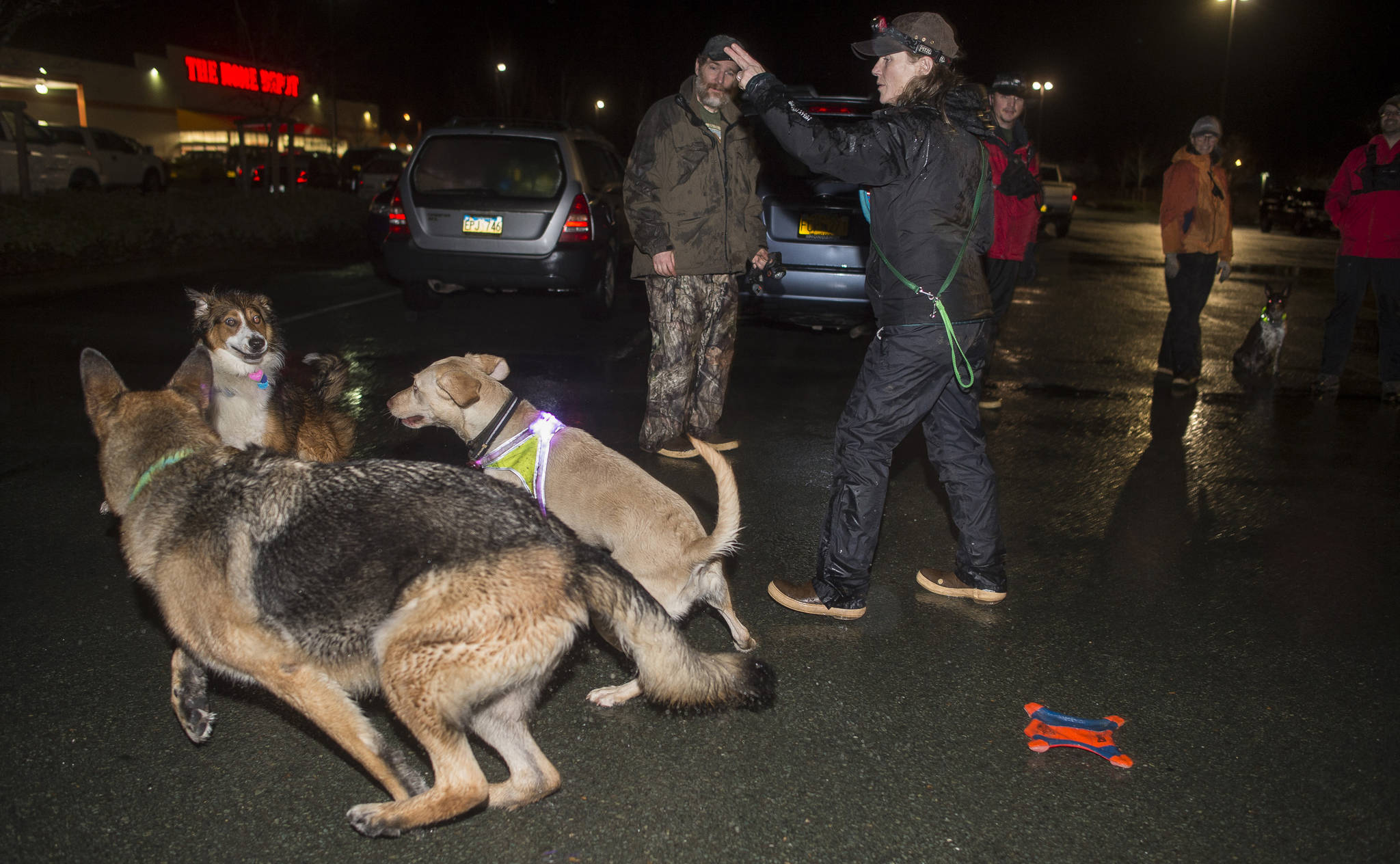
Members of the SEADOGS K-9 search and rescue team gather for practice at The Home Depot parking lot on Wednesday, Dec. 13, 2017. (Michael Penn | Juneau Empire)
