
SMYRNA, Ga. — Adventure Outdoors is an 80,000-square-foot store with walls lined with long guns, cases packed with handguns and aisles jammed with all the accessories an avid outdoorsman would need: coolers, clothing, ammo. At the customer service counter is a government-issued poster that warns: “Don’t lie for the other guy.”
Store founder Jay Wallace said his staff is diligent about making sure buyers are legitimate and not fronting for someone who is legally prohibited from buying a gun. But once a sale goes through, he said, it’s out of his hands.
“A firearm takes on a life of its own after it leaves. It can be bought and sold many times over,” Wallace said.
The flow of guns from one person to another, and from states with loose gun laws to those with strict ones, has long flummoxed law enforcement and gun-control advocates and is emerging again as a hot topic.
Democratic presidential candidate Hillary Clinton singled out rival Bernie Sanders’ home state of Vermont, which has few gun restrictions, for supplying a disproportionate share of firearms used in crimes in New York. (She exaggerated: in reality, many more guns flow in from states to the South.) California Gov. Jerry Brown, after the San Bernardino attack, charged that lax gun laws in Arizona and Nevada have created a weapons pipeline into California. And Chicago has long been plagued by guns traced to points as far away as Mississippi.
While the vast majority of guns used in crimes were originally sold legally, what happens to such weapons after their initial sale is difficult to track and even harder to prevent, because most criminals get their guns from friends, family or on the street.
“We have very little information about the precise course that all the guns take that are used by criminals,” said Daniel W. Webster, director of the Johns Hopkins Center for Gun Policy and Research.
The government has essentially two snapshots of a gun: where it was purchased and where it was recovered, an incomplete picture because not every gun recovered by police is traced.
Data from the U.S. Bureau of Alcohol, Tobacco, Firearms and Explosives show that guns used in crimes usually are bought in the state where the offense is committed.
Of the 7,686 firearms recovered in New York that were traced by the ATF in 2014, 1,397 were originally sold in New York. The top out-of-state source of firearms was Virginia, where 395 firearms originated, followed closely by Georgia and Pennsylvania.
After the attacks in San Bernardino, California’s governor noted that his state has some of the country’s toughest gun laws and complained that neighboring Arizona and Nevada are “a gigantic back door through which any terrorist can walk.” The governors of Nevada and Arizona rebuked Brown and, in any event, the guns used in the attacks were bought legally in California.
Around the U.S., the data suggest three significant routes for out-of-state guns: the “iron pipeline” that runs along Interstate 95 from the South to the Northeast; a path from Mississippi and Indiana into Chicago, which has some of the toughest run restrictions in the nation and does not have a single gun shop within the city limits; and a channel that runs from Arizona and Nevada into California.
I-95’s accessibility — it connects more than a dozen major cities — makes it nearly impossible for law enforcement to prevent firearms from making their way northward, said John DeCarlo, a former police chief in Branford, Connecticut, who is now a professor at the University of New Haven.
“It’s the equivalent of the Old Silk Road,” he said.
Johns Hopkins’ Webster said I-95’s accessibility coupled with less strict laws in the South are the reasons the South is a key exporter of guns to the Northeast.
The gun lobby and firearms dealers say the tracing data are misleading. They say the problem is not law-abiding gun dealers or a particular state’s laws.
“The bottom-line answer is passing a law doesn’t stop bad guys from breaking the law,” said Erich Pratt, executive director of Gun Owners of America. “Bad guys are still going to get the guns — and what happens is it prevents good people from getting guns.”
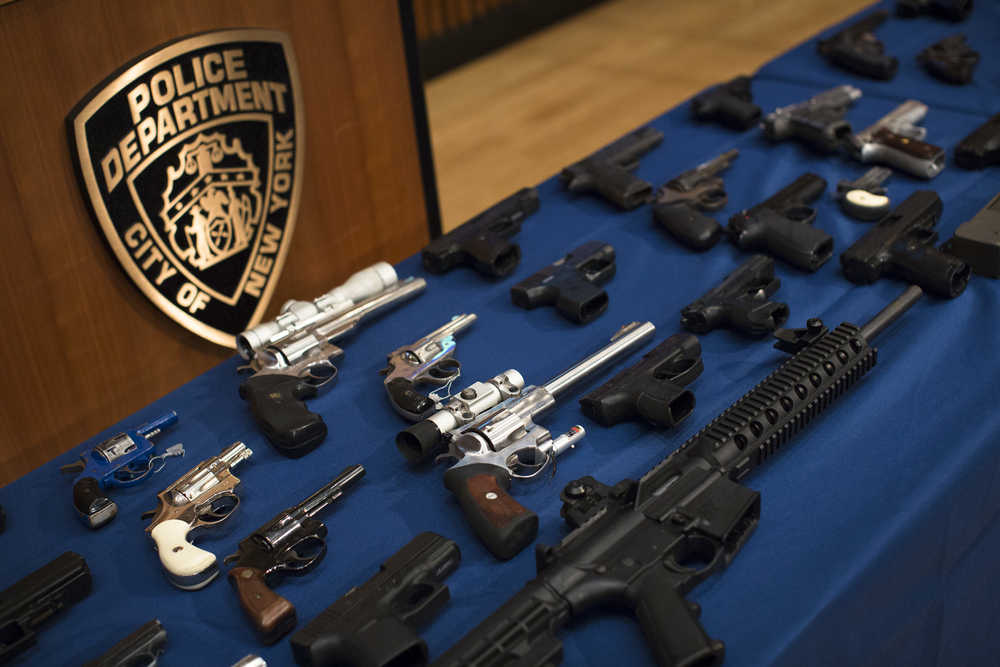
A decade ago, Wallace’s store was among about two dozen that found themselves in the crosshairs of a sting operation when then-Mayor Michael Bloomberg of New York sought gun dealers he accused of turning a blind eye to “straw purchases” that allow weapons to fall into the hands of criminals in the big city. A straw buyer is someone who poses as a customer but is actually purchasing the weapon for a person who is ineligible because of a criminal conviction, mental illness or some other reason.
About a dozen guns recovered from crimes in New York over a six-year period were originally purchased at Wallace’s store in metro Atlanta. Not one, he said, was ever fired during a crime, and only one was actually employed as a weapon, when it was used to hit somebody.
During that six-year period, his store sold 60,000 firearms, said Wallace, a member of the board of directors of the American Firearms Retailers Association. A court-ordered special master later monitored sales at Wallace’s store for several years and issued recommendations. But no fines were ever levied or further action taken.
Wallace said customers encounter at least four employees during the purchase, each of whom asks a series of questions meant to pinpoint potential red flags while also helping customers pick out the best weapon for their needs.
“We’re at the front lines,” he said. “You never read about it when we turn down a transaction.”
