
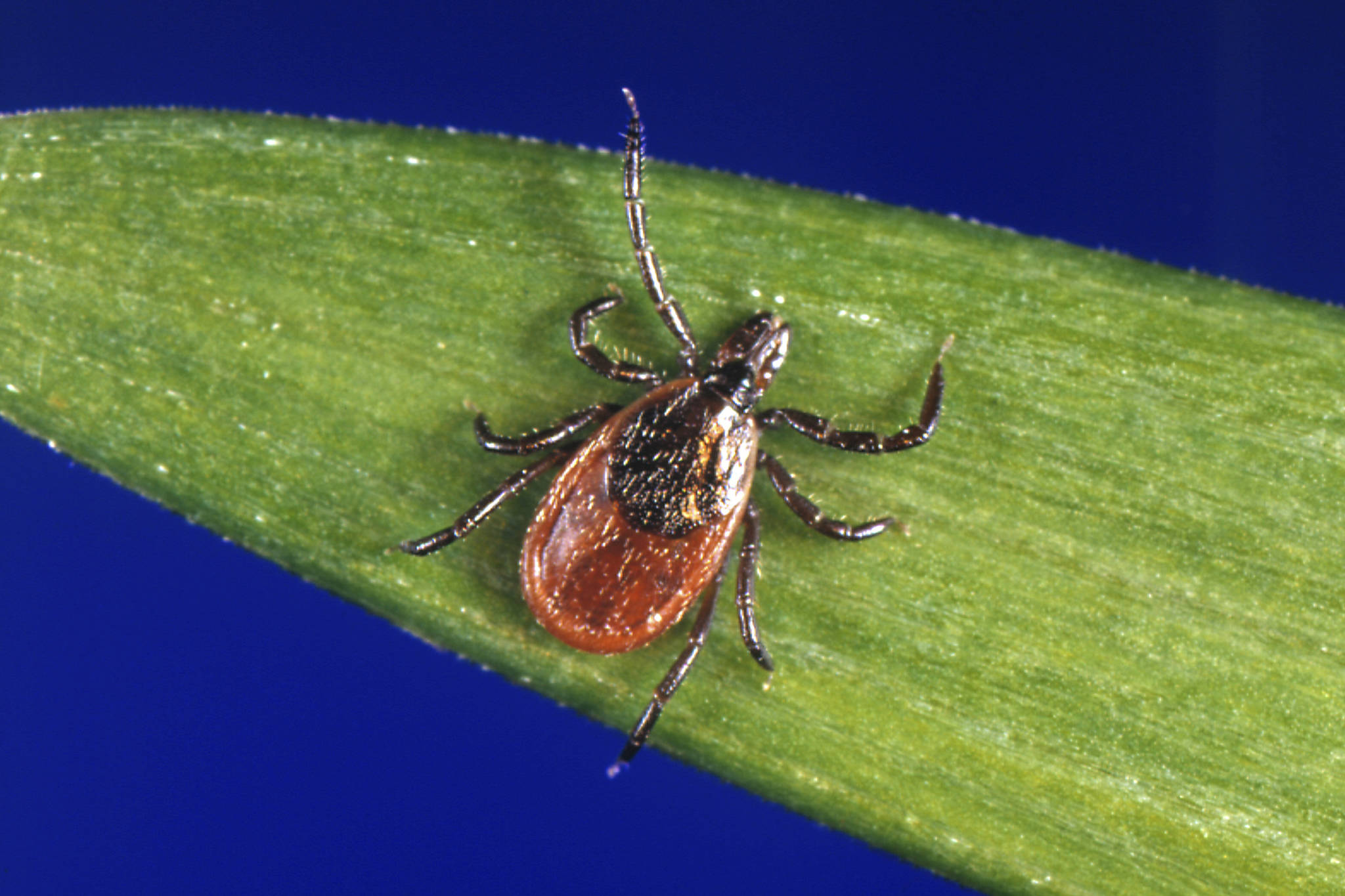
In this undated photo, a blacklegged tick, also known as a deer tick, rests on a plant. Non-native ticks, including some with significant veterinary and medical importance, are showing up in Alaska and health officials fear a warmer climate may allow them to become established. A collaborative project between the University of Alaska and state wildlife and veterinary officials is working to understand the risk of non-native ticks such as blacklegged ticks and pathogens they could carry. (U.S. Centers for Disease Control and Prevention)

In this undated photo, a blacklegged tick, also known as a deer tick, rests on a plant. Non-native ticks, including some with significant veterinary and medical importance, are showing up in Alaska and health officials fear a warmer climate may allow them to become established. A collaborative project between the University of Alaska and state wildlife and veterinary officials is working to understand the risk of non-native ticks such as blacklegged ticks and pathogens they could carry. (U.S. Centers for Disease Control and Prevention)

Tick, tick, tick: Alaska braces for invading parasites

These non-native ticks represent a threat to wildlife, people

ANCHORAGE — Health and wildlife officials are taking steps to prepare for potentially dangerous parasites that could gain a foothold because of Alaska’s warming climate.

Non-native ticks represent a threat to wildlife and people because they can carry and transmit pathogens, said Micah Hahn, an assistant professor of environmental health with the Institute for Circumpolar Health Studies at the University of Alaska Anchorage.

“Things are changing really rapidly in Alaska,” she said. “It’s really important for us to establish a baseline. We need to know what ticks are already here, what ticks are established and reproducing, and where they are, so that we can monitor these changes as the environment changes in the future.”

A $125,000 grant from the National Institutes of Health will help sample ticks and prepare a model to forecast where ticks could thrive, she said Tuesday in a presentation to the Local Environmental Observer network, whose members report unusual animal, environment and weather events.

Researchers will look for ticks in the field. Researchers, wildlife officials and the state veterinary office also are encouraging biologists and the public to participate in a “Submit-a-Tick” program, in which they pluck blood-sucking arachnids from people and pets, drop them off at Department of Fish and Game offices and fill out a form with details of their capture.

Alaska is largely free of many pests that bedevil people elsewhere, from snakes to creepy-crawly insects. Alaska’s handful of native ticks attach themselves to squirrels, snowshoe hares and wild birds and sometimes moose, dogs, or cats, but no one buys bug repellent or tick collars to keep them at bay.

However, the Alaska Department of Fish and Game nearly a decade ago began to collect tick samples out of concern that moose ticks, which can kill moose, especially calves, could establish themselves in Alaska.

Moose ticks have been found within Alaska’s neighbor, Canada’s Yukon Territory.

“We are nervous that it’s very close to our border,” Hahn said.

The search for moose ticks led to the recovery of a variety of non-native ticks, she said. Most were associated with travel outside the state. Researchers believe they hitch rides on people and pets but also migratory birds.

In some cases, non-native brown dog ticks and American dog ticks were found by people who had not left the state in months, Hahn said. “The question is, where did that tick come from?”

Officials have created an online Alaska tick information page with instructions on how to collect ticks. Researchers will use data collected to create a model focused on two nonnative ticks of concern, blacklegged ticks and western blacklegged ticks. Both can transmit Lyme disease. Ten Alaskans reported Lyme disease in 2017 but all were exposed in other states.

Just because non-native ticks reach Alaska, it doesn’t mean they will survive, Hahn said. Some ticks are vulnerable to dry conditions or harsh winters. The models will coordinate tick sampling information with environmental conditions in Alaska, such as humidity, temperature and rainfall, to project where non-native ticks might thrive in future decades as climate conditions change.

Alaska doctors and veterinarians don’t now automatically consider a connection to ticks if a person or pet shows up for treatment and has not traveled, Hahn said.

“If we know what species are here, and where they are in the state, it can help us develop control measures to make sure we stay on top of the problem,” Hahn said.


• This is an Associated Press report by Dan Joling.


More in News

Map showing approximate location of a 7.0-magnitude earthquake on Saturday, Dec. 6, 2025. (Courtesy/Earthquakes Canada)
7.0-magnitude earthquake hits Yukon/Alaska border

Earthquake occurred about 55 miles from Yakutat

A commercial bowpicker is seen headed out of the Cordova harbor for a salmon fishing opener in June 2024 (Photo by Corinne Smith)
Planned fiber-optic cable will add backup for Alaska’s phone and high-speed internet network

The project is expected to bring more reliable connection to some isolated coastal communities.

Gustavus author Kim Heacox talked about the role of storytelling in communicating climate change to a group of about 100 people at <strong>Ḵ</strong>unéix<strong>̱</strong> Hídi Northern Light United Church on Wednesday, Dec. 3, 2025. (Mari Kanagy / Juneau Empire)
Author calls for climate storytelling in Juneau talk

Kim Heacox reflects on what we’ve long known and how we speak of it.

The Juneau road system ends at Cascade Point in Berners Bay, as shown in a May 2006 photo. (Michael Penn / Juneau Empire file)
State starts engineering for power at proposed Cascade Point ferry terminal

DOT says the contract for electrical planning is not a commitment to construct the terminal.

Members of the Alaska Air and Army National Guard, Alaska Naval Militia, and Alaska State Defense Force work together to load plywood onto a CH-47 Chinook helicopter, in Bethel, Alaska, Nov. 2, 2025, bound for the villages of Napaskiak, Tuntutuliak, and Napakiak. The materials will help residents rebuild homes and restore community spaces damaged by past storms. (U.S. Army National Guard photo by Spc. Ericka Gillespie)
Gov. Dunleavy approves Alaska National Guard assisting ICE in Anchorage

The National Guard said five service members will assist with administrative support; lawmakers and civil rights advocates worry that the move signals a ramping up of immigration enforcement operations in Alaska

A cruise ship, with several orange lifeboats visible, is docked in downtown Juneau. (Laurie Craig / Juneau Empire file photo)
CBJ seeks input on uses for marine passenger fees

Public comment period is open for the month of December.

Browsers crowd into Annie Kaill’s gallery and gift shop during the 2024 Gallery Walk. (Juneau Empire file photo)
Gallery Walk guide for Friday, Dec. 5

The Juneau Arts & Humanities Council announced community events taking place during… Continue reading

The Alaska State Capitol is seen on Tuesday, Nov. 25, 2025. (Photo by James Brooks/Alaska Beacon)
Alaska Senate Republicans confirm Rauscher, Tilton and open two vacancies in state House

The Alaska Republican Party is moving quickly after Republicans in the Alaska… Continue reading

Downtown Skagway, with snow dusting its streets, is seen in this undated photo. (Photo by C. Anderson/National Park Service)
Skagway’s lone paramedic is suing the city, alleging retaliation by fire department officials

This article was reported and published in collaboration between the Chilkat Valley… Continue reading

Most Read